Travel Blanket OEM Production Scalability Planning for United Arab Emirates Buyers
Vincent Xi, Editorial Author | Author profile
United Arab Emirates buyers who need OEM travel blankets at program scale should treat production scalability planning as a written capacity, change-control, and inspection lock—not a unit-price contest. Freeze the specification pack first. Require a sampling-to-bulk lock on the same fabric, fold, and packing. Demand daily packed output by process step (cutting, sewing, finishing, packing) rather than a single factory headline. Only then compare FOB quotes. Published mill pages can supply challenge questions; they are not an approved calendar for a United Arab Emirates inbound program.
Do not scale if the mill cannot map a published daily number to packed travel blankets of the specified size and fold, cannot name the process step that constrains a second ship window, or cannot cut the pre-production sample from bulk fabric. The figures below are supplier-published challenge items to confirm or strike on the travel-blanket line that will run the order.
Production scalability planning for travel blanket OEM manufacturing
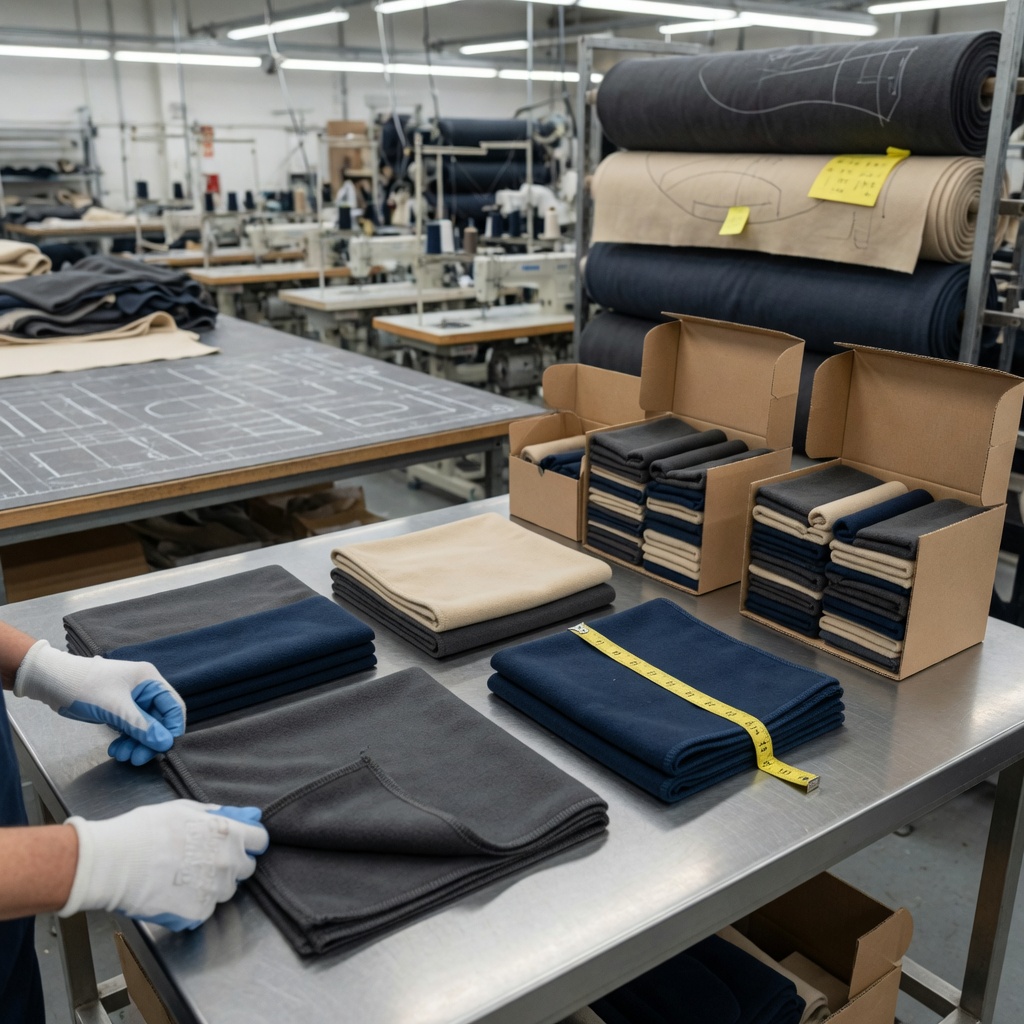
Production scalability planning for travel blanket OEM manufacturing is the documented path from an approved sample to repeatable weekly packed output without silent substitutions. A cutting claim does not prove sewing, binding, folding, or carton-packing capacity. For a compact travel-blanket SKU, write RFQ risk into fabric GSM consistency, pilling after wash, hem strength, folded size, and packed cube rather than treating the item as a loose bedding blanket.
Lock five files before you treat a quote as scalable:
- Specification sheet: fabric construction, GSM range and tolerance, flat size, folded size, color standard, stitch type, binding, and packing.
- Bill of materials: approved substitutes and a no-substitute list (yarn lot, face finish, filling if any, binding, polybag, carton mark).
- Process flow: in-line checkpoints at cutting, sewing, and finishing, plus packed-carton audit.
- Capacity file: machines, shifts, and historical packed output for the same construction—not a mixed-blanket headline.
- Sample-to-bulk delta log: what may not change after pre-production approval.
FanMan’s published sequence—inquiry and quotation, sampling, contract, then mass production with checks at cutting, sewing, and finishing, then inspection, packaging, and shipping—is a useful skeleton for those files, not a substitute for buyer gates (FanMan OEM blanket process).
Scalability is not a large-factory headline. It is whether the mill can add a second colorway, a second fold, or a second ship window without changing yarn lot, stitch density, or carton marks. Hybrid machine-plus-hand workflows, as described in one manufacturer overview, can raise daily output while also raising variation unless work instructions and a documented sampling plan are written for the exact travel-blanket SKU (MJ Textile blanket manufacturing overview).
United Arab Emirates RFQ conditions for OEM travel blanket scale-up
Keep this page a travel-blanket manufacturing decision brief, not a country guide. Name United Arab Emirates as the inbound program market in the RFQ so packing, carton marks, and receiving rules are quoted instead of guessed.
One manufacturer overview links lightweight travel-blanket production to airline customers such as Emirates. Treat that as a product-type example of a compact amenity throw, not as proof of a current contract and not as Fieldloom Mill output (MJ Textile blanket manufacturing overview). If the United Arab Emirates program is airline amenity, hotel, or corporate kit, state that end use so fold, polybag, and carton SKU rules can be priced.
Specify wash method and cycle count as buyer requirements. The bulk buying guide’s emphasis on durability for frequent washing is a specification item, not a lab result on file here (Veken bulk travel blanket buying guide). Require composition, care, and country-of-origin marks in the language set the importer actually uses. Do not assume a mill’s standard hangtag satisfies airline, hotel, or corporate receiving in the United Arab Emirates.
Landed cost is a buyer-side workbook. FOB, freight, insurance, destination charges, and any duty or VAT the broker applies were not published in the source pages used for this article, so they belong as lines to complete—not as invented rates. A published mill production lead is not a door-to-door United Arab Emirates date. Add material booking, inspection, carton marking, and ocean or air transit as separate calendar rows. If the program is multi-drop, require a packing SKU matrix so finishing does not become the hidden bottleneck.
Capacity, sampling, and lead-time numbers to verify—not assume
Every exact number below is supplier-published. Unit, scope, as-of context, and source are stated with the figure. None of these values is a Fieldloom Mill measurement, a third-party audit, or a dated factory certificate.
- Sampling duration of 2–7 days, and mass production of about 30 days after contract, with quality checks at cutting, sewing, and finishing: OEM blanket process as described by FanMan Textiles on an undated process page. Confirm whether 30 days starts at deposit, fabric arrival, or cut start, and whether the calendar applies to compact travel-blanket sewing and packing (FanMan OEM blanket process).
- Sample lead of 3–5 days; 25-day lead for 20,000-unit orders; automated laser cutting stated at 50,000 blankets daily; hybrid workflow output stated at 30,000 daily; 12-day fleece production cycles; China stated at 60% of global blanket manufacturing: figures as published on an undated MJ Textile overview. These are supplier-reported, mixed-blanket claims unless the mill isolates travel-blanket construction, machine list, and recent packing records. The China share is a manufacturing-origin statement on that page, not a sales-market target and not a United Arab Emirates inbound calendar (MJ Textile blanket manufacturing overview).
- Sample-before-scale and documented QC, including a buyer-requested OEKO-TEX document: recommendation from a bulk travel-blanket buying guide, undated in the excerpt. OEKO-TEX is a standard a buyer may require; it is not evidence that any mill holds a current certificate unless a valid document is produced for the exact material (Veken bulk travel blanket buying guide).
Minimum order quantity is not a universal constant in the source pages. The 20,000-unit figure is an order-size/lead-time pairing, not a stated MOQ for every travel-blanket construction. Ask for MOQ by fabric, color, and packing, plus the increment to add a second color. If a mill quotes a low MOQ that cannot be sewn on the same line used for the capacity claim, the program is not scalable.
Trade-offs to measure in the quote:
- Faster sample (3–5 days versus 2–7 days, both supplier-published, undated) can hide fabric substitutions. Require mill-side fabric lot photos, GSM cut-and-weigh, and a retained sample sealed against the bulk lot.
- High daily cutting (50,000 blankets daily laser cutting, as published on an undated mill page, mixed-blanket scope) does not equal high daily packed travel blankets. Ask for packed-carton output for the last three similar orders, with size and fold stated.
- A mass-production window of about 30 days after contract is only useful if fabric is already approved. Indent yarns or special colors add an unstated material queue.
- Hybrid output stated at 30,000 daily can improve binding finish while increasing stitch variation. Set stitch density, seam allowance, and corner tolerance rather than hand-finished language.
- A planning scenario of weekly demand rising 30%, or adding a second ship window, is an example assumption to verify in the supplier quote—not a measured mill result.
If a mill cannot show how 20,000 units in 25 days maps to sewing-head hours and packed cartons for the specified GSM and hem type, treat the lead time as marketing.
Quality-control gates that keep scalable travel blanket manufacturing consistent
Scalable OEM production fails at the second lot when the first lot was a supervised sample. Write QC as gates that travel with volume.
Incoming: fabric roll list, shade band, GSM, width, and defect mapping. Require a pre-production wash on the bulk fabric—not only on a salesman sample—using the wash method and cycle count in the RFQ (Veken bulk travel blanket buying guide).
In-process: follow the published OEM skeleton of checks at cutting, sewing, and finishing (FanMan OEM blanket process). For a travel blanket, add fold-size audit, corner fill, and binding tension. If the named end use requires it, specify metal detection as a buyer gate rather than assuming it is already in the mill’s line. Raschel or jacquard constructions, when offered, change both look and defect types; specify construction rather than premium-weave language, and ask how QC sampling rate changes when daily output rises (Veken bulk travel blanket buying guide).
Final: a stated AQL (or equivalent documented sampling plan) by critical/major/minor, carton check, packing-SKU scan, and a retained gold sample. State what happens when packed output rises: does the sampling plan stay the same, or does inspection thin out? Write that rule before cut start.
Standards versus practice: a buyer may require OEKO-TEX or equivalent chemical documentation for the fabric lot. That is a current-document request. It does not replace stitch, size, and packing inspection, and this article does not assert that any mill is certified.
Buyer decision table for OEM travel blanket scalability
| Decision factor | Specify in the RFQ | Compare across mills | Verify before you approve | Order implication |
|---|---|---|---|---|
| Construction and GSM | Exact fabric type, GSM range, face/back, color standard | Same construction quoted, not a heavier throw substituted | Cut-and-weigh on bulk rolls; shade band vs sealed sample | Reject lots outside GSM; freeze substitutes |
| Size, fold, packed cube | Flat size, folded size, pieces per poly, pieces per carton | Cube and carton strength for United Arab Emirates inbound handling | Example audit: measure 20 random packed units from pre-production (state this count in the RFQ) | Carton and freight lines change if fold drifts |
| Sampling gate | Paid sample in bulk fabric; restate any published 2–7 or 3–5 day claim as a dated calendar | Sample speed vs fabric authenticity | Retain sealed sample; photo lot numbers | No mass cut until written pre-production approval |
| Process capacity | Daily packed output at cutting, sewing, finishing, packing for this SKU | Headline 50,000/day cutting vs packed travel-blanket output | Machine list, shift plan, last similar order pack-out | Split shipment if sewing or packing is the constraint |
| Lead time | Material vs cut-sew-finish vs inspection vs ex-factory | 25-day / 20,000-unit example vs your color count | Fabric-in-house date, not only contract date | Add United Arab Emirates transit as a separate buyer calendar |
| QC plan | Checkpoints at cutting, sewing, finishing plus a stated sampling plan | In-line vs end-only inspection | Live pre-production; defect photos with counts | Hold/release rule before balance payment |
| Chemical/document pack | Composition, care, origin, any requested standard (e.g. OEKO-TEX as a lot document) | Certificate scope vs actual fabric mill | Current document for the bulk lot, not a brochure | Do not ship unlabeled cartons to United Arab Emirates receiving |
| Change control | What may not change after sample (yarn, needle, binding, carton mark) | Verbal same-quality language vs written delta log | Compare bulk vs sealed sample on an example 10-piece audit (specify in the RFQ) | Second colorway needs a mini pre-production, not a verbal OK |
| Scalability scenario | Packed output if weekly demand rises (example: +30%, verify in the quote) or a second ship window is added | Which process step becomes the constraint | Sewing-head hours and packed cartons, not cutting headlines | Freeze color count or split ship rather than silent overtime |
Every row is a specify–compare–verify–order action. If a mill cannot complete a cell, do not treat the quote as scalable.
RFQ checklist for travel blanket OEM production scalability planning
Use this list as the RFQ body, not as a cover email.
- State program market as United Arab Emirates inbound and name end use (airline amenity, hotel, or corporate kit) so packing and labeling can be quoted.
- Specify travel-blanket construction, GSM range and tolerance, flat size, folded size, color count, and whether Raschel, jacquard, or fleece knit is required.
- Require a capacity file: machines and daily packed output for this construction, plus the last comparable order quantity and ex-factory date. Use these only as challenge numbers to confirm or strike: 20,000 units / 25 days; 30,000 daily hybrid output; 50,000 daily laser cutting—ask which, if any, apply to this SKU.
- Separate MOQ by color and packing; state the increment to add a second colorway without an unquoted development fee.
- Ask for sample calendar in days and what fabric will be used (stock vs indent). Cite the published 2–7 day and 3–5 day windows only as questions to confirm on this line.
- Ask for mass-production calendar in days after pre-production approval, split by fabric arrival, cutting, sewing, finishing, inspection, and packing. Use the published mass-production figure of about 30 days as a challenge, not a promise.
- Require in-process QC at cutting, sewing, and finishing, plus a stated sampling plan and, if relevant to the named end use, a metal-detection policy.
- Require a wash-durability method and cycle count; request a washed pre-production panel cut from bulk fabric.
- List documents: composition, care, origin, packing list, and any chemical standard as a current lot document—not a website badge.
- Freeze change control: yarn lot, needle, stitch density, binding, logo application (if any), polybag, carton mark.
- Require a pre-production sample cut from bulk fabric and a written approval form before mass cut.
- Ask for inspection photos and defect tally by type at 20%, 80%, and final, with hold/release language. Those inspection points are an example RFQ structure to verify with the mill and inspector—not a published mill rule.
- Request carton specs, pieces per carton, barcode/SKU rules, and folded-size tolerance for United Arab Emirates receiving.
- Split the quote by Incoterm (state FOB as the comparison basis unless you instruct otherwise) and by process step; leave freight, duty, and VAT as buyer-completed landed-cost lines.
- Ask the mill to state its published claim window, then replace it with your retain-sample and photo-claim rule.
- Require a scalability scenario: packed output if weekly demand rises (example: +30%, to verify in the quote) or a second ship window is added, with the constraining process step named.
- Name the person who signs pre-production approval and the person who can stop the line.
- Attach the decision table above and require the mill to complete every verify cell before deposit.
- Ask whether third-party inspection is quoted, who books it, and whether packed-carton output—not cutting output—is the quantity the inspector signs.
- Require lab-dip or bulk-lot shade continuity against the sealed sample before the second colorway is cut.
Evidence, method, and what to verify
How these figures were derived. This editorial transcribes three public pages: an OEM blanket process description (sampling 2–7 days; mass production about 30 days after contract; checks at cutting, sewing, finishing); a blanket-manufacturing overview (China stated at 60% of global blanket manufacturing; 12-day fleece cycles; 50,000 blankets daily laser cutting; 30,000 daily hybrid output; 25-day leads for 20,000 units; 3–5 day samples; lightweight travel blankets for airlines such as Emirates); and a bulk travel-blanket buying guide (wash durability, samples before scale, weaving types, QC, optional OEKO-TEX request). Numbers are copied as published. They are not Fieldloom Mill measurements, not third-party audits, and not dated factory certificates.
Source contexts. Context 1 is a step-by-step OEM process page aimed at buyers who need a sampling and mass-production sequence. Context 2 is a manufacturing-origin and capacity narrative that includes travel-blanket and airline examples. Context 3 is a bulk purchasing guide focused on quality selection before large OEM runs.
Limitations / what to verify. Page dates, certificate numbers, equipment lists, and United Arab Emirates customs rulings were not in the excerpts. Capacities may mix blanket types and may not apply to compact travel-blanket sewing and packing. Emirates appears as an example customer type on one mill page; it is not a current supply claim for any mill named here and not a Fieldloom claim. OEKO-TEX is a buyer-requested standard, not a verified certification in this article. Landed cost into the United Arab Emirates, label language, and airline/hotel receiving rules must be completed with the mill, the lab, and the importer’s broker. Re-run GSM, shade, wash, measurements, and carton audits on the bulk lot. If a mill cannot map a published daily number to packed travel blankets of the specified size and fold, do not scale.
Editorial research by Vincent Xi, Editorial Author. Author profile: https://www.fieldloommill.com/authors/vincent-xi/. This page does not claim first-person factory visits, tests, awards, or customer outcomes.
Discuss Your Requirements
Review our manufacturing capabilities, then share your specifications for a supplier-fit review.