Sherpa Throw Wholesale Supplier Minimum Order Quantity for Canada
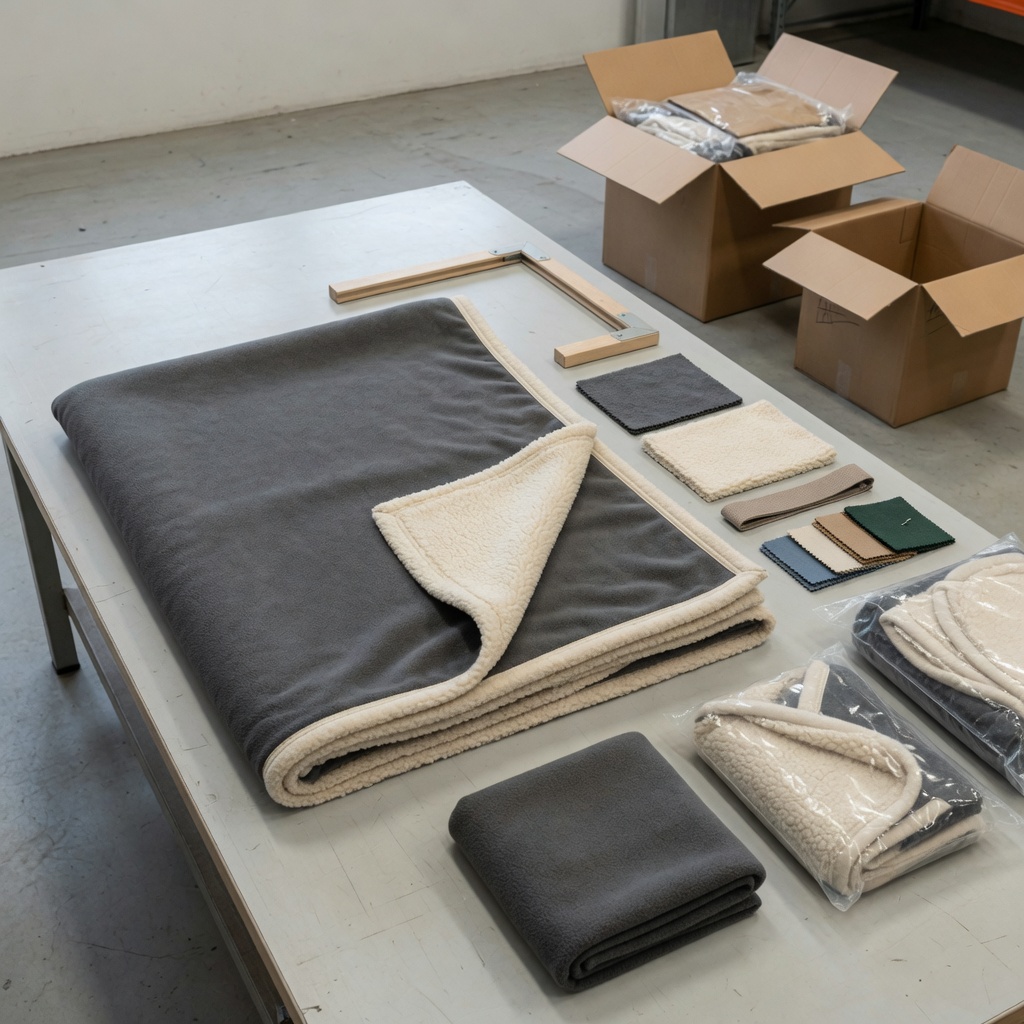
By Vincent Xi, Editorial Author
Direct answer: The supplied evidence does not establish a universal minimum order quantity for sherpa throws sold to Canadian B2B buyers. The cited suppliers publish quantities on different bases: per design in a broader blanket program, per design for fleece blankets, and by container for a sherpa blanket program. Those figures are RFQ references, not interchangeable offers or a Canada-wide benchmark.
The binding minimum should come from a current written quote for the exact sherpa throw construction, SKU allocation, packaging configuration, and buying route. Compare the accepted quantity for each SKU, not only the headline MOQ.
Published Minimum Order Quantity Evidence for Canada
| Source and date context | Published data point | Product scope | How to use it |
|---|---|---|---|
| Renrui Textile; no publication date is available in the supplied excerpt | 100 pieces per design | The supplier's broader wholesale blanket program | Use only as an RFQ reference. Require the current quote to define design and state whether color, size, material, label, or packaging changes create separate minimums. |
| Blanket Manufacturer; no publication date is available in the supplied excerpt | 500-1,000 pieces per design | Fleece blankets; the excerpt says printed or sherpa-lined constructions can vary | Do not apply this range to a requested sherpa-lined SKU unless the supplier confirms it in the current product-specific quote. |
| Fashion Hometex; article dated March 2025 | A minimum of one 20-foot container load, estimated at 1,800-2,200 full-size blanket pieces per 20-foot container, depending on construction weight and packaging | The supplier's container-based sherpa blanket program | Treat this as a supplier-specific loading estimate. Require carton, packing, and SKU-allocation calculations for the quoted product. |
| Fashion Hometex; article dated March 2025 | 125 x 150 cm per throw | A listed product dimension | The supplied excerpt does not connect this dimension to the separately published container estimate. Do not combine the claims without written confirmation. |
| Renrui Textile; no publication date is available in the supplied excerpt | Volume-pricing thresholds of 1,000 pieces, 3,000 pieces, and 5,000 or more pieces per order | The supplier's broader wholesale blanket program | Treat these as reported price-break quantities, not confirmed production minimums. Ask the supplier to show MOQ and price breaks in separate quote fields. |
These supplier-published values answer different commercial questions. Averaging them would produce a number with no consistent product definition, allocation rule, or packing basis. None of the cited figures establishes a FIELDLOOM offer, current supplier capacity, or a general market minimum.
Define the MOQ Before Comparing Suppliers
A quotation is comparable only when it identifies what creates the minimum. Ask each supplier to complete the following fields against the same sherpa throw specification revision.
| MOQ field | Required supplier response |
|---|---|
| Order basis | Binding minimum for the complete purchase order and whether other products may be combined |
| Design basis | Definition of design and the minimum assigned to each design |
| Construction basis | Minimum for the specified face material, sherpa reverse, GSM basis, edge finish, and stitching |
| Variant allocation | Minimum by color, size, pattern, or other sellable SKU difference |
| Decoration | Separate minimum created by print, embroidery, or another quoted treatment |
| Label and packaging | Minimum for each label set, insert, band, bag, compression method, or retail package |
| Mixed assortment | Total commitment, permitted SKU mix, and minimum allocation for every included variant |
| Container basis | Container commitment, carton assumptions, finished-piece estimate, and allocation by SKU |
| Quantity variance | Permitted overrun or underrun, approval rule, invoicing basis, and treatment of shortages |
A blank field should be resolved as not applicable or completed before approval. Do not infer what per design includes.
The undated Blanket Manufacturer excerpt lists sizes, GSM, colors, logos, and private-label packaging as customizable fields while noting that printed or sherpa-lined fleece minimums can vary (Blanket Manufacturer). It does not quantify how any individual option changes the minimum. The current quote should therefore show the quantity effect of each selected variable.
Production minimums and volume-pricing thresholds should remain separate. A price break does not prove that production is available below that threshold, and it does not create a higher production minimum unless the quote expressly says so.
Calculate the Effective Minimum by SKU
Normalize every quotation against the same product revision and proposed SKU matrix. Use a separate row for each sellable combination.
| Allocation field | Buyer and supplier entry |
|---|---|
| SKU identifier | Buyer's unique reference for the sellable specification |
| Specification revision | Dated product document controlling the quote and approval sample |
| Finished dimensions | Width, length, unit, measurement method, and tolerance |
| Construction | Face material, sherpa reverse, layer definition, edge finish, and stitching |
| GSM basis | Target, tolerance, and whether the value applies to a layer or the complete construction |
| Color and decoration | Color reference, artwork revision, and quoted treatment |
| Label and packaging | Label set, unit package, compression method, and export-carton configuration |
| Requested quantity | Buyer's proposed allocation for the SKU |
| Supplier minimum | Binding minimum and the rule that creates it |
| Accepted quantity | Quantity included in the commercial quotation |
| Variance | Permitted overrun or underrun and its invoicing treatment |
Illustrative assumption to verify in the supplier quote: assume the requested custom construction requires 500 finished pieces per colorway, and the buyer selects 2 colorways for the design. The assumed calculation is 500 finished pieces per colorway x 2 colorways = 1,000 finished pieces for the design.
Every figure in that calculation is an example assumption, not source data, a supplier offer, or a market benchmark. The result changes if the supplier permits both colorways to share one production allocation or applies another order-level rule.
The supplier's accepted quantities should reconcile in both directions: each SKU must meet its stated rule, and the SKU quantities must add up to the accepted order commitment. Reject a quote that provides only an order total without explaining the variant allocations that create it.
Container-Based Minimum Order Quantity for Canada
The Fashion Hometex article conditions its published container estimate on construction weight and packaging. It also lists a throw dimension, but the supplied excerpt does not state that the same product specification, weight, fold, package, or carton was used for both claims (Fashion Hometex). Keep those claims separate unless the supplier confirms the connection in writing.
For a container-based MOQ, require a product-specific loading worksheet containing:
- The product and packaging revision used for the estimate.
- Finished-unit weight and packed-unit dimensions.
- Units per export carton.
- External carton dimensions, net weight, and gross weight.
- Estimated carton count.
- Piece and carton allocation for every SKU.
- Whether cartons contain one SKU or a mixed assortment.
- The compression method and the condition in which packed dimensions were measured.
- Permitted production and loading variance.
- The final packing-list and loading-plan deliverables.
The accepted order quantity should equal the sum of accepted pieces across the SKU matrix. The accepted carton count should also reconcile to the carton allocation for those SKUs. These controls test whether the requested assortment fits the quoted container commitment; the cited evidence does not establish destination-specific costs or requirements for Canada.
Practical Minimum Order Quantity RFQ Checklist for Canada
Use this checklist with the same controlled sherpa throw specification and SKU matrix for every candidate supplier. Do not approve a category-page quantity as the binding minimum without a current written quotation.
- [ ] Attach a dated specification identifying the face material, sherpa reverse, finished dimensions, GSM basis, edge finish, stitching, decoration, labels, and packaging.
- [ ] List every proposed sellable SKU separately, including each color, size, design, decoration, label set, and package variation.
- [ ] State the requested quantity for each SKU and the requested total order quantity.
- [ ] Ask the supplier to identify the buying route as ready stock, standard production, custom production, or a container-based program.
- [ ] Obtain the binding order-level minimum and the rule that creates it.
- [ ] Obtain the minimum for each design, construction, color, size, decoration, label set, and packaging configuration.
- [ ] Require a written definition of
per designand every similar allocation term used in the quote. - [ ] Confirm which variants may share a minimum and which variants require separate production allocations.
- [ ] Record the supplier's accepted quantity for each SKU and reconcile those quantities to the accepted order total.
- [ ] Separate production minimums from volume-pricing thresholds in the quotation.
- [ ] Confirm whether packaging, compression, carton configuration, or container loading changes the minimum.
- [ ] For a container-based quote, obtain the packed-unit, carton, and SKU-allocation worksheet used to calculate the proposed load.
- [ ] Record any permitted production overrun or underrun, the approval process, and how the final invoice will treat the variance.
- [ ] Confirm whether sample approval, artwork changes, or later specification revisions can change the quoted minimum.
- [ ] Record the quote issue date, validity period, assumptions, exclusions, and the supplier contact authorized to confirm the terms.
- [ ] Transfer the accepted SKU quantities, allocation rules, and variance terms into the purchase-order record before approval.
The written response should also complete this RFQ schedule:
| RFQ field | Response required |
|---|---|
| Product definition | Exact face, sherpa reverse, dimensions, GSM basis, finish, decoration, label set, and packaging revision |
| Buying route | Ready stock, standard production, custom production, or container-based program |
| Total minimum | Binding order-level quantity and the rule creating it |
| Variant minimums | Minimum by design, construction, color, size, decoration, label set, and package |
| Mixing rules | Which variants may share a minimum and which require separate allocations |
| Accepted allocation | Accepted quantity by SKU and accepted total for the order |
| Price breaks | Price-break quantities shown separately from the production minimum |
| Stock relationship | Whether a ready-stock quantity has any bearing on a later custom-production order |
| Sample relationship | Whether sample approval or a specification revision changes the minimum |
| Packing basis | Packed-unit data, carton configuration, and loading calculation when packaging affects MOQ |
| Variance | Permitted overrun or underrun, approval process, and invoicing treatment |
| Quote status | Issue date, validity period, stated assumptions, exclusions, and approval contact |
Approve the minimum order quantity only when the quotation names the exact sherpa throw specification, defines every allocation rule, and reconciles the accepted SKU quantities to the order total. A ready-stock quantity should not be presented as the repeatable minimum for a custom order unless the supplier expressly confirms that relationship.
For container quotations, the packing worksheet and SKU matrix should use the same product revision as the commercial quote. For all buying routes, retain the supplier's written definitions with the purchase-order record so that per design, per color, and similar terms cannot change after approval.
Methodology and Limitations
This review uses the supplied excerpts from the cited supplier-published pages and the FIELDLOOM author profile. Each commercial statement was recorded with its unit, stated product scope, MOQ basis, conditions, source URL, and publication-date status. The figures were classified as production minimums, pricing thresholds, product dimensions, or container estimates. Values with different bases were not averaged or converted into a market-wide MOQ.
The Fashion Hometex article is dated March 2025 (source). The supplied Renrui Textile and Blanket Manufacturer excerpts do not provide publication dates (Renrui Textile, Blanket Manufacturer). All commercial figures are supplier-published and have not been independently verified.
The evidence does not establish a current supplier quote, current inventory, production capacity, sample terms, final product weight, carton configuration, or product-specific loading count. It also does not establish a universal minimum order quantity for Canada. Verify the exact construction, MOQ definitions, accepted SKU quantities, mixing rules, price breaks, packaging assumptions, quantity variance, and quote validity in the current supplier quotation and purchase-order records.
Author context: The FIELDLOOM profile identifies Vincent Xi as Editorial Author. This article uses a documentary evidence basis and does not claim product testing, factory visits, sourcing outcomes, or customer results.
Discuss Your Requirements
Review our manufacturing capabilities, then share your specifications for a supplier-fit review.