Sherpa Throw Sourcing Product Development Capability for United States Buyers
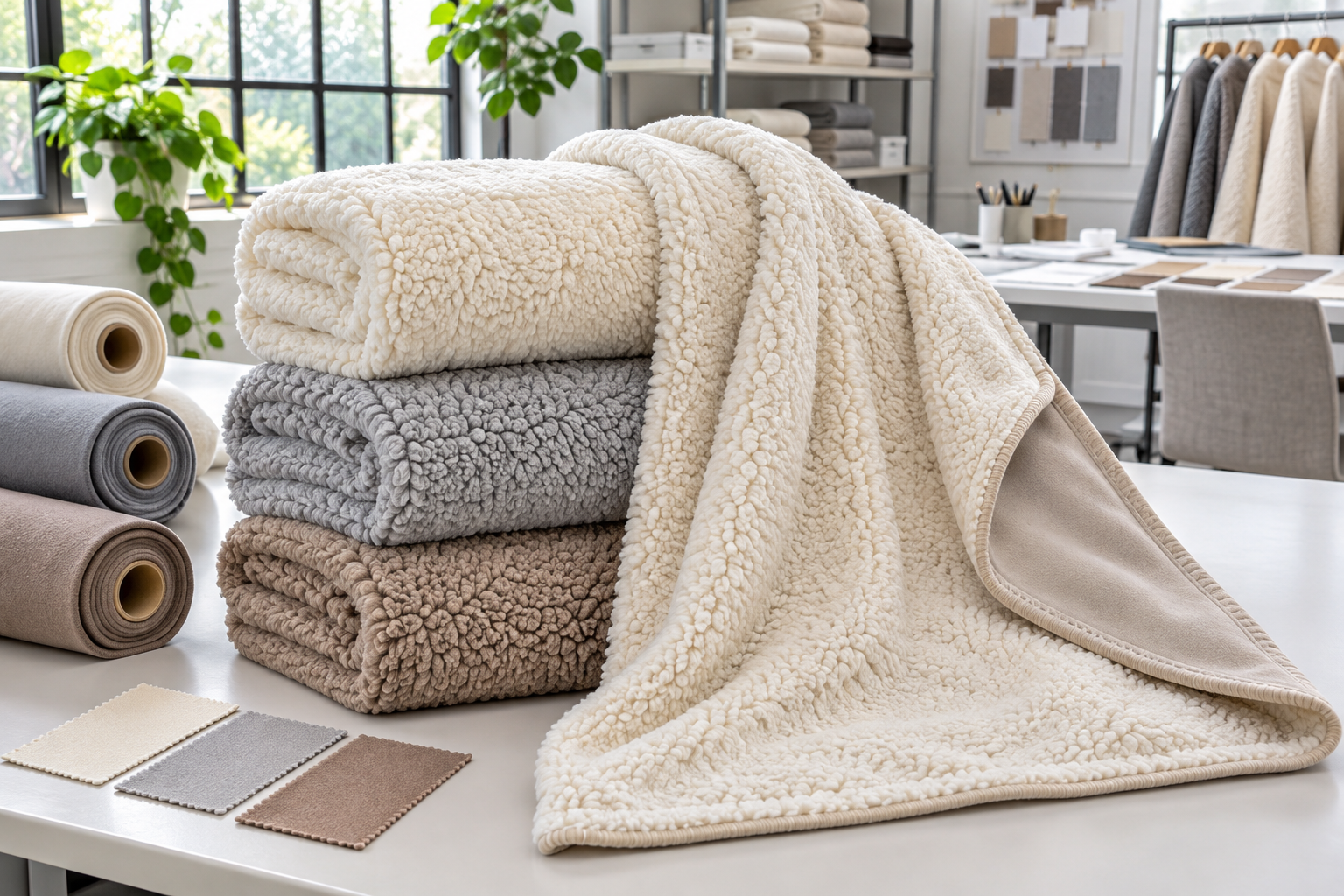
Effective sherpa throw sourcing product development capability is the ability to turn a buyer brief into a defined, sampled, revised, and approved product without losing control of specifications, cost inputs, or delivery expectations. For buyers in the United States, the procurement task is not simply to find a sherpa throw. The task is to test whether a supplier can develop the exact construction, finish, color direction, packaging, and labeling presentation the buyer intends to sell, and whether that development work can be recorded clearly enough for repeat ordering.
This page treats product development as a procurement control. Every important choice should move from a general idea to a written specification, from a written specification to a physical sample, and from a physical sample to a documented approval. Where a detail affects price, appearance, handling, packing, or acceptance, the buyer and supplier should agree it before production rather than discover differences after shipment.
How Product Development Capability Shapes Sherpa Throw Procurement
Product development capability in sherpa throw procurement shows up in the quality of questions a supplier asks, the clarity of sample feedback it can work from, and the discipline with which revisions are tracked. A supplier may be able to make a throw, yet still be a poor development partner if color changes are handled informally, fabric alternatives are substituted without notice, or approvals are not tied to a specific sample version.
Buyers should therefore evaluate development as a process, not as a promise. Ask how a brief is received, who reviews it, how fabric and trim options are presented, how comments are recorded, and how the approved sample is protected as the reference for production. The answers reveal whether the supplier can support structured procurement. Vague answers are a signal to slow down, tighten the brief, and require written confirmation at each stage.
A useful development relationship also separates creative exploration from production commitment. Early samples can explore texture, backing feel, binding style, and color families. Later samples should narrow those choices until only the approved combination remains. Keeping those stages distinct prevents exploratory options from being priced, packed, or produced as if they were final.
United States Buyer Decisions Before Development Starts
United States buyers should define the commercial purpose of the sherpa throw before requesting development work. A throw intended for a curated home range, a promotional program, a hospitality setting, or a private label assortment will lead to different priorities for hand feel, durability expectations, presentation, care instructions, and packaging. The supplier does not need a broad market story. The supplier needs a precise brief that connects the intended channel to measurable and observable product choices the buyer will later approve.
Start by defining the product architecture. Specify which side is the feature face, what backing appearance is wanted, how edges should be finished, and whether the design is solid, patterned, reversible in presentation, or built around a particular color palette. If dimensions, folded size, or packed size matter for shelving, cartons, or freight planning, state the target and the tolerance approach the buyer will use at approval and ask the supplier to confirm what it can hold.
Packaging and labeling decisions should also be made early. Define whether the throw will be folded, rolled, banded, bagged, boxed, or presented with an insert, and identify the exact label content, care wording, origin wording, and brand artwork the buyer will supply or approve. Do not assume the supplier will infer United States retail or wholesale presentation from a photograph. Provide the layout, wording, and placement for review, and require a packaging sample or clear photographic proof for approval before bulk packing begins.
From Brief to Sample: A Development Process Buyers Can Control
A controlled process gives both sides a shared record and reduces rework. Buyers can structure development in steps, with each step closing a set of decisions before the next one opens.
- Submit a written brief that covers construction, colors, finish, packaging, labeling, quantity range for quotation, destination, and the approval criteria the buyer will apply.
- Review supplier questions and confirm that every unclear point has been answered in writing before sampling begins.
- Evaluate the first sample against the brief only, recording what matches, what differs, and what remains undecided.
- Issue revision comments that refer to specific areas of the sample, such as pile appearance, backing, stitching, binding, shade, size, or packing method.
- Review the revised sample as a new version, not as a casual correction, and keep earlier comments closed only when the change is visible and confirmed.
- Designate one final sample as the approval reference and record the version, date of approval in the buyer's files, and any remaining production notes.
This sequence makes product development capability observable. A supplier that follows version control, answers comments point by point, and resamples the exact requested changes is demonstrating capability through work. A supplier that relies on verbal assurance, mixes comments from different rounds, or treats the latest sample as interchangeable with earlier versions creates procurement risk that should be addressed before any order is placed.
Buyer Decision Table for Sherpa Throw Procurement
Use the table below to compare suppliers on development discipline rather than on unsupported claims. Each row is a buyer-defined check that can be answered from briefs, samples, documents the supplier provides on request, and written confirmations.
| Decision Area | What the Buyer Defines First | What to Ask the Supplier to Confirm | Buyer Acceptance Check |
|---|---|---|---|
| Fabric and backing combination | Desired face texture, backing appearance, and overall hand feel direction | The exact materials and construction proposed for sampling | Compare the sample face and backing directly with the brief and approved reference |
| Size and finished shape | Target finished dimensions and how variation will be judged | Whether the proposed construction can be made to the stated target | Measure and record the approval sample using the buyer's agreed method |
| Edge finish and stitching | Binding, hemming, stitching appearance, and corner treatment wanted | The finish method that will be used in sampling and production | Inspect edges and corners on the final sample and note any change requested |
| Color and pattern development | Color palette, pattern direction, and approval tolerance approach | How shades will be matched, presented, and revised between sample rounds | Approve shade and pattern only on a named sample version |
| Construction changes | Which changes are allowed during revision and which require requotation | Whether a requested change affects materials, labor, packing, or price | Keep a written change log tied to each sample version |
| Packaging presentation | Fold or roll method, outer packaging, inserts, and retail or wholesale presentation | The packing method that will be sampled and repeated in bulk | Approve a packed sample or detailed packing proof before production |
| Labeling and artwork | Exact label wording, placement, care content, and brand files supplied by the buyer | That production will use only the approved artwork and placement | Check the label and artwork on the pre-production reference |
| Sampling and revision control | Number of decision points the buyer will use and comment format | How comments will be answered, tracked, and closed | Close each comment in writing when the revised sample is accepted |
| Quotation basis | The specification version on which pricing should be based | Which materials, finish, packaging, and quantity assumptions the quote includes | Requote when the approved specification differs from the quoted version |
The table works best when it is completed before prices are compared. Two quotations are not comparable if one is based on a lighter construction, a simpler finish, different packaging, or an unapproved color process. Align the specification first, then use price as one factor among development reliability, communication quality, and approval control.
Sampling, Revision, and Approval Controls
Sampling is where product development capability becomes visible. Buyers should handle every sample as evidence for a decision, not as a general impression. When a sample arrives, check it against the brief in a consistent order: overall appearance, face texture, backing, dimensions as measured by the buyer, edge finish, stitching, color under the buyer's normal viewing conditions, label placement if present, and packed presentation if supplied.
Revision comments should be specific enough for a supplier to act on without interpretation. Instead of asking for a softer result or a better color, describe the observable change wanted, identify the area of the product, and state whether the current version is rejected, conditionally accepted, or accepted except for that point. Ask the supplier to reply to each comment individually and to state whether the change affects cost, materials, construction, or later production consistency.
Approval should be equally explicit. Name the approved sample, list any final notes that still apply, and state that substitutions in fabric, backing, trim, color method, packaging, or labeling require renewed approval. This protects both sides. The supplier has a clear reference to follow, and the buyer has a record if the delivered goods differ from what was agreed. If a detail cannot be verified from the sample alone, ask the supplier to provide the relevant documentation or written confirmation rather than assuming the point is covered.
RFQ Checklist
- Ask the supplier to quote only against the written sherpa throw specification and sample version identified in the RFQ.
- Specify the face texture, backing, edge finish, stitching, color direction, and finished size targets the supplier must address in the response.
- Require the supplier to state all material, construction, packaging, and labeling assumptions included in the quotation.
- Ask the supplier to identify any proposed substitution or alternative separately, with its effect on appearance, cost, and approval status.
- Specify the packaging method, packed presentation, label wording, label placement, and artwork files that must be used for approval.
- Require the supplier to respond to sampling comments point by point and to track each revision against a named sample version.
- Ask the supplier to confirm how the approved sample will be retained and referenced during production and final inspection by the buyer.
- Specify the quotation validity conditions, quantity basis, destination, and delivery terms the buyer wants priced.
- Require the supplier to itemize cost elements the buyer asks to see separately, such as product, packaging, and freight-related charges where applicable.
- Ask the supplier to confirm the pre-production approval steps, documents, and proofs that will be provided before bulk production and packing.
Landed Cost, Packaging, and Delivery Alignment for the United States
For United States procurement, a low product price can be misleading if packaging, carton configuration, freight assumptions, and delivery responsibilities are not aligned. Buyers should ask suppliers to make the quotation structure transparent enough to build a landed cost view using the buyer's own logistics inputs. Define the destination, delivery terms, carton requirements, and packing configuration the quote should assume, and require the supplier to flag any point it cannot confirm.
Packaging decisions affect more than presentation. Fold method, compression, bag or box choice, carton fill, and outer labeling can change freight volume, warehouse handling, and shelf readiness. Those points belong in development, not as an afterthought once the product is approved. Ask for a packed sample or packing confirmation that reflects the real method, and check that the labeling and artwork approved for the product remain correct in the packed form.
Delivery planning should be tied to approval milestones. State when final sample approval, packaging approval, and any pre-production confirmation must be complete before the buyer authorizes production. If timing matters, ask the supplier to provide a production and dispatch plan in writing based on the approved specification, and update the RFQ if the specification changes. Avoid relying on informal timing comments made during early sampling, when materials and packaging were still undecided.
Making Product Development Capability Verifiable in Procurement
The strongest evidence of product development capability is a clean chain from brief to quotation to approved sample to production reference. Buyers create that chain by writing precise specifications, comparing suppliers on the same basis, using the decision table to expose gaps, and closing every revision in writing. Suppliers demonstrate capability by asking clear questions, sampling what was requested, explaining the effect of changes, and holding the approved version as the reference.
For a sherpa throw, small differences in pile appearance, backing, binding, shade, or packing can change how the product is received by the buyer's customers. Those differences are manageable when they are surfaced during development and locked down through approval. They become disputes when they are left to assumption. Disciplined sherpa throw procurement keeps the product, the price basis, and the acceptance standard connected, so the final order reflects the item the buyer actually developed and approved.
Discuss Your Requirements
Review our manufacturing capabilities, then share your specifications for a supplier-fit review.