Picnic Mat Wholesale Supplier Sustainability Sourcing Criteria for Malaysia
By Vincent Xi, Editorial Author
For Malaysian B2B buyers applying picnic mat wholesale supplier sustainability sourcing criteria, the purchase decision should depend on more than environmental wording in a quotation. Each claim should connect to the legal supplier, production site, quoted SKU, covered mat component or facility, current supporting record, approved sample, and Malaysia-bound purchase order.
Hold the quote when support is limited to a logo, an undated webpage, a document for an unrelated material or site, or a percentage with no defined numerator and denominator. Before release, require a matched file covering supplier identity, layer-by-layer construction, exact claim wording, evidence scope, sample and QC references, lot traceability, packed shipment data, and written change control.
This page addresses picnic mat wholesale supply for Malaysia only. It does not assert that a supplier, facility, product, or FIELDLOOM offering is certified, audited, compliant, or tested. The supplied evidence also does not establish a mandatory Malaysian sustainability label, customs classification, importer document requirement, or tropical-climate performance threshold for picnic mats.
Malaysia picnic mat sustainability sourcing criteria for RFQ release
The following release gates are buyer-defined procurement controls. They are not presented as requirements issued by Malaysian authorities, source publishers, certification schemes, or audit programs.
| Buyer-set release gate | Required supplier return | Release condition | Hold condition |
|---|---|---|---|
| Supplier and site identity | Legal manufacturer, factory address, exporter relationship, subcontractors, and processes performed at each location | The quotation, evidence, sample records, test reports, and production plan identify matching entities and sites | A document belongs to an undisclosed or unlinked entity, material supplier, related company, or production site |
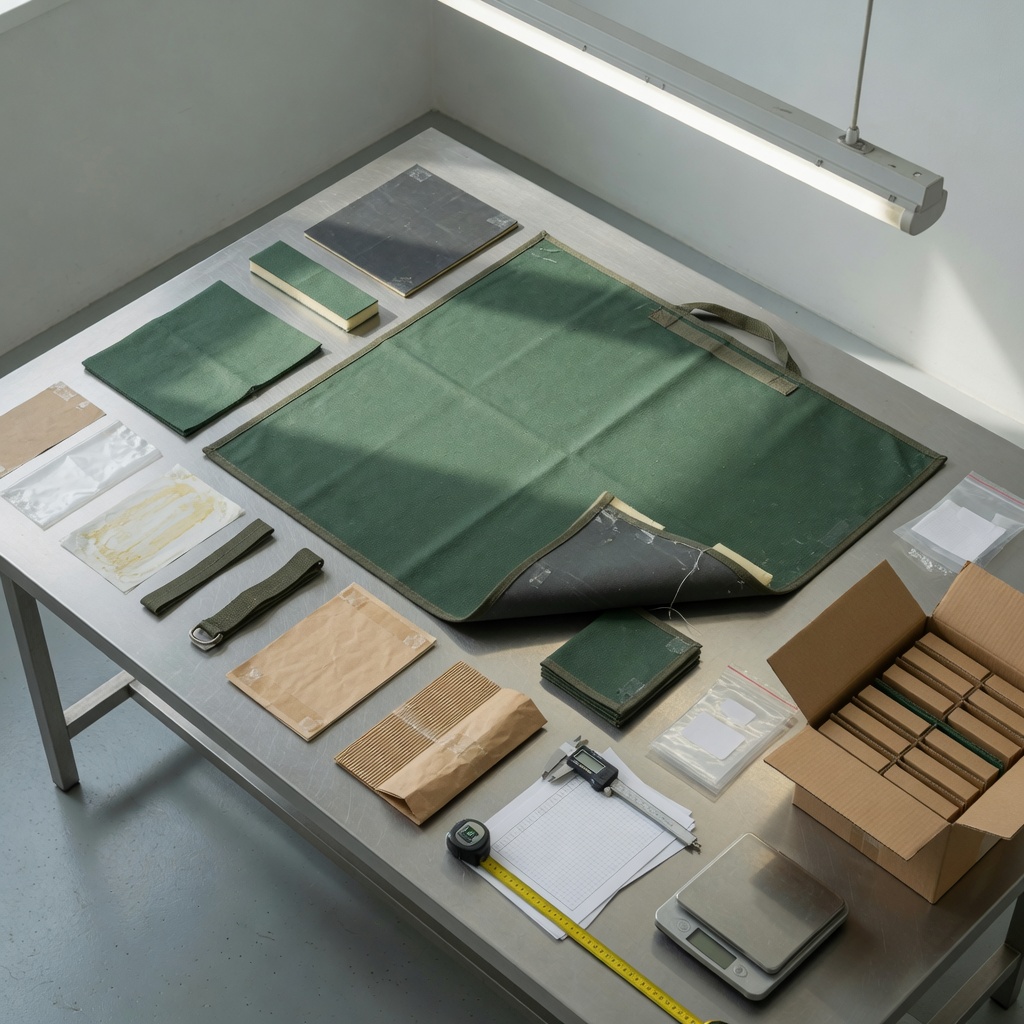
| Quoted picnic mat construction | Buyer specification, unfolded dimensions and tolerances, finished mass, and bill of materials for the face, cushioning, backing, coating, ink, adhesive, binding, strap, individual pack, and master carton | Every physical layer and accessory is disclosed, and the approved sample matches the quoted construction | A component is omitted, described only with marketing language, or open to undisclosed substitution |
| Sustainability claim definition | Exact proposed wording, covered component or site, value, unit, numerator, denominator, boundary, reporting period, and calculation method | The claim can be reproduced from identified records without extending its scope | A component claim is presented as a finished-product claim, or its denominator or reporting boundary is missing |
| Evidence scope and status | Document type, holder, issuer, reference, issue details, current status, facility, process, material or product scope, and verification route | The document matches the quoted entity, site, material, process, claim, and order | Evidence is unverifiable, outside scope, no longer current, or connected only by an unsupported supplier statement |
| Sample and QC mapping | Sample identifier, construction, test method, condition, buyer-set limit, result, result unit, test date, site, and report holder | Each result maps to the approved material, color, finish, backing, adhesive, production route, and site | The report covers an unidentified or materially different sample |
| Traceability and change control | Incoming-material references, production-lot identifiers, carton and shipment links, and a written substitution procedure | Approved evidence and materials can be traced through production to the finished shipment | A material, process, site, subcontractor, or package may change without written buyer approval |
| Malaysia-bound commercial file | MOQ by option, price, currency, quotation validity, lead time, packed-unit data, carton data, shipment volume, trade term and named place, origin, exporter, and proposed documents | The quote supports claim review, logistics planning, and importer-side verification | MOQ conditions, packed data, origin, proposed classification, or document responsibilities remain unclear |
Use approved for the current purchase order only after every buyer-designated mandatory gate passes. Use hold when a resolvable gap has a responsible party, required evidence, and closure point. Use not approved for the current quotation for an entity mismatch, unverifiable document, undisclosed component, failed buyer-set criterion, or rejected change-control requirement.
Build a claim-to-evidence map before comparing quotes
For each proposed sustainability statement, record:
- The exact wording and where it will appear, including the quotation, specification, packaging, invoice, or other commercial document.
- Whether it covers the finished picnic mat, a named component, packaging, a process, or a facility.
- Any value and unit, together with the numerator, denominator, exclusions, reporting boundary, period, and calculation method.
- The supporting record's holder, issuer, reference, issue details, current status, facility, and material, process, or product scope.
- The link between the document, incoming material, approved sample, production lot, carton code, and shipment record.
A logo or cropped document image is not a substitute for this record. When evidence is held by a yarn, fabric, foam, coating, adhesive, or packaging supplier, the picnic mat manufacturer should show how that material enters the quoted construction and production order.
Supplied source context
| Supplied source | Source-reported context retained for this article | Permitted use | What the source does not establish |
|---|---|---|---|
| Dotex retailer and wholesaler sourcing article | Discusses manufacturing integration, customization, compliance, and sustainability, and names GRS, OEKO-TEX, and BSCI in supplier screening | Supports requesting supplier, process, customization, and document-scope information | Does not prove that FIELDLOOM or a candidate supplier has a current certificate, audit, approved product, or Malaysia-specific compliance status |
| Sapana Mats sustainable-production overview | Names GRS, OEKO-TEX, BSCI, SMETA, and ISO 14001 as sourcing or sustainable-production considerations | Supports organizing evidence into recycled-claim, component-assurance, facility-management, and social-due-diligence categories | Does not verify any quoted supplier's document status, facility scope, product scope, test result, or order traceability |
| GulTrek manufacturer roundup | Reports a dated wholesale-order range for selected China-based suppliers and gives examples of layered Oxford-cloth and polyethylene-foam picnic mat construction | Provides manufacturing-origin MOQ context and a construction example for RFQ layer disclosure | Does not establish a Malaysia market norm, a FIELDLOOM specification, or the MOQ and construction available for the current quote |
These commercial secondary sources support RFQ questions only. They are not primary scheme documents, supplier certificates, audit reports, laboratory reports, or Malaysian regulatory sources.
Handle named sustainability documents without overclaiming
The controls below describe how a Malaysian buyer can classify supplier-submitted evidence. They do not restate the requirements of a scheme or standard. Verify current requirements and document status through the applicable owner, issuer, or recognized verification route before purchase-order release.
| Supplier-submitted reference | Buyer record to request | Scope limit |
|---|---|---|
| GRS-related recycled-content evidence | Exact claim wording, material type, covered layer, claimed percentage, numerator and denominator, content category, document holder, facility, current status, and order link | Do not describe the finished picnic mat as certified or assign it a whole-product recycled percentage when the evidence covers only the face textile or another component |
| OEKO-TEX-related evidence | Covered article or component, material, color, print, coating or finish, document reference, holder, facility, issue details, and current status | Do not extend evidence for the face fabric to foam, ink, adhesive, backing, binding, strap, or another unlisted component |
| ISO 14001 documentation named by the Sapana Mats source | Document holder, named facility, covered activities, reference, issue details, current status, and separate records supporting any quantitative site claim | Treat it as facility-level management evidence for the stated scope; do not use it alone to claim measured product-level recycled content, emissions, water use, or environmental impact |
| BSCI- or SMETA-related material | Audited entity and address, audit timing, available status information, corrective-action status, covered processes, and subcontractor coverage | Treat it as site-related social due-diligence evidence; do not describe it as picnic mat product certification or assume that it covers undisclosed sites |
Practical RFQ checklist for Malaysia picnic mat wholesale supply
Construction and claim denominator
- [ ] State the supplier SKU and buyer specification for unfolded size, tolerance, color, print, edge construction, carry strap, fold or roll configuration, and packing method.
- [ ] Report finished unpacked mass and packed-unit mass separately, with the unit and weighing condition stated.
- [ ] Identify the material, mass contribution, supplier reference, coating or treatment, and assembly method for every product layer and accessory.
- [ ] Disclose bonded or inseparable layers and the adhesive or lamination route used between the face, cushioning, and backing.
- [ ] Reproduce each proposed sustainability claim exactly as it would appear in commercial use.
- [ ] For each percentage, state the covered material, numerator, denominator, calculation method, and excluded layers or packaging.
- [ ] Quote conventional and sustainability-claim options separately when their construction, evidence, MOQ, price, performance, or lead time differs.
Approved sample, QC, and change control
The supplied sources establish no mandatory picnic mat performance threshold. The buyer should therefore define the relevant methods, conditions, units, and acceptance limits for the intended SKU and Malaysia-bound distribution route.
- [ ] Submit a pre-production sample made with the proposed face, cushioning, backing, coating, ink, adhesive, binding, strap, and packaging.
- [ ] Retain a matching approved reference for production and pre-shipment comparison.
- [ ] Define measurable checks for dimensions, mass, appearance, print registration, seam and edge construction, lamination adhesion, color transfer, odor, abrasion, and any offered liquid-barrier or waterproofness claim.
- [ ] Record the sample identifier, test method, conditioning, result unit, buyer-set limit, result, test date, test site, and report holder for each measured characteristic.
- [ ] Map reports to the exact material, color, coating, finish, backing, adhesive, production route, and site used in the quotation.
- [ ] Define inspection stages, sampling procedure, defect classifications, acceptance rules, failed-lot handling, corrective action, and reinspection responsibility.
- [ ] Prohibit changes to materials, packaging, production sites, or subcontractors without written buyer approval and an assessment of affected claims, samples, tests, and documents.
Malaysia-bound quotation, logistics, and document controls
The commercial return should allow the buyer to reconcile the approved specification with the packed shipment rather than reviewing sustainability evidence as a separate file.
- [ ] Quote MOQ separately by construction, size, color, print, sustainability claim, and packaging option.
- [ ] State unit price, currency, quotation validity, sample and setup charges, payment terms, production lead time, agreed trade term, and named place.
- [ ] Identify the legal manufacturer, exporter, production country of origin, and proposed product classification. Treat the classification as a supplier proposal, not an importer ruling.
- [ ] Report individual-pack materials, dimensions, mass, and the scope of any packaging claim.
- [ ] Report master-carton materials, external dimensions, unit count, net mass, gross mass, and calculated carton volume.
- [ ] Calculate total units, carton count, packed mass, and shipment volume, stating whether carton tare, pallets, and loading allowances are included.
- [ ] Provide proposed commercial-invoice and packing-list fields and show how certificate, audit, material, lot, and sample references remain linked to the shipment.
- [ ] Reserve the relevant production, shipment, payment, or purchase-order release point until evidence validation, sample approval, change-control closure, and agreed inspection are complete.
The cited evidence does not establish Malaysia-specific sustainability labeling, customs classification, labeling rules, importer documents, or tropical-climate test limits for picnic mats. The Malaysian importer or a qualified adviser should verify current obligations for the exact product construction and shipment.
Source-reported MOQ context and illustrative RFQ calculations
The GulTrek roundup reports 300–1,000 units per wholesale order for selected China-based suppliers covered by its 2026 roundup. The unit, supplier scope, date context, and range are those reported by GulTrek. This is manufacturing-origin context only; it is not a FIELDLOOM offer, a Malaysia market norm, or evidence of the MOQ available for the current quotation.
Require the supplier to quote the current MOQ by variant and identify related setup charges, documentation conditions, production constraints, and lead-time changes.
Example calculations to verify in the supplier quote
Every figure below is an article-created example assumption or a direct calculation from those assumptions. None is a FIELDLOOM specification, supplier promise, test result, or market statistic. Verify every input against the current quotation, approved sample, packing specification, and pre-shipment record.
| RFQ field | Illustrative figure and scope | Basis |
|---|---|---|
| Purchase quantity | 1,000 units for one illustrative Malaysia-bound purchase order | Example assumption to verify in the supplier quote |
| Unfolded dimensions | 200 cm × 150 cm per illustrative picnic mat | Example assumption to verify against the approved specification and sample |
| Surface area | 3.0 m² per illustrative mat and 3,000 m² for the illustrative order | Direct calculation from the example dimensions and order quantity |
| Packed-unit mass | 1.1 kg per illustrative unit, including the individual pack but excluding master-carton tare | Example assumption to verify from the packing specification |
| Packed-unit subtotal | 1,100 kg for the illustrative order, excluding master-carton tare and pallets | Direct calculation from the example quantity and packed-unit mass |
| Master-carton pack | 10 units per illustrative master carton | Example assumption to verify from the pack-out specification |
| Carton count | 100 master cartons for the illustrative order | Direct calculation from the example quantity and carton pack |
| Master-carton volume | 0.055 m³ per illustrative master carton | Example assumption to verify from external carton dimensions |
| Shipment volume | 5.5 m³ for the illustrative order, before pallets and loading allowances | Direct calculation from the example carton count and carton volume |
| Recycled-content wording | 65% by mass of the face textile only, not 65% of the finished picnic mat | Example claim used only to demonstrate denominator control; verify or replace from current supplier evidence |
The example component percentage must not be multiplied by the packed-order mass. Its denominator covers only the illustrative face textile, while packed mass includes other mat layers and the individual package. An order-level recycled-material quantity cannot be calculated until the supplier provides the verified face-textile mass and all exclusions.
Record the purchase-order decision
| Decision status | Use when | Required record |
|---|---|---|
| Approved for the current purchase order | Supplier identity, construction, claim, evidence, sample, QC, traceability, change-control, and shipment fields all pass | Transfer the approved specification, claim wording, denominators, document references, sample identifier, test limits, and substitution controls into the purchase order |
| Hold | Evidence is missing, mismatched, or pending but can be resolved before the applicable release point | Record the missing item, responsible party, closure evidence, and the production, shipment, payment, or approval point that cannot proceed |
| Not approved for the current quotation | A document is unverifiable, an entity or scope does not match, a component is undisclosed, a buyer-set criterion fails, or change controls are rejected | Obtain a corrected quotation and evidence package before reconsidering the SKU |
Commercial comparison should begin only after the buyer-designated sustainability evidence gates pass. Unit price cannot resolve an unverifiable claim, mismatched entity, undisclosed product layer, or missing order-traceability link.
Methodology, limitations, and author basis
This article uses only the explicit sourcing contexts represented by the cited commercial secondary sources. The Dotex source informs supplier-identity, customization, compliance, sustainability, and document-screening fields. The Sapana Mats source informs the named recycled-claim, component-assurance, facility-management, and social-due-diligence categories. The GulTrek source provides dated MOQ context and examples of layered Oxford-cloth and polyethylene-foam construction. The release gates and RFQ fields are editorial procurement controls derived from those contexts, not requirements attributed to the publishers or named schemes. Illustrative arithmetic uses direct multiplication or division of assumptions clearly marked for supplier verification.
Limitations and points to verify include:
- No primary certificate, audit report, laboratory report, bill of materials, quotation, customs ruling, production record, or shipment file was supplied for validation.
- No supplier identity, production site, document validity, product construction, claim denominator, MOQ, test result, or order traceability has been independently verified.
- No FIELDLOOM certification, audit outcome, factory capability, picnic mat specification, customer result, or Malaysia-specific compliance status is asserted.
- Commercial secondary sources may use certification, audit, compliance, and membership terms imprecisely or may change after publication.
- Current documents should be checked for holder, issuer, status, facility scope, process scope, material or product scope, and connection to the quoted order.
- Malaysian legal, customs, classification, labeling, importer, and climate-related requirements require current primary verification beyond the cited evidence base.
The author profile identifies Vincent Xi as Editorial Author. That approved basis does not support a first-hand factory visit, supplier audit, product test, client outcome, or personal sourcing claim, so none is made here.
Discuss Your Requirements
Review our manufacturing capabilities, then share your specifications for a supplier-fit review.