Picnic Blanket Sourcing Production Scalability Planning for United Arab Emirates Buyers
Vincent Xi, Editorial Author (author profile)
United Arab Emirates buyers who need picnic blanket sourcing production scalability planning should lock three inputs before they approve a program: a dated capacity statement by process, not a marketing daily-output headline; a calendar that separates sampling, bulk cutting and sewing, finishing, and export booking; and an MOQ plus bottleneck map that shows whether dyeing, waterproof backing, or packing—not sewing headcount—sets the true ceiling.
Procurement decision, answer first. Approve only when the quote states weekly finished pieces on your construction, MOQ per color and backing, and a consignee week into the United Arab Emirates. Hold if capacity is sewing-only, if backing, folding, or packing output is unstated, or if MOQ is not broken down by colorway. Reject a single blended lead time that mixes sampling, bulk manufacture, and a non-UAE transit window.
Keep each published figure attached to its source page. The mill and OEM pages cited below publish daily-output, MOQ, sampling, and bulk-calendar ranges. Challenge those ranges in the RFQ; they are not Fieldloom test results and they are not a United Arab Emirates transit quote.
Vincent Xi is named on Fieldloom as Editorial Author. This briefing does not add credentials, years of experience, factory visits, in-house lab tests, named customer programs, or first-person production claims. The buyer task is procurement: specify the picnic blanket SKU, compare mill evidence, verify documents, then approve and order.
Production capacity signals that actually support scale
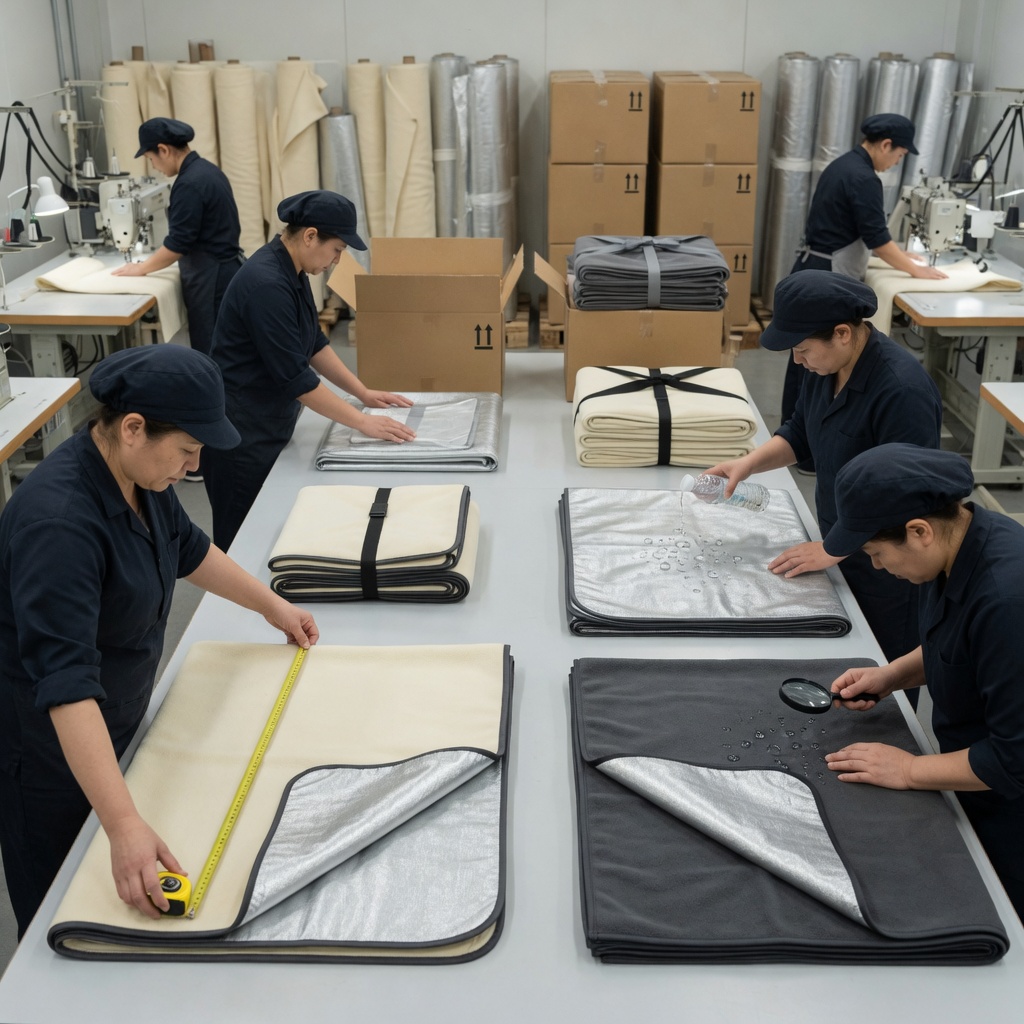
A picnic blanket is a multi-process SKU. One OEM page describes a fleece face and aluminum backing, plus customization, manufacturing, and packing steps (Tiroflx OEM picnic blanket manufacturer). Binding, labels, folding, and a carry strap are construction details you specify. They are not proof of unused capacity. Sewing headcount does not prove scale if backing, printing, or carton packing sits on a smaller calendar.
A retailer and wholesaler sourcing guide tells B2B buyers to evaluate vertical integration and production capability. It describes four mills for knitting, weaving, dyeing, and sewing, and daily capacity of over 30,000 blankets for large-volume programs (Dotex picnic blanket sourcing guide).
- Unit: blankets per day (finished goods, as stated on that page).
- Scope: that operator’s published multi-mill description covering knitting, weaving, dyeing, and sewing.
- As-of context: as published on that B2B sourcing page. No independent audit date is supplied in the source excerpt. Require a signed capacity letter dated for your season and naming the producing legal entity and site.
- Trade-off: a five-figure daily headline can still miss your program if dyeing, printed pattern, or waterproof-backing capacity is a fraction of sewing capacity.
Ask for capacity by process on the exact construction you will order: face-fabric supply or knitting, named waterproof backing, cutting, binding, folding, and carton packing. Request peak versus normal weeks, capacity already reserved for other customers, and how many lines can run your SKU without a changeover loss. If the mill cannot state output in the units you purchase (pieces per style, per color, per week), do not treat a large-factory claim as evidence of picnic blanket production scalability planning.
Measurable comparison points for United Arab Emirates program buyers:
- Weekly pieces on your open size and backing, not a mixed-SKU average.
- Dye-lot size versus the number of colors in the first shipment.
- Backing width versus blanket width, including edge waste, stated on the quote.
- Packing rate: whether folded picnic blankets with straps pack at the same pieces-per-hour as flat sewn panels.
- Replenishment output after the first bulk lot, as pieces per week.
Example calculation to verify in the supplier quote (not a Fieldloom result and not a published mill figure): if sewing is 10,000 pieces in a week and waterproof backing is 3,000 pieces in that week, the waterproof picnic blanket ceiling is 3,000 pieces. Put the constraint process on the quote.
Sampling, production, and shipping calendars
Scale fails when sampling, bulk, and logistics collapse into one lead-time number. A picnic blanket manufacturer page describing China and Vietnam production publishes these ranges: sampling 7–14 days, production 30–45 days, and US delivery 60–90 days (Milan Pacific picnic blanket manufacturer). China and Vietnam are manufacturing-origin references on that page, not sales-market targets for this briefing.
Use those numbers only as published analog calendars:
- Sampling 7–14 days. Unit: calendar days. Scope: that manufacturer’s published sampling window for picnic blankets. As-of: as published on the manufacturer page. This window is not pre-production approval of bulk dye lots, bulk backing bond, or carton marks.
- Production 30–45 days. Unit: calendar days after the stated start trigger. Scope: bulk manufacturing as published. As-of: as published. Confirm whether the window includes backing, print or embroidery, folding, packing, and final inspection.
- US delivery 60–90 days. Unit: calendar days as published for US delivery. Scope: that manufacturer’s published US lane. Not a United Arab Emirates transit time. UAE buyers must request a separate destination calendar covering origin, Incoterm, ocean or air mode, and consignee receiving week.
Trade-offs that change the order decision:
- A 7-day sample that skips waterproof-backing bond tests will not de-risk a multi-thousand-piece run.
- A 30-day production slot that starts only after fabric arrives from a third mill is not 30 days of mill-controlled time.
- Compressing third-party QC to hit a vessel cut-off transfers defect cost to the importer.
- Reusing a published US 60–90 day door-to-door window for a United Arab Emirates inbound date will mis-state warehouse readiness.
Build a backward plan from the United Arab Emirates in-warehouse date: export cut-off, production end, inline QC, pre-production sample sign-off, lab reports, and fabric-in date. Put each date on the purchase order so production scalability planning is a calendar, not a slogan.
MOQ, vertical integration, and bottleneck mapping
Published MOQ for one picnic blanket manufacturer is 1,000–3,000 units (Milan Pacific picnic blanket manufacturer).
- Unit: units (pieces) as stated.
- Scope: that manufacturer’s published OEM/ODM picnic blanket MOQ band.
- As-of: as published; confirm per color, per print, and per backing type on the live quote.
An OEM manufacturer page describes a project lifecycle: sourcing fleece and aluminum, customizing patterns, lab testing, manufacturing with third-party QC, on-time delivery, and flexible MOQs for mid-size and large buyers (Tiroflx OEM picnic blanket manufacturer). Flexible MOQ is not a number. Require the actual piece count, the surcharge below the band, and whether the band applies to the first color only or to every colorway.
Vertical integration trade-off:
- More processes in-house (knit or weave, dye, backing, sew, pack) can reduce fabric-in risk and support larger repeat runs, which is why multi-mill descriptions are used as a scale signal (Dotex picnic blanket sourcing guide).
- More subcontracted processes can lower the pilot MOQ but cap weekly output when the backing, printer, or carton plant is booked.
Map bottlenecks before you approve assortment. Put these on the RFQ as measurable checks, not as assumed industry averages: backing width versus blanket size, dyeing lot size versus color count, and folding/packing labor versus sewing heads. For production scalability planning, the constraint process is the capacity that matters.
Example calculation to verify in the supplier quote (not a market price and not a Fieldloom quote): if MOQ is 1,000 pieces per color and the United Arab Emirates program needs six colors in one shipment, the first scalable order is 6 × 1,000 = 6,000 pieces. If MOQ is 3,000 pieces per color, the same six-color set is 18,000 pieces. Ask which rule applies before you design the assortment.
A practical split used in RFQs: lock construction on a first colorway at the published 1,000-piece end of the band, then release remaining colors only after bulk-cut approval. If the mill requires 1,000–3,000 pieces on every color from day one, the inventory and cash effect in the United Arab Emirates warehouse is the decision, not the sewing story.
Quality control, lab claims, and what a certificate is not
Standards named on supplier pages are those companies’ published claims. They are not this publication’s certification, not Vincent Xi’s test results, and not a substitute for a current document covering your SKU and producing site.
Published examples from the source pages:
- GRS, BSCI, and OEKO-TEX are listed alongside the four-mill, 30,000-blanket-per-day description (Dotex picnic blanket sourcing guide).
- Lab testing for OEKO-TEX, REACH, AZO, PAHS, CD, and LEAD, plus third-party QC, is described on an OEM picnic blanket page (Tiroflx OEM picnic blanket manufacturer).
- SMETA 4-Pillar and SCAN are listed with seasonal-planning language on another manufacturer page (Milan Pacific picnic blanket manufacturer).
Distinguish a scheme from a webpage practice:
- Scheme or regulatory frame: OEKO-TEX STANDARD 100 is a product certification with a defined scope and expiry. REACH is a substance framework. Social audits such as BSCI or SMETA 4-Pillar cover facilities, not automatically every picnic blanket lot. This article does not restate legal limit values.
- Company webpage practice: listing marks or test names. That is not proof that your picnic blanket lot is certified.
RFQ action: request certificate PDFs that show legal entity name, site address, standard, product scope, and expiry overlapping your production window. Request the third-party QC protocol: AQL, sample size, checkpoints (incoming fabric, inline, final), and whether waterproof-backing bond, seam quality, colorfastness, and folded-size tolerance are included.
Trade-off: skipping lot-specific chemical tests to save calendar days can block a United Arab Emirates inbound if the consignee or retailer later asks for reports you never ordered. Paying for tests on proto fabric only, then cutting bulk from a different dye lot, is not the same as lot release.
United Arab Emirates production scalability planning for picnic blanket programs
United Arab Emirates procurement teams should keep the product decision primary: construction, mill capacity, MOQ math, and calendar. This page is not a customs manual. Duty rates, mandatory label statutes, and climate-performance numbers are not in the manufacturer excerpts used here. Specify those items as buyer requirements and verify them with the importer of record.
What UAE buyers can still lock in the RFQ without using unpublished local rates:
- Destination calendar. State origin factory, Incoterm, and required arrival week in the United Arab Emirates. Do not reuse the published 60–90 day US delivery window (Milan Pacific picnic blanket manufacturer).
- Assortment versus MOQ. If MOQ is 1,000–3,000 units per style or color, state how many SKUs, colors, and pack methods land in one shipment so warehouse slots and cash are planned.
- Outdoor-use specs as buyer-defined tests. Waterproof backing, peel or bond, colorfastness, and folded dimension should be defined as methods and accept/reject limits on the purchase order. Do not assume a mill’s default picnic blanket matches your outdoor display or event use unless you specify those tests.
- Documents pack. Commercial invoice, packing list, packing method (pieces per carton, carton outer size, gross weight), fibre content as you require on labels, and copies of any lab reports you paid for. Request an HS-code proposal from the supplier and have your broker confirm it. The supplier pages used here do not publish United Arab Emirates tariff treatment.
- Seasonal reservation. One manufacturer describes dedicated management for seasonal planning (Milan Pacific picnic blanket manufacturer). Convert that claim into a reserved-capacity week, a maximum extra-piece figure, and a cancellation window in writing.
- Replenishment slot. First-order scale is not program scale. Require the pieces-per-week figure that remains available after the first shipment, and the cutoff date to add a color without losing the reserved week.
Landed-cost components such as freight, insurance, duty, and port charges belong in the buyer’s cost model. This briefing does not publish United Arab Emirates duty rates because they are not in the supplied evidence. The scalable decision is still the mill’s weekly output on your construction versus the week you must receive goods.
Buyer decision table for picnic blanket capacity and scale
| Planning factor | Published signal to challenge | Specify in the RFQ | Verify before approval | Order implication if weak |
|---|---|---|---|---|
| Finished output | Over 30,000 blankets per day across 4 mills (knit, weave, dye, sew), as published (Dotex sourcing guide) | Weekly pieces by SKU and color for your construction; peak versus normal | Signed capacity letter naming legal entity and site; line count; process map; dye-lot calendar | Cannot commit the UAE season volume; split sources or cut assortment |
| Vertical integration | Four-process mill claim; design plus China and Vietnam factories as published (Dotex sourcing guide; Milan Pacific) | Which steps are in-house versus subcontract for fleece, named waterproof backing, print, sew, pack | Subcontractor list, their lead times, and who owns QC | Hidden fabric or backing queue moves the ship week |
| MOQ | 1,000–3,000 units published; flexible MOQ claimed elsewhere (Milan Pacific; Tiroflx OEM) | Pieces per color, per backing, per label language; surcharge below band | Quote line items that match the PO SKU list | Inventory overbuy or refused replenishment |
| Sample calendar | 7–14 days published (Milan Pacific) | Proto versus PPS versus top-of-production; tests included | Dated sample tracker; sealed countersamples retained | Bulk starts on unapproved hand-feel or folded size |
| Bulk calendar | 30–45 days production published (Milan Pacific) | Start trigger (deposit, fabric-in, PPS sign-off); weekly output curve | Gantt with process owners; written delay terms if used | Missed United Arab Emirates inbound week |
| Destination lead time | 60–90 days US delivery published—not a UAE quote (Milan Pacific) | Incoterm, origin, UAE consignee week, carton plan | Forwarder booking plus factory ex-works date | Missed vessel; unplanned air cost |
| Chemical and QC claims | OEKO-TEX, REACH, AZO, PAHS, CD, LEAD, GRS, BSCI, SMETA 4-Pillar, SCAN as page claims (Tiroflx OEM; Dotex sourcing guide; Milan Pacific) | Certificate scope, lot tests, and AQL checklist for picnic blanket construction | PDFs still valid on ship date; third-party reports on the bulk lot | Failed customer onboarding or rejected lot |
| Seasonal surge | Seasonal-planning management as published (Milan Pacific) | Reserved week, max extra pieces, cutoff for add-on colors | Written reservation and deposit terms | Peak-month output stays at sample-line speed |
RFQ checklist for picnic blanket sourcing production scalability planning
Use each item to specify, compare, verify, approve, or order. Do not send a brand-only brief.
- Construction sheet. Face fabric type and mass (GSM to be quoted if unknown), backing type as named on the quote (aluminum laminate is described on one OEM page; do not assume another film unless quoted), finished open size, folded size, binding, carry strap, and label positions so capacity is calculated on the real SKU.
- Quantity ladder. Forecast pieces by month for the United Arab Emirates program, plus firm first PO quantity and color count. State whether MOQ is per color.
- Capacity letter. Pieces per week for this construction, number of lines, and dyeing or backing limits, with a document date covering your ship window and the producing site name.
- Process map. In-house versus subcontract for knit/weave, dye, named waterproof backing, cut, sew, fold, and pack. Name subcontracted processes if any.
- MOQ math. Confirm 1,000–3,000 units (or the mill’s actual band) against your colorway count. Require a unit price for the exact piece count you will order, labeled as quote-specific.
- Sample protocol. Proto and PPS in calendar days; whether a waterproof-backing bead or bond test is included; who pays courier to the United Arab Emirates; retain countersamples.
- Bulk calendar. Compare the 30–45 day published analog with your dates. State fabric-in date, inline inspection date, final inspection date, and carton-mark approval date.
- Destination plan. Incoterm, origin, United Arab Emirates delivery week, and carton inner quantity. Do not paste US 60–90 day delivery as the UAE plan.
- QC file. AQL, defect definitions for stains, backing delamination, size, and stitching, plus a third-party inspector option as described on OEM pages.
- Certificate file. Request current OEKO-TEX, GRS, or social-audit PDFs only if your customer requires them. Match legal entity and site. Reject webpage marks as proof.
- Lab tests. List OEKO-TEX, REACH, AZO, PAHS, cadmium, and lead only if required by your specification. State test method, lab, and whether tests are on bulk fabric or finished picnic blankets.
- Packaging engineering. Pieces per inner pack and carton, carton outer dimensions and gross weight, stacking, and locked folding method. Packing can be the silent capacity limit; require a pieces-per-hour or pieces-per-week packing figure.
- Change control. How a color or size add-on changes MOQ, reserved capacity, and ship date.
- Payment that reserves capacity. Deposit that actually holds dyeing and sewing slots; cancellation terms if PPS fails.
- Replenishment gate. Pieces per week still available after the first shipment; cutoff to add a color without losing the reserved week; whether reorder MOQ matches first-order MOQ.
- Approval gate. No bulk fabric cutting before written PPS approval and, if specified, passing lab reports.
Evidence basis, method, and what to verify
Source contexts. This briefing uses three manufacturer and OEM pages. A retailer and wholesaler picnic blanket sourcing guide publishes vertical integration across four mills, daily capacity over 30,000 blankets, and named compliance marks (Dotex picnic blanket sourcing guide). An OEM picnic blanket page describes fleece and aluminum sourcing, a chemical-test list, third-party QC, and flexible MOQs (Tiroflx OEM picnic blanket manufacturer). A picnic blanket manufacturer page publishes MOQ 1,000–3,000 units, sampling 7–14 days, production 30–45 days, US delivery 60–90 days, and SMETA 4-Pillar and SCAN mentions (Milan Pacific picnic blanket manufacturer).
Method. Figures are transcribed as supplier-stated planning ranges from those pages and converted into RFQ questions for picnic blanket procurement. Example calculations, including 6 colors × 1,000 pieces = 6,000 pieces if MOQ is per color, are assumptions to verify on the supplier quote.
Limitations. The source excerpts available for this briefing are not independently dated; capacities, MOQs, lead times, and certificates can change. Over 30,000 blankets per day does not define SKU mix, shift hours, or yield. The 60–90 day US delivery window is not United Arab Emirates transit. Certification names on a website are not a current certificate for your lot. Fieldloom is not presenting these operators’ claims as Fieldloom factory results, awards, or customer outcomes. Before you approve a purchase order, verify every number on a dated quote, a capacity letter, and documents that name the producing site. United Arab Emirates buyers should have their importer of record confirm classification, labeling, and entry documents; those rules are outside the supplied manufacturer excerpts.
Discuss Your Requirements
Review our manufacturing capabilities, then share your specifications for a supplier-fit review.