Picnic Blanket OEM Production Scalability Planning for United States Buyers
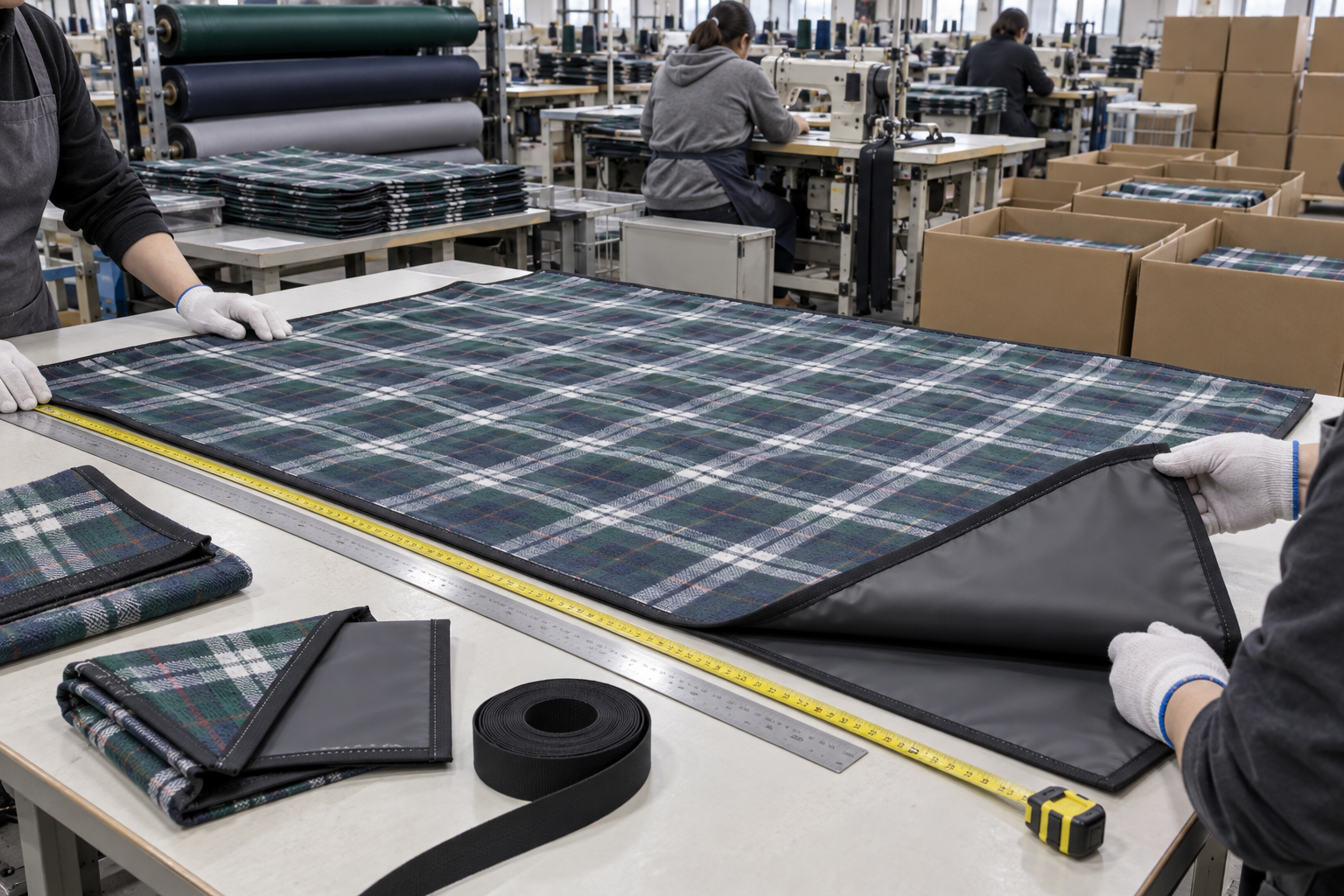
For United States buyers, picnic blanket OEM production scalability planning requires sizing the purchase order against process-specific minimums and production calendars, not against a single factory headline. Production scalability planning, for this manufacturing decision, means confirming how many pieces of a defined construction a supplier can sample, sew, inspect, and ship in a stated window, then checking whether that window still holds when print method, size, or packaging changes. Public supplier pages reviewed for this article show customized picnic-blanket minimums from 100 pieces on one digital-print offer to 500–2,000 units in a 2025 supplier overview, with bulk production statements ranging from 20–30 days to 30–45 days after approval. Those figures are claims by the cited factories or directories, not a capacity rating for any one mill and not a FIELDLOOM production commitment. This briefing is written by Vincent Xi, Editorial Author, whose profile is published at https://www.fieldloommill.com/authors/vincent-xi/. It does not rest on a factory visit, a laboratory test, or a customer outcome.
What United States Buyers Should Lock Before Scaling Picnic Blanket Manufacturing
A United States purchase order is scalable only if the specification that will be repeated is already fixed. Lock finished size, fabric construction, coating, print method, edge finish, label content, and pack before asking a factory to reserve capacity. Changing any of those items can move the order from a stock-item minimum to a custom minimum, or from a shorter digital-print slot to a longer reactive-print slot.
For goods entering the United States, the buyer, not the overseas sewing line, remains responsible for the commercial import file. Specify who is importer of record, which Incoterm applies (for example FOB port of loading versus a delivered term), and which U.S. distribution center or 3PL receives the freight. Require the quotation to separate unit manufacturing cost from packaging, inland haulage to the load port, ocean or air freight, duty, and brokerage so a larger piece count is not mistaken for a lower landed cost. Do not treat a supplier's export history as proof that the SKU meets U.S. textile labeling practice. Ask counsel or a customs broker to confirm fiber content, country of origin, and manufacturer or importer identification against the rules that apply to the product, and require the supplier to submit label artwork for written approval before bulk cutting.
Seasonal outdoor demand in the United States often compresses bookings into a spring ship window. A bulk statement of about 30 days that starts only after sample approval will miss that window if artwork, strike-offs, or packaging dielines are still open. Put the U.S. in-DC date on the RFQ and work backward.
Production Scalability Planning Signals That Are Measurable
Useful production scalability planning signals are countable and tied to one SKU. Floor area, headcount, and machine lists describe a site. They do not, by themselves, state pieces per week of a coated picnic blanket. Ask for a capacity figure in finished, accepted pieces per week for the quoted construction, name the bottleneck (fabric, coat, print, cut, sew, or pack), and record whether that figure is dedicated or shared with other blanket types.
Three public pages show how wide those signals run. They are not a ranked shortlist and they were not audited for this article.
Suzhou Sunwen Textile Co., Ltd. states, on its picnic blanket manufacturer page, more than 10 years of manufacturing experience, an owned factory, OEM and ODM service, a minimum of 500 pieces for customized products, and 100 pieces for stock items. The same page states that digital printing allows a minimum as low as 100 pieces with 25–30 days of production, while reactive printing requires 1,000 pieces and 35–40 days. Materials named include Oxford fabric and polyester with a TPU waterproof coating, plus custom size, printing, edges, labels, and packaging. The page also states OEKO-TEX 100 certification for that company. That is a supplier claim about Sunwen, not a certification of any other factory. A buyer should request the current certificate number, product scope, and expiry before relying on it. Source: Sunwen Textile picnic blanket page.
A Nantong factory page states an 1,800 square meter site with zones for weaving, knitting, dyeing, printing, cutting, sewing, and quality control; picnic blankets among other blanket types; OEM and ODM options for size, GSM, fiber, print method, labels, and packaging; a minimum from 200 pieces; and 20–30 day production lead times. It states 30-plus skilled staff, circular knitting machines, rapier looms, digital printing, embroidery, and automated cutting, a 4-stage QC system, and export documentation for 30-plus countries. Square meters and headcount on that page are site descriptors, not a piece-rate. Source: Blanket manufacturer factory page.
A supplier overview whose title refers to 2025 states that OEM picnic blanket production in China clusters in Zhejiang, Jiangsu, and Guangdong, and it advises buyers to verify scalability using a factory size of 10,000-plus square meters and 100-plus employees. It states a typical minimum from 500 to 2,000 units depending on customization, sampling of 7–15 days, and bulk production of 30–45 days after approval. It cites Jiangsu New Feeling Outdoors as a high-capacity example with a 150,000 square meter facility, 180-plus staff, and a claim of 100 percent on-time delivery. Those thresholds are the overview's screening suggestions and examples, not a regulatory definition of a scalable plant. Source: Accio China OEM picnic blanket supplier overview.
Buyer Decision Table for Picnic Blanket Manufacturing Scale
Use the table to decide what to write into the RFQ. Published ranges are reference points to challenge, not default order quantities. "As stated" means the figure appears on the cited page. No independent recount of machines or shipments was performed.
| Decision point | What to compare | Buyer control | Published reference, scope, and as-of basis |
|---|---|---|---|
| Custom versus stock minimum | 100-piece stock or digital minimum versus 500-piece custom minimum versus a 200-piece stated floor | Specify one SKU; do not mix stock and custom rules on one line | 100 pieces stock and 500 pieces custom; digital print as low as 100 pieces. Sunwen picnic blanket page, as stated on that page |
| Print-process minimum and calendar | Digital slot versus reactive slot | Approve one print method before capacity is promised | Digital: 100 pieces and 25–30 production days. Reactive: 1,000 pieces and 35–40 days. Sunwen page, as stated |
| Alternate stated floor | 200-piece minimum and 20–30 day lead time at an 1,800 square meter Nantong site with 30-plus staff | Ask for pieces per week on the quoted construction, not only floor area | Blanket-manufacturer.com factory page, as stated |
| Site-size screen versus proof | Suggested check of 10,000-plus square meters and 100-plus employees, versus an example of 150,000 square meters and 180-plus staff | Treat size bands as questions; require a loading plan for the actual quantity | Accio overview titled for 2025, as stated in that article |
| Sample gate then bulk | 7–15 day sampling and 30–45 day bulk after approval, versus 20–30 day production statements | Start the bulk clock only after written sample approval | 7–15 and 30–45 days on the Accio overview; 20–30 days on the Nantong page; both as stated |
| On-time claim | A stated 100 percent on-time delivery at one large Jiangsu example | Require the milestone (ex-factory versus U.S. in-DC), the period, and the order count behind the percentage | Accio overview citing Jiangsu New Feeling Outdoors, as stated; not independently verified here |
Example calculation, assumption only, to verify in the supplier quote: a United States buyer needing 2,000 finished picnic blankets should not treat "about 30 days" as one block. If the construction uses the reactive-print path cited at a 1,000-piece minimum and 35–40 production days, the piece floor is met, but the calendar is the reactive calendar, not the 25–30 day digital calendar. If the same 2,000 pieces are two 1,000-piece colorways, confirm whether the factory counts one bulk slot or two. Add sample days, cited as 7–15 days on the overview, only after art is frozen. Then add the ocean, customs, and deconsolidation time the forwarder quotes into the United States. Do not add those day ranges as if they start on the same morning.
Print, Fabric, and Pack Decisions That Move the Capacity Number
Material and decoration change the scalable quantity. The Sunwen page names Oxford fabric and polyester with a TPU waterproof coating, and it separates digital printing from reactive printing by both minimum and days. A buyer who wants a coated, packable picnic blanket should state the coating and a waterproof target as a test method and pass level, not the word "waterproof" alone. If the supplier cannot quote the method, the scale plan is not yet specified. This article does not assign a performance ranking to digital versus reactive printing beyond the minimums and day ranges those pages publish.
The Nantong page lists GSM, fiber, size, print method, labels, and packaging as custom fields, with a minimum from 200 pieces. GSM and size change cut yield and sewing minutes. A larger mat uses more fabric per piece, so a weekly piece capacity quoted on a small size will overstate output on a larger size. Require the capacity statement to name the finished size and GSM it assumes.
Packaging is part of the same capacity number. A zip pouch is a different sewing and packing load from a handle, buckle, or retail carton. Ask whether the cited 20–30 day or 25–30 day statement includes packing. If a U.S. retailer requires a carton count, barcode placement, or drop-test level, put that in the RFQ. Those retailer rules are not in the source pages and must come from the buyer's account brief.
A first order at the digital-print minimum cited as 100 pieces can be a pilot. It does not prove the plant can repeat that SKU at the 500–2,000 unit band the overview calls typical for customized work. Ask for the maximum accepted pieces per week at a stable bill of materials, and for the lead time to reopen that bill of materials after a gap.
How to Compare Factory Scale Without Confusing Area and Output
The three sources use different size languages. One site is described as 1,800 square meters with 30-plus staff. The overview suggests 10,000-plus square meters and 100-plus employees, and it gives an example of 150,000 square meters and 180-plus staff. Do not rank these as if square meters were finished pieces. An 1,800 square meter plant that cuts and sews coated, bought-in fabric can fit a defined picnic blanket if printing is subcontracted under a named process. A much larger campus can still miss a picnic-blanket week if the coating line or sewing team is booked by other products.
Ask for a process map for the quoted blanket: which steps are in-house, which are subcontracted, and which address applies to each step. The overview's note that production clusters in Zhejiang, Jiangsu, and Guangdong is a freight-planning cue, not evidence that any factory in those provinces has open capacity. A manufacturing-origin reference is not a sales-market target. Request the port of loading that matches the sewing site, because a long inland truck leg can erase a short ocean leg into the United States.
Headcount needs the same denominator. "30-plus skilled staff," "100-plus employees," and "180-plus staff" are not comparable until the quote states how many people sew this blanket during the ship window. Compare finished, accepted pieces per week for one size, one fabric, one print method, and one pack. A "100 percent on-time" statement, as repeated for one Jiangsu example, does not say whether the clock stops at the factory gate or at a U.S. warehouse. Require that definition in writing, and do not copy the percentage into an internal forecast.
Sampling Gates, Bulk Slots, and Delivery Into the United States
Lead time is a chain. The overview states sampling of 7–15 days and bulk of 30–45 days after approval. Sunwen states 25–30 days for the low-minimum digital path and 35–40 days for reactive printing at 1,000 pieces. The Nantong page states 20–30 days. None of these excerpts states that the clock includes a U.S. customs hold, a missed approval, or a third-party lab test. Plan separate lines: art freeze, strike-off, pre-production sample, bulk start, inline inspection, final inspection, ex-factory date, vessel or flight, and U.S. availability.
Approve a pre-production sample in bulk fabric, not a sales sample in a substitute cloth. State who pays sample freight to the United States reviewer and how many days that reviewer has to accept or reject. A 7-day sample make that then sits for two weeks in a U.S. office is a longer gate than the factory line alone.
When volume steps up, ask whether the factory will add a shift, add a line, or subcontract sewing, and require the quality plan for that choice. Do not assume the headcount on a parent-company page is the headcount on the order. For a repeat U.S. season, ask for the reservation window and the cancellation terms if the forecast drops. A minimum of 500 or 1,000 pieces is a commercial floor, not a promise that the factory holds fabric for the account.
Require a quote that can be re-run at two volumes, such as the process minimum and the quantity the buyer may actually ship, on the same Incoterm. Example assumption to verify, not a price and not a duty rate: if volume doubles and only the sewing line is discounted, fabric and TPU coating may still dominate unit cost, so the landed-cost change can be smaller than the capacity change. Have the supplier show which cost lines move with quantity. Duty and brokerage are U.S.-side figures from the broker for the correct classification. They are not published on these factory pages and should not be guessed.
QC Evidence That Makes a Larger Order Repeatable
The Nantong page states a 4-stage QC system but the material used here does not name the four stages. Ask the supplier to list each stage, the inspection level or sample size, and what fails the lot. A practical buyer request is incoming fabric check, inline seam and size check, final measurement audit, and packing audit. Those four labels are a buyer checklist, not a claim that the cited factory uses them.
Put measurement points in numbers: length and width tolerance, corner alignment, binding width, and stitch density, with the unit (centimeters or inches) and the method (laid flat, without tension). Coating checks should cover folds and edges, where a waterproof picnic blanket usually fails first. A U.S. retailer chargeback often starts from a tolerance the factory never received.
Read the Sunwen page's OEKO-TEX 100 statement as that supplier's claim, not as proof of waterproof performance, colorfastness, or social compliance, and not as a certificate held by any other company. OEKO-TEX sets its own article scope and limits; only a current certificate shows what was tested. If a U.S. retailer asks for additional chemical or flammability paperwork, list those documents as separate RFQ lines and accept only unexpired copies that name the product. No certificate is assumed for FIELDLOOM or for unnamed factories in this article.
Export documentation "for 30-plus countries," as stated on the Nantong page, means the factory says it prepares export papers. It does not replace the U.S. importer's classification, labeling, or recordkeeping. Require a shipment pack with commercial invoice, packing list, and any test report the purchase order names, using lot or PO references that match the cartons.
RFQ Checklist
- Specify finished size, fabric construction, GSM or fabric weight, coating, print method, edge finish, and pack-out as one frozen bill of materials before capacity is quoted.
- Ask the supplier to state finished, accepted pieces per week for that bill of materials, name the bottleneck, and say whether capacity is dedicated or shared.
- Require the manufacturer to quote each minimum in pieces for stock, digital print, and any other print method, and to attach a production-day range to each minimum.
- Specify the United States in-DC date, Incoterm, port of loading, and importer of record, and ask the supplier to set the ex-factory date backward from that in-DC date.
- Require the supplier to separate sample lead time from bulk lead time and to start bulk only after written pre-production sample approval.
- Ask the supplier to identify in-house versus subcontracted processes, with site addresses, before the order quantity is increased.
- Specify measurement tolerances, inspection stages, and accept/reject rules in units, and require the final report to cite the purchase-order number.
- Require current certificate copies, with scope and expiry, for any chemical or safety claim the quotation uses, and do not treat another company's certificate as transferable.
- Ask the supplier to quote unit costs across two planned volume tiers on identical Incoterms, isolating which line items scale with order size.
- Verify that packaging, carton count, and any U.S. retailer barcode or drop-test requirement are inside the quoted lead time and price.
How the Figures Were Derived, and What This Article Does Not Prove
The numbers above were taken from three public web pages, not from a mill audit, a shipment file, or a FIELDLOOM production record. The Sunwen page supplied the experience statement of more than 10 years, the 500-piece custom and 100-piece stock minimums, the digital-print statement of 100 pieces and 25–30 days, the reactive-print statement of 1,000 pieces and 35–40 days, the Oxford and polyester-with-TPU note, and the OEKO-TEX 100 claim. The Nantong factory page supplied the 1,800 square meter site, 30-plus staff, process list, minimum from 200 pieces, 20–30 day lead time, 4-stage QC statement, and documentation statement for 30-plus countries. The Accio overview, whose title refers to 2025, supplied the Zhejiang, Jiangsu, and Guangdong cluster note, the 10,000-plus square meter and 100-plus employee screening suggestion, the 500–2,000 unit typical minimum, the 7–15 day sample and 30–45 day bulk statements, and the Jiangsu New Feeling Outdoors example of 150,000 square meters, 180-plus staff, and 100 percent on-time delivery. No excerpt used here carried an independent test date. Treat every figure as current only if the supplier reconfirms it on the quotation.
These pages do not state prices, U.S. duty rates, ocean transit days, defect rates, or weekly piece capacity for a named picnic-blanket size. A 4-stage QC phrase and an on-time percentage are not procedures. Certificates mentioned belong only to the company that claims them, and only while the document is in force. Nothing here awards a factory, forecasts U.S. sell-through, or states FIELDLOOM manufacturing capacity. Vincent Xi's author page identifies the editorial byline. It is not a record of personal production trials, and no such trial is claimed. Before a United States buyer places a scalable OEM order, the controls that matter are the frozen specification, the pieces-per-week commitment, the sample-to-bulk calendar through the U.S. in-DC date, and the inspection and document pack tied to the purchase order.
Discuss Your Requirements
Review our manufacturing capabilities, then share your specifications for a supplier-fit review.