Picnic Blanket OEM Customization Options for United Arab Emirates RFQs
By Vincent Xi, Editorial Author
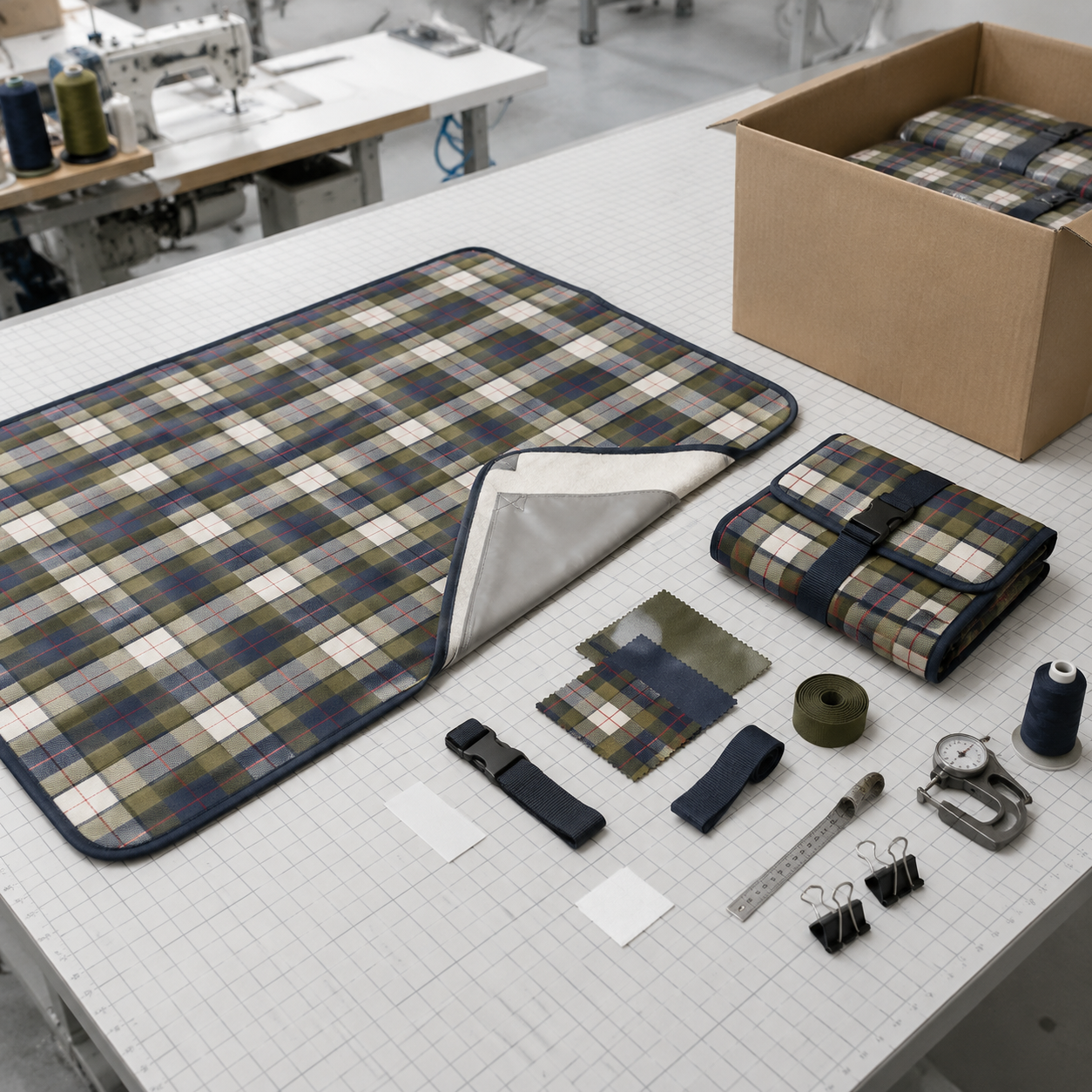
For United Arab Emirates B2B buyers, picnic blanket OEM customization options become useful only when each choice has a price, sample route, verification method, and change-control rule. The RFQ should define one comparable configuration across material layers, finished dimensions, folding method, carry components, branding, labels, packaging, quality checks, and delivery inputs.
The beach mat material and use guide discusses intended use, candidate materials, backing, and portability. The OEM picnic blanket manufacturer guide provides category context for materials, sampling, process ownership, and sample-to-bulk control. The custom picnic blanket guide provides image-led personalization context. These commercial guides do not prove a bidder's capability, product performance, certification, pricing, lead time, or UAE compliance.
RFQ release rule: compare quotations only when they reference the same specification revision, artwork revision, sample status, quantity allocation, packaging route, and delivery basis.
United Arab Emirates Picnic Blanket Customization Options to Lock Before Quoting
A bidder should return a defined proposal wherever the buyer leaves a field open. That proposal should state the selected material or process, supplier code where applicable, price effect, sample route, packed-data effect, and verification method.
| Decision area | Buyer-controlled RFQ field | Bidder return | Approval evidence |
|---|---|---|---|
| Intended use | Intended surface, cleaning route, presentation channel, and carry format | Proposed construction and stated exclusions | Material swatches and an assembled sample |
| Material stack | Face, optional interlayer, backing, binding, thread, and carry-component requirements | Material descriptions, supplier codes, and substitution limits | Signed swatches and an assembled sample tied to the quote |
| Open size and fold | Finished dimensions, tolerances, measurement condition, fold path, and packed envelope | Measured open and packed sample data | Dimension record for the approved sample |
| Carry system | Strap, handle, buckle, pouch, integrated fold, or no carry component | Component materials, attachment method, and packing method | Functional packed sample |
| Decoration | Artwork revision, process, placement, orientation, dimensions, and color reference | Quoted process, proof route, setup charges, and subcontractor disclosure | Proof or decorated sample tied to the artwork revision |
| Labels and packaging | Buyer-approved content, unit pack, carton configuration, and carton marks | Artwork proofs, material descriptions, measured pack-out data, and exclusions | Approved pack-out sample and carton record |
| Delivery inputs | UAE destination or handoff point, requested delivery rule, timing, and document list | Included charges, exclusions, assumptions, and cargo-ready basis | Dated quotation and draft shipping records |
Descriptions such as standard material, normal size, or waterproof backing are not inspectable specifications. Ask the bidder to replace them with measurable construction fields and a defined verification route.
Material and Construction Customization Options
The cited guides discuss candidate face materials including fleece, polyester, and Oxford-type woven material, together with PEVA- or PE-type backing options. Those names identify possibilities to investigate; they do not establish comfort, water resistance, durability, recycled content, availability, or suitability for a particular program. Beach mat material and use guide OEM picnic blanket manufacturer guide
| Component | Fields to specify | Evidence to request |
|---|---|---|
| Face fabric | Fiber content, woven or knitted construction, finished mass in grams per square meter, supplier material code, solid or printed route, color reference, and hand-feel reference | Swatch identified by the quoted material code and agreed measurement method |
| Interlayer | None or proposed layer, material, construction, finished mass, attachment route, and effect on folding | Assembled sample with measured packed dimensions and unit mass |
| Backing | Exact material, supplier grade, color, thickness or mass field, lamination route, and intended performance claim | Identified backing sample and an assembled-product check |
| Edge and seams | Binding or hem construction, finished width, thread, stitch construction, corner treatment, and reinforcement | Approved sample and construction record |
| Quilting | Pattern, spacing, thread, layers penetrated, and appearance reference | Sample tied to the quoted production method |
| Carry components | Strap, handle, buckle, pouch, attachment points, closure method, or confirmation that none are required | Packed-unit fit and operation check |
| Claims | Exact proposed wording for water performance, recycled content, or another requested attribute | Current evidence whose scope covers the relevant material, product, or production lot |
A material name is not a performance result. If the buyer requests a water-barrier claim, the contract should define the sample orientation, liquid quantity, contact period, observation method, pass threshold, responsible party, and record format. Until a method is contractually adopted, describe it as a buyer-defined check rather than a certification or industry-standard result.
Apply the same control to recycled-content and other documentary claims. A current document should identify the relevant material, product, or lot and support the precise wording proposed for labels or packaging. Do not authorize a certification name, mark, or logo based only on a bidder's statement that an equivalent material is generally available.
Ask each bidder to disclose which cutting, printing, lamination, quilting, sewing, labeling, packing, and inspection operations apply to the quoted configuration, where they occur, and which are subcontracted. The OEM guide supports asking about process ownership and sample-to-bulk control; it does not establish the operations or certifications of any bidder. OEM picnic blanket manufacturer guide
UAE Quote, Label, and Landed-Cost Inputs
State the United Arab Emirates as the sold-to market and name the actual handoff point. The supplied sources do not establish current UAE customs classifications, duty or tax rates, mandatory label content or language, product-specific climate criteria, or required import documents. Those items require current review for the buyer's product and transaction.
| RFQ area | Buyer entry | Supplier return | Buyer verification |
|---|---|---|---|
| Destination | UAE city, port, airport, warehouse, or other named handoff point | Quoted routing and handoff point, including exclusions | Quote and shipping drafts use the same destination |
| Delivery basis | Requested delivery rule, named place, included charges, and excluded charges | Written confirmation of the commercial handoff | The same rule and named place appear throughout the order records |
| Manufacturing origin | Required country and production-site disclosure | Country of manufacture and quoted production site | Origin information is consistent across quote and shipping drafts |
| Label content | Buyer-approved fiber, care, importer, barcode, and program fields | Artwork proof and identification of unavailable or pending fields | Current UAE requirements are checked before printing |
| Customs input | Product description, composition, origin, and supplier-proposed classification input | Supporting product and material data | A buyer-appointed UAE customs adviser verifies current treatment |
| Landed-cost data | Unit, carton, quantity, and handoff data required by the buyer or forwarder | Unit net mass, carton gross mass, carton dimensions, units per carton, shipment quantity, and charge breakdown | The landed-cost worksheet uses measured production pack-out data |
| Timing | Required sample sequence, approval milestones, cargo-ready requirement, and quote validity | Sample lead time, production lead time after approval, and timing assumptions | Dates are recorded in the bidder's dated quotation |
| Documents | Buyer document list for the program | Included, chargeable, unavailable, and pending documents identified separately | The final list is verified before production release |
Keep the supplier quotation separate from the UAE landed-cost worksheet. Ask the bidder to separate product, decoration, packaging, setup, sample, document, and delivery charges. Current freight, customs, tax, clearance, and final-delivery amounts should be added by the buyer's appointed advisers using the confirmed production pack-out. The supplied evidence supports no specific UAE rate, fee, or freight amount.
Practical UAE Picnic Blanket RFQ Checklist for Customization Options
Use this checklist before releasing an RFQ and again before comparing returned quotations. Each checked item should point to a specification field, supplier response, approval record, or current document rather than an informal assurance.
- [ ] RFQ identity: State the buyer reference, product or SKU reference, specification revision, artwork revision, quotation currency, quote-validity date, and United Arab Emirates sold-to market.
- [ ] Use case: Define the intended surface, cleaning route, presentation channel, carry format, and any performance claim that must be evaluated.
- [ ] Material stack: Specify the face fabric, optional interlayer, backing, binding, thread, carry components, supplier material codes, and prohibited substitutions.
- [ ] Dimensions: State finished open dimensions, tolerances, measurement condition, fold sequence, packed-envelope limit, and unit-mass field.
- [ ] Construction: Define edge treatment, seams, corners, quilting, reinforcement, attachment points, closure method, and acceptable appearance reference.
- [ ] Branding: Attach the current artwork revision and state the decoration process to quote, placement from finished edges, orientation, image area, and color reference.
- [ ] Labels: Supply buyer-approved content fields and require the bidder to identify pending information before printing; arrange a separate current UAE requirements review.
- [ ] Unit packaging: Define fold presentation, pack material, closure, inserts, barcode file, and buyer-approved warning or recycling content where applicable.
- [ ] Master cartons: Request carton construction, inner arrangement, units per carton, external dimensions, net mass, gross mass, carton marks, and pack-out verification method.
- [ ] Quantity structure: State the total requested quantity and allocation by colorway, artwork, or SKU; require the bidder to disclose MOQ constraints and allocation-related price effects.
- [ ] Sampling: Define required swatches, construction sample, decorated sample, pack-out sample, approval authority, sample charges, timing, and resampling triggers.
- [ ] Claims and documents: Request current, scope-relevant support for each proposed material, performance, environmental, or certification claim; remove unsupported wording from product and packaging files.
- [ ] Production route: Require the manufacturing site, applicable operations, subcontracted processes, and controlled components or sites that cannot change without written approval.
- [ ] Quality control: Attach measurement methods, acceptance criteria, defect classifications, sampling plan, hold conditions, evidence format, and responsibility for inspection or testing.
- [ ] Commercial breakdown: Separate product, decoration, setup, sample, packaging, document, and delivery charges, with exclusions and bidder assumptions shown explicitly.
- [ ] UAE delivery inputs: Name the destination or handoff point, requested delivery rule, routing assumptions, cargo-ready basis, required shipping records, and responsibilities excluded from the quote.
- [ ] Landed-cost inputs: Request measured production unit and carton data for the buyer's appointed freight, customs, tax, clearance, and final-delivery review.
- [ ] Change control: Require written approval and, where relevant, a new sample before changing a material, component, process, production site, subcontractor, artwork, label, or packaging item.
- [ ] Supplier confirmation: Require the returned quotation to reference the current RFQ and artwork revisions and to identify every deviation, alternative, pending field, and unavailable document.
A quotation is comparison-ready only when the checklist fields are answered against the requested configuration. An unanswered field should remain visible as an exception; it should not be treated as included merely because another bidder supplied it.
Branding and Packaging Customization Options
The custom-blanket source supports visual personalization context, but it does not prove that a bidder controls a particular decoration process or can meet a durability threshold. Require the bidder to identify the process actually quoted, the production location, and any subcontractor. Custom picnic blanket guide
| Custom element | RFQ specification | Approval evidence |
|---|---|---|
| Blanket decoration | Artwork revision, process, placement measured from finished edges, image area, orientation, and buyer-approved color reference | Proof or decorated sample tied to the artwork revision |
| Sewn label | Buyer-approved content, material, finished dimensions, fold type, seam location, and artwork revision | Physical label sample and placement approval |
| Strap or pouch | Decoration process, location, packed orientation, component color, and artwork revision | Approved packed sample |
| Hangtag or retail band | Dieline, material, finish, fastening method, barcode file, and buyer-approved content | Artwork proof and pack-out sample |
| Carton marks | Buyer-supplied mark file, placement, SKU identifier, quantity field, and destination reference | Marked-carton record before shipment |
Packaging fields should cover the fold sequence, unit-pack material, closure, buyer-approved warning or recycling content, inner arrangement, moisture-control proposal if requested, carton construction, units per carton, external dimensions, carton net mass, and carton gross mass. Freight planning should use the measured production pack-out rather than an unpacked blanket or catalog estimate.
Worked RFQ Assumptions to Verify in the Supplier Quote
Every exact value below is an undated example assumption created for this article. Each value must be confirmed or replaced in the supplier's dated quotation and approved sample. These values are not product facts, supplier capabilities, market benchmarks, or recommendations.
| Field | Example assumption to verify | Scope |
|---|---|---|
| Finished open size | 200 cm long by 150 cm wide | Per finished blanket, measured under the buyer-approved condition |
| Finished-size tolerance | +/- 2 cm | Per finished open dimension |
| Maximum packed envelope | 30 cm x 20 cm x 10 cm | Per packed unit, including the strap |
| Draft allocation | 1,200 units total across 3 colorways, with 400 units per colorway | Entire illustrative order; MOQ and allocation feasibility remain subject to the quote |
| Planning master pack | 10 packed units per master carton | Illustrative carton quantity to be replaced by confirmed production pack-out data |
| Planning carton size | 32 cm x 42 cm x 52 cm external | Per illustrative master carton, to be replaced by measured production-carton dimensions |
Example calculation from those assumptions: 32 cm x 42 cm x 52 cm = 69,888 cm3, or 0.069888 m3 per illustrative planning carton. The illustrative allocation gives 1,200 units / 10 units per carton = 120 cartons. The corresponding planning volume is 0.069888 m3 x 120 cartons = 8.38656 m3 for the illustrative order. These are example worksheet outputs derived only from the assumptions above; they are not freight-booking data, landed-cost figures, or verified pack-out results.
Make the Approved Sample the Manufacturing Reference
An appearance sample alone does not define every production variable. Link the approved sample to records that state what the bidder must reproduce.
| Approval record | Minimum content | Control purpose |
|---|---|---|
| Material record | Face, interlayer, backing, binding, thread, hardware, labels, packaging, and supplier codes | Prevent unapproved component substitution |
| Dimension record | Open dimensions, tolerances, fold method, packed dimensions, measurement condition, and unit mass | Align bulk inspection with approved methods and limits |
| Decoration record | Artwork revision, process, placement, color reference, proof, and accepted sample | Prevent release of obsolete artwork |
| Construction record | Edges, corners, quilting, seams, reinforcement, carry parts, and component locations | Define the bulk construction reference |
| Claim record | Approved wording, supporting document, scope, validity, and material or lot relationship | Keep unsupported claims off the product and packaging |
| Pack-out record | Fold sequence, unit pack, inner arrangement, carton marks, units per carton, dimensions, and masses | Connect shipping data to the approved configuration |
| Change-control record | Components, processes, sites, and subcontractors requiring written approval or resampling | Pause production when a controlled item changes |
The inspection sheet should identify the product and production lot, measurement methods, sampling plan, defect classifications, hold conditions, evidence format, and approval authority. It should check identity, open and packed dimensions, backing performance under the agreed method, decoration, seams and edges, carry-component operation, labels, carton quantity, carton marks, and measured pack-out data.
If the buyer later makes a named standard contractual, record its current edition, applicable clause or method, sample-selection rule, responsible test or inspection party, and acceptance criteria. A standard imposes only the requirements adopted in the contract. Naming it does not establish that FIELDLOOM or a bidder is certified; any certification claim requires a current, scope-relevant document.
Compare Quotes on the Same Custom Configuration
Normalize each quotation against the RFQ before ranking price. The comparison sheet should show the quoted material codes, dimensions, decoration route, carry components, labels, packaging, documents, quantity allocation, manufacturing site, subcontracted operations, and delivery basis. Record exclusions and bidder-proposed alternatives separately rather than blending them into the requested configuration.
Hold the award when:
- The quotation does not reference the current specification and artwork revisions.
- A material or backing is defined only by a marketing adjective.
- A critical subcontracted process is undisclosed.
- Packed dimensions or carton masses remain estimates without a verification plan.
- A product, performance, or environmental claim lacks current supporting evidence.
- The bidder reserves an undefined right to substitute a material, component, process, site, or packaging item.
- Decoration, packaging, setup, sample, document, or delivery charges are neither included nor separately stated.
- The approval sample and bulk acceptance rules describe different configurations.
- The UAE handoff point or delivery basis is incomplete.
Release the purchase order only when the selected quotation, approved sample record, artwork, inspection sheet, pack-out record, and delivery basis describe the same picnic blanket configuration.
Evidence, Methodology, and Verification Limits
Source contexts. The OEM picnic blanket manufacturer guide was used for category context concerning candidate materials, backing choices, sampling, process ownership, and sample-to-bulk control. The beach mat material and use guide was used for intended-use, material, backing, and portability context. The custom picnic blanket guide was used only for visual personalization context. None of these sources was treated as proof of a bidder's capability, product performance, UAE compliance, or commercial result.
Methodology. Source-supported decision categories were translated into buyer-controlled RFQ fields, bidder-response requirements, sample evidence, inspection controls, and award gates. The worked example is derived only from the explicitly labeled assumptions in its table, with volume and carton totals calculated by direct arithmetic. No factory audit, supplier verification, laboratory test, customs review, freight quotation, or UAE legal analysis was performed for this article.
Author basis. The FIELDLOOM author profile identifies Vincent Xi as an Editorial Author. The article does not rely on personal factory visits, product tests, sourcing outcomes, client work, or product-use experience.
Limitations and what to verify. The cited pages are commercial guides, not UAE statutes, customs schedules, laboratory reports, freight quotations, or current supplier certificates. They do not establish FIELDLOOM production capacity, MOQ, pricing, lead time, certifications, test results, customer outcomes, or UAE product compliance. Before award, verify materials, supplier codes, dimensions, tolerances, artwork, claim documents, sample results, production site, subcontractors, packing data, quote validity, and delivery terms. Current UAE customs, labeling, freight, tax, and legal requirements should be checked by the buyer's appointed advisers for the specific product and transaction.
Discuss Your Requirements
Review our manufacturing capabilities, then share your specifications for a supplier-fit review.