Picnic Blanket OEM Compliance Requirements for Europe
By Vincent Xi | Editorial Author
For a Europe-bound B2B order, picnic blanket OEM compliance requirements should be resolved against the quoted construction and destination route before sample approval. The procurement file needs to connect the bill of materials, intended use, claims, manufacturing site, responsible legal entities, labels, packaging, chemical review, test evidence, and change controls to the specific SKU being purchased.
The practical RFQ question is whether each declaration, report, artwork file, and risk record can be traced to the relevant component, material code, colourway, manufacturing process, legal entity, issue date, and intended destination. Statements such as Europe compliant or REACH compliant do not answer that question.
Europe is not a single legal route. EU Member States, non-EU EEA destinations, Great Britain, and Northern Ireland require separate applicability and operator reviews. Country-specific language, packaging, registration, and artwork questions also remain destination decisions rather than generic European conclusions.
Unless a control below is expressly tied to a cited legal source, treat it as a buyer-set manufacturing and release condition. Write those conditions into the RFQ and purchase documents without presenting them as statutory requirements.
Europe RFQ gates for picnic blanket OEM compliance requirements
Use the RFQ to establish what must be returned, who owns each decision, and what prevents release.
| Release gate | Buyer defines | Supplier or responsible operator returns | Hold approval when |
|---|---|---|---|
| Destination and operator route | Intended country, sales channel, placement timing, legal manufacturer, importer, distributor, and other relevant roles | Route-specific responsibility matrix, legal names and addresses, exclusions, and sources used for applicability decisions | A destination or accountable legal entity is missing |
| Finished-product classification | Intended users, foreseeable use, construction, accessories, treatments, and exact claims | Written classification and marking rationale tied to the quoted SKU | The rationale relies on a generic product category, previous shipment, or unexplained conformity mark |
| BOM and sample identity | Controlled specification, component codes, colourways, sources, processes, tolerances, artwork, and sample revision | Version-controlled BOM, manufacturing-site details where relevant, subcontracted processes, and proposed substitutions | The quote, sample, BOM, artwork, and evidence cannot be reconciled |
| Legal and chemical evidence | Applicable source, affected route or component, required document, acceptance rule, owner, and review point | Dated declarations, reports, risk records, source versions, and an evidence index | Evidence covers another material, colour, process, site, or SKU without a documented grouping rationale |
| Labels, packaging, and claims | Required content, language, placement, operator details, identifiers, care information, and claim wording | Destination-specific artwork and evidence supporting each factual or performance claim | Generic artwork is reused without route review or a claim exceeds its evidence scope |
| Production and commercial control | Approved sample, inspection characteristics, traceability, change-notification rules, tests, document work, and release stages | Inspection proposal, lot-coding plan, advance-change commitment, separate costs, lead times, and exclusions | Compliance work is hidden in an unqualified unit price or a relevant change can occur without reapproval |
Supplier history, management-system certificates, and previous European shipments may support commercial due diligence, but none establishes conformity of the current picnic blanket SKU. This article makes no supplier approval or manufacturing-capability claim.
EU compliance requirements tied to the picnic blanket BOM
The data points below come from official EU or ECHA sources. They are legal decision inputs, not universal pass criteria for every picnic blanket and not performance or search-demand forecasts.
| Sourced decision point | Unit, scope, date context, and source | Manufacturing RFQ action |
|---|---|---|
| 13 December 2024 | Unit: calendar date. Scope: the application date stated for Regulation (EU) 2023/988 for products within that regulation's scope. Date and source context: stated in the official EU regulation text; confirm the text in force and applicability on the buyer's recorded legal-review date. | For an in-scope EU consumer product, identify the economic operators responsible for the risk analysis, technical documentation, product identification, operator information, safety information where required, complaints, and corrective-action records. |
| 80% by weight | Unit: textile-fibre mass as a percentage of product mass. Scope: Regulation (EU) No 1007/2011 treats products containing at least this proportion of textile fibres in the same way as textile products within the regulation's stated scope. Date and source context: the official EU textile regulation, using the consolidated text in force on the recorded classification and artwork-review date. | Obtain controlled component masses and material identities before deciding applicability or approving fibre names, percentages, label presentation, and destination-language artwork. |
| 30 mg/kg | Unit: milligrams of a listed aromatic amine per kilogram of the relevant tested textile or leather article or dyed part. Scope: the concentration threshold stated in the REACH azo-colourant restriction for covered dyed materials that may have direct and prolonged skin or oral contact. Date and source context: verify the current restriction entry and referenced methods through ECHA's restricted-substances information on the recorded test-plan approval date. | Map dyed or printed face material, binding, webbing, labels, and leather parts, if any, to the relevant contact scenario. Request declarations or risk-based test evidence for the applicable materials and colourways rather than treating one fabric report as universal coverage. |
| 0.1% weight by weight | Unit: Candidate List substance mass as a percentage of the legally relevant article. Scope: ECHA states that communication duties can arise when a Candidate List substance is present above this concentration; the exact duties depend on the role and circumstances. Date and source context: ECHA's Candidate List obligations, using the Candidate List current on the declaration issue date and rechecking it at the buyer's recorded order-release date. | Require the assessment to identify the article or component basis, substance, concentration basis, covered material codes, issuing legal entity, Candidate List version, and resulting communication or notification analysis. |
Product-safety and operator file
For an EU route, first decide whether the finished product falls within the cited general product-safety regulation and whether more specific legislation applies to any feature. The RFQ should then allocate ownership of the risk analysis, technical documentation, product and batch identification, manufacturer and operator details, safety content, complaint records, and corrective actions relevant to the final construction.
No CE-marking conclusion is made here. If CE marking is proposed, require the supplier or responsible operator to identify the specific legislation that requires it and explain why the finished SKU falls within that legislation. A reference to the General Product Safety Regulation alone is not a marking rationale.
Textile composition and destination artwork
A layered picnic blanket can combine face fabric, padding, backing film or coating, adhesive, binding, thread, straps, closures, labels, and packaging. Record the material identity and controlled mass of each relevant part before applying the sourced textile-fibre threshold.
Where the EU textile regulation applies, the artwork review should address permitted fibre names, composition calculation, presentation and attachment of the label or marking, durability, and the language required for each intended EU destination. If a non-textile part of animal origin is proposed, give it a separate legal and artwork review. Do not approve composition wording from visual appearance, a generic material description, or an unverified supplier percentage.
REACH review by component and colourway
Build the chemical matrix from the frozen BOM. Include the face fabric, print system, padding, backing polymer, coating or finish, laminate adhesive, binding, thread, webbing, buckle, snaps or eyelets, labels, and any treatment. Review packaging separately where its materials, inks, or adhesives create a relevant question.
For each applicable row, request:
- Component name, material code, colour code, source, and relevant manufacturing site.
- Restriction or Candidate List question and the source version used.
- Evidence type, issuer, legal entity, issue date, and covered material or article.
- Test method and edition where testing is used, specimen identity, result unit, reporting limit, and measured result.
- Written rationale for grouping materials or colourways under the same evidence.
- Reassessment triggers for changes to dyes, pigments, finishes, adhesives, sources, processes, or the Candidate List.
Do not approve broad claims such as PFAS-free, non-toxic, or chemical-safe unless the claim defines the substances, components, analytical or documentary basis, reporting limits where relevant, evidence date, exceptions, and destination-law basis. This is an RFQ claim-control rule, not an assertion that a single test panel can establish every possible substance absence.
Europe route control for the same manufacturing SKU
Keep the picnic blanket and its manufacturing evidence central while recording a separate legal route for each destination.
| Route | RFQ treatment | Release decision |
|---|---|---|
| EU Member State | Name each intended country, channel, operator chain, artwork version, and planned placement timing | Apply the relevant EU sources, then verify destination-specific language, packaging, producer-responsibility, sorting, registration, and enforcement questions using current official or qualified legal sources |
| Non-EU EEA destination | Maintain a national-market row instead of copying the EU conclusion | Obtain a current official incorporation record or qualified legal analysis for each relevant EU act and any national measures; do not infer coverage from an EU document pack |
| Great Britain | Treat England, Scotland, and Wales as a route separate from the EU and Northern Ireland | Start with current UK product-safety guidance for businesses, then record the specific Great Britain sources supporting product-safety, chemical, textile-labelling, operator, and packaging conclusions for the finished SKU |
| Northern Ireland | Maintain a separate legal-role, label, and evidence row | Obtain current Northern Ireland-specific official sources or qualified legal review; do not rename either the Great Britain file or an EU file and assume it transfers |
| Country artwork variant | Record fibre wording, language, operator address, product identifier, safety content, care content, pack information, and sorting information by destination | Release only artwork tied to the confirmed route, frozen BOM, and responsible operator |
When the available sources do not establish a country-specific answer, record legal review required. An unresolved question must not be converted into an affirmative compliance statement.
Classify the OEM construction before selecting evidence
Classification begins with the actual product being quoted, not a supplier's customary test package.
| Classification input | RFQ question | Required response |
|---|---|---|
| Intended use and users | Is this an ordinary passive ground blanket, and who is expected to use it? What contact and foreseeable misuse require assessment? | Product description and user assumptions tied to the quoted construction |
| Added functions | Are heating, lighting, protective functions, detachable accessories, antibacterial treatments, or insect-repellent treatments proposed? | Applicability and marking analysis for each added feature or treatment |
| Contact map | Which surfaces may contact skin, damp ground, food containers, or removable carry parts? | Component map linked to the safety and chemical evidence rows |
| Claims | What waterproof, washable, recycled-content, treatment, or environmental wording is proposed? | Exact claim wording, evidence scope, method where relevant, limitations, and destination review |
| Operator route | Which legal entity performs each role for every intended destination? | Route-specific responsibility and document-ownership matrix |
Freeze the manufacturing BOM
| Component group | Mandatory specification fields | Evidence linkage |
|---|---|---|
| Face fabric and print | Fibre identity, construction, material code, mass in g/m2, usable width in cm, colour code, dye or print process, finish, source, and tolerances | Fibre-composition record, colour-specific chemical evidence, and any buyer-set appearance or colour-fastness criterion |
| Padding | Fibre or polymer identity, material code, mass in g/m2 or thickness in mm, density where relevant, source, and tolerance | Chemical matrix, construction identity, and buyer-set recovery or integrity criteria where selected |
| Backing and lamination | Polymer, film or coating code, thickness in mm or mass in g/m2, adhesive identity, application process, source, and tolerance | Chemical evidence, bond assessment, and claim-specific water-resistance evidence where a claim is made |
| Sewing and edges | Binding and thread codes, seam type, stitch specification, corner construction, reinforcement, and workmanship limits | Approved sample, defect definitions, and selected seam or edge checks |
| Carry accessories | Webbing, handle, buckle, snap, eyelet, and removable-part material codes; dimensions; attachment method; and source | Component declarations, attachment criteria, breakage review, and corrosion assessment where metal is present |
| Labels and packaging | Composition, care content, identifier, operator details, safety content, traceability code, attachment, pack materials, inks, adhesives, and destination version | Approved artwork, durability requirements, packaging specification, and assigned country-review owner |
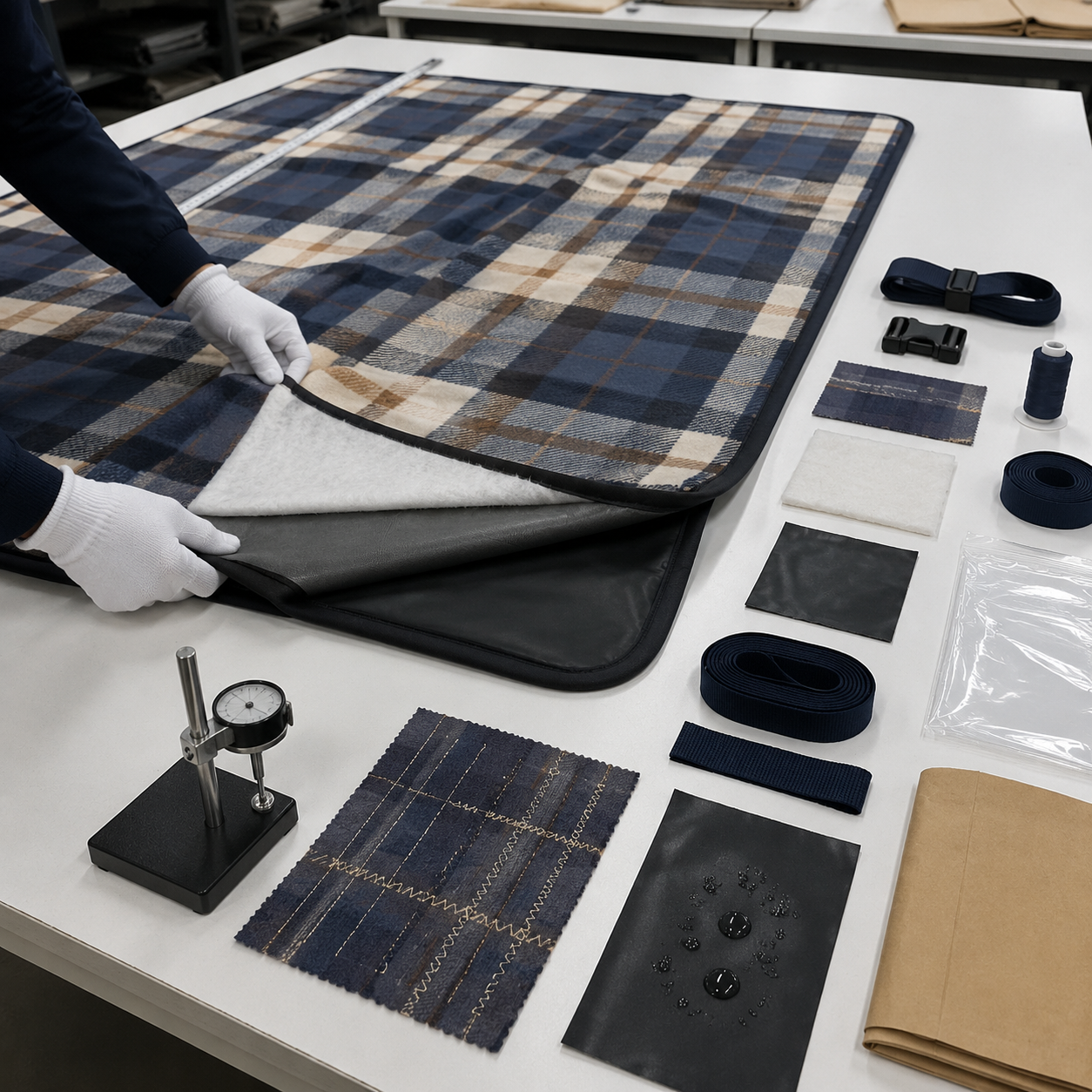
Illustrative RFQ assumption to verify in the supplier quote: An editorial pre-quotation sample specification uses an open finished size of 150 cm by 200 cm. Unit and scope: centimetres across the finished open width and length of one hypothetical picnic blanket SKU. Date and source context: this is an editorial assumption created for the current RFQ example, not measured production data, a legal requirement, or a FIELDLOOM product specification. The assumed construction uses a brushed polyester face, polyester nonwoven padding, matte polyethylene film backing, polyester binding, polypropylene carry webbing, and an acetal buckle. The supplier must verify actual dimensions, tolerances, folded size, unit mass, material codes, sources, and construction before sampling.
Give every physical sample an identity record linking it to the RFQ revision, BOM revision, material and colour codes, quoted manufacturing site, sample date, label artwork, packaging artwork, and related evidence. A change to material, colourant, finish, adhesive, accessory, source, subcontractor, site, or process should reopen every affected classification, chemical, test, label, claim, and destination decision.
Test and evidence requirements for RFQ release
Select a standard or laboratory method only when it is relevant to the classified construction, legal issue, intended use, or stated claim. Naming a voluntary standard does not make it a statutory requirement, and a purchaser-specific acceptance limit remains a contractual control unless a cited law establishes otherwise.
For every selected assessment, require the quotation to state:
- Characteristic and affected BOM component or finished SKU.
- Method title, edition or date, procedure option, specimen preparation, and conditioning.
- Tested material code, colourway, manufacturing site, and sample identity.
- Result unit, reporting limit or measurement resolution where relevant, and individual results rather than only pass.
- Acceptance limit and whether it comes from law, a voluntary benchmark, a product claim, or the buyer's contract specification.
- Laboratory identity and the relevant scope requested by the buyer.
- Failure disposition, retest rule, and evidence-refresh trigger after a change.
| Limit source | Correct RFQ treatment |
|---|---|
| Applicable law | Quote the sourced threshold and scope without relabelling a different internal limit as the law |
| Voluntary standard | Identify the method or benchmark and explain its relevance; do not imply statutory or certification status without a current supporting source |
| Buyer specification | Label the limit as contractual and obtain written supplier acceptance before sample production |
| Product claim | Link the method, conditions, measured result, claim wording, and limitations |
| Supplier proposal | Review it against the frozen BOM, contact map, claims, and destinations before acceptance |
Potential contractual subjects for this product family include dimensional change after the stated care process, colour fastness, seam integrity, laminate bond, backing integrity, water resistance, accessory attachment, corrosion where metal is present, and workmanship. This is a selection list, not a universal legal test package. The final RFQ must identify the chosen method and measurable acceptance criterion.
Evidence acceptance checks
| Evidence type | Minimum acceptance check | What it does not prove by itself |
|---|---|---|
| Laboratory report | Sample identity or photographs, component, material and colour codes, method and edition, result, unit, reporting limit where relevant, laboratory identity, requested scope, and report date | Untested colours, finishes, accessories, sources, sites, substitutions, or production lots |
| Supplier declaration | Issuing legal entity, covered SKU or component, relevant site, cited law or list version, issue date, supporting records, and authorised signatory | Independent testing or any subject outside the declaration's scope |
| Management-system certificate | Named entity and site, issuer, certified scope, validity, and current verification status | Certification of the picnic blanket or proof of product-level chemical conformity |
| Material or claim certificate | Scheme owner, issuer, entity, site, process and product scope, validity, chain-of-custody stage where relevant, and permitted claim wording | General product safety, REACH conformity, or unrelated environmental claims |
| Classification memorandum | Intended use, users, features, claims, destinations, applicable sources, and marking conclusion | Continued validity after an unreviewed design, claim, operator, or route change |
| Label or packaging artwork | BOM revision, destination, language, operator data, identifier, version, and approval owner | Accuracy after materials, claims, or operators change |
| Approved physical sample | Identity record linked to the BOM, artwork, reports, quotation, and purchase order | Production consistency without lot traceability and inspection |
A current certificate should be verified against its issuer, holder, site, scope, and validity. Do not imply certification of FIELDLOOM, a supplier, a facility, or a picnic blanket without the corresponding current document.
Practical Europe RFQ checklist for supplier returns
Use this checklist before issuing the order and repeat it at sample, production, and shipment release. Mark an item complete only when the response matches the frozen SKU, destination route, responsible legal entities, BOM revision, artwork, and evidence index.
- [ ] Confirm destinations and legal roles. Record each country, channel, planned placement timing, manufacturer, importer, distributor, other relevant operators, current source, review date, and unresolved exclusions. Reject Europe compliant as a substitute for route-specific analysis.
- [ ] Freeze the SKU and BOM. Record intended use, users, dimensions, tolerances, component and colour codes, sources, finishes, processes, accessories, packaging, claims, manufacturing site, and approved sample revision.
- [ ] Map compliance evidence. Link each legal, chemical, textile, label, packaging, and claim question to the affected component, destination, evidence file, issuing entity, issue date, source version, and acceptance decision.
- [ ] Approve the test plan. State the characteristic, method and edition, specimen, colourway, site, result unit, acceptance source, measurable limit, laboratory, price, lead time, and failure or retest rule.
- [ ] Verify document scope. Check each declaration, report, certificate, memorandum, and artwork file for issuer, entity, site, SKU or material coverage, BOM revision, issue date, stated validity, authenticity route, and exclusions.
- [ ] Separate commercial costs. Itemise samples, testing, artwork variants, inspection, retesting, document work, and route-specific review, with lead times and responsible parties rather than hiding them in an unqualified unit price.
- [ ] Obtain advance change control. Require written notice and buyer reapproval before changes to materials, colours, sources, sites, subcontractors, processes, treatments, claims, labels, packaging, or test coverage.
- [ ] Control production and shipment release. Link the approved sample, inspection criteria, defect rules, lot codes, traceability records, nonconformity disposition, and shipment evidence to the purchase order and approved BOM.
Beside every checkbox, record the supplier response, evidence filename, owner, due date, buyer reviewer, status, and any residual action. Keep RFQ release, sample approval, production-order release, and shipment release as separate decisions. An open legal or evidence gap requires a named owner and disposition; document volume alone is not an acceptance criterion.
Methodology, source context, and limitations
Methodology: Each sourced legal datum was handled by identifying its destination and product scope, preserving the stated unit or date, mapping it to the relevant picnic blanket component or operator question, and converting that question into an RFQ evidence or release gate. Buyer-set controls are labelled as contractual controls. No EU threshold was automatically extended to the non-EU EEA, Great Britain, Northern Ireland, or a specific country.
EU legal-source context: The EU General Product Safety Regulation and EU textile regulation support the stated EU application date and textile-fibre threshold. The buyer should check the consolidated texts in force on the recorded legal and artwork-approval dates against the final product classification.
ECHA source context: ECHA's restricted-substances information and Candidate List obligations page support the cited REACH concentration questions. The order file should record the restriction text or Candidate List version, access date, affected article or material, contact scenario where relevant, and evidence scope.
UK source context: The retained UK product-safety guidance is a starting point for official route research. It is not used here to assert that one document set covers both Great Britain and Northern Ireland.
Secondary commercial-source context: The supplied beach-mat selection page and eco-friendly textiles page are retained only as secondary commercial context. No legal threshold, certification, supplier capability, product conformity, environmental claim, or manufacturing outcome is derived from either page.
Limitations and verification: This package is an RFQ and release-control framework, not a legal opinion or conformity determination. Before ordering, verify the law in force on the intended placement date, final classification, operator chain, non-EU EEA incorporation status, current Great Britain and Northern Ireland arrangements, Candidate List version, destination-language requirements, country-specific packaging obligations, claim wording, laboratory scope, document authenticity, and coverage of every material and colourway.
Author basis: The supplied FIELDLOOM author profile identifies Vincent Xi as an Editorial Author. It is the sole source used for author attribution; no first-hand factory visit, audit, product test, certification, client engagement, or manufacturing outcome is claimed.
Discuss Your Requirements
Review our manufacturing capabilities, then share your specifications for a supplier-fit review.