Fleece Throw OEM Product Development Capability for European Manufacturing Buyers
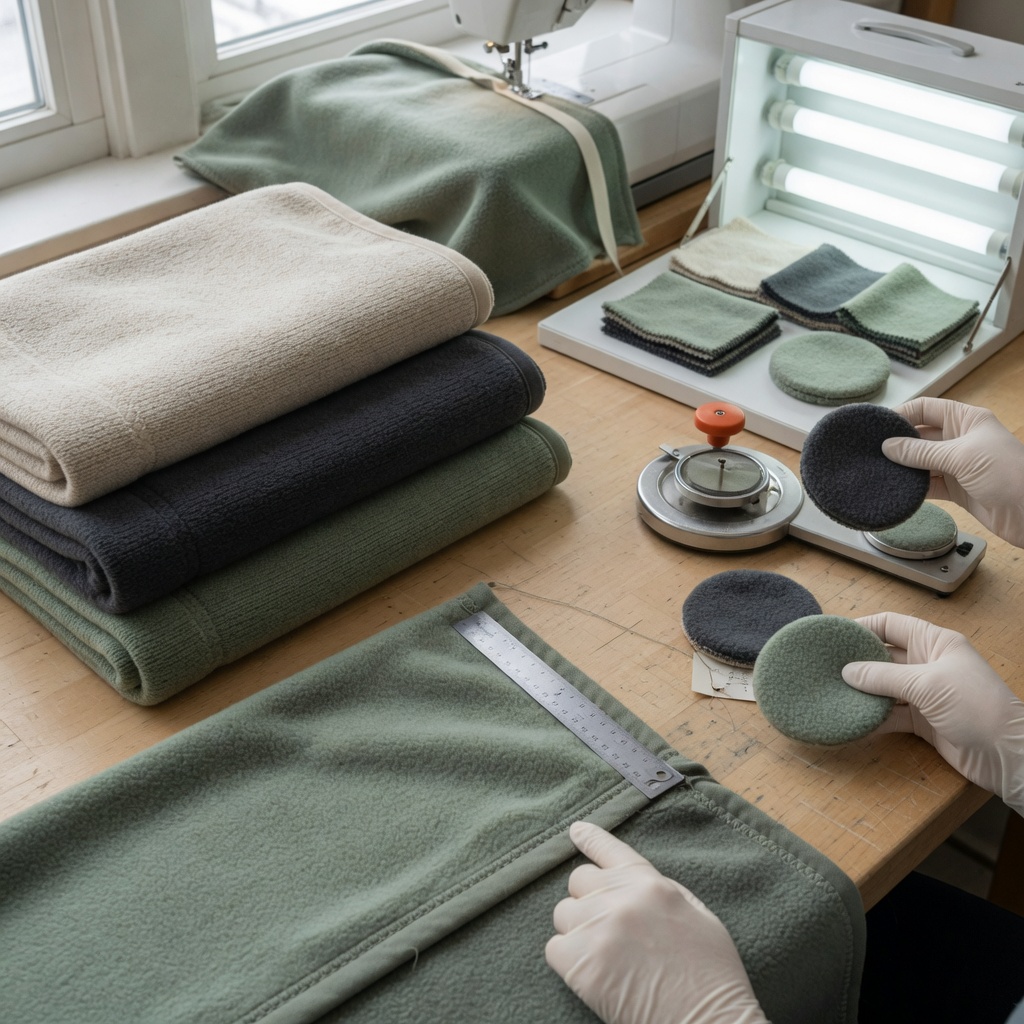
Approve a mill for a fleece-throw program in Europe only when fleece throw OEM product development capability is written as a gated manufacturing path on a dated quotation—not as a brochure line. Freeze a specification pack a technician can sew against; approve a pre-production sample (PPS) from bulk fabric, bulk colour, bulk decoration, and bulk packing; then release bulk against a written inspection plan and a market-entry file for named EU member states, EEA destinations, Great Britain, or Northern Ireland.
Do not treat the EU, the EEA, and the United Kingdom as one customs and labelling zone. A photo plus a Pantone is sampling luck, not a manufacturing system.
Ask the OEM team to put the inquiry-to-bulk sequence in writing: technical review, lab dips or strike-offs, size and shrinkage control, logo placement, packing, and the lot inspection plan. Public OEM pages from custom-blanket factories describe similar gates—specification intake, quotation, sampling, confirmation, mass production, inspection, and shipment. Commercial numbers on those pages (MOQ, calendar days, GSM bands) are supplier-stated terms, not independent industry benchmarks. Reconfirm every figure on a dated quotation for Europe Incoterms, labelling language, and responsible-person setup.
This brief is written by Vincent Xi, Editorial Author at Fieldloom (author profile). It is a desk-based procurement note for European manufacturing RFQs. It does not claim a factory visit, a laboratory test, a named customer program, or a first-person production result.
How this brief was derived (methodology)
Workflow and commercial figures about third-party OEM programs come from three supplier pages supplied for this editorial: Renrui’s custom blanket OEM page, Galink Ltd’s custom blankets page, and FanMan’s OEM blanket manufacturing-process page (hosted at famantextiles.com). Numeric claims—MOQ in pieces per design, sample and bulk days, GSM in g/m², stated floor area, stated line count—are attributed to those pages as published marketing statements on undated commercial URLs. Named legal instruments (EU textile fibre labelling, REACH, UK REACH, GPSR, and Great Britain textile-labelling rules) are identified so buyers can check official texts; they are not certificates of this publisher, and this note is not legal advice. No Fieldloom production capacity, price, certificate number, or lead time is asserted.
Limitations (what to verify on the quotation date)
Supplier websites are sales documents. Stated sample windows of a few days and bulk windows of a few weeks can exclude yarn dyeing, peak season, fabric knitting, reserved capacity, third-party laboratory booking, or holiday calendars. Certificates expire and are scope-limited by product, fibre, and site. A GRS or OEKO-TEX mention on a website is not the shipment’s transaction certificate or scope certificate. Duties, fibre-name rules, responsible-person duties, and packaging-registration rules differ across the EU, the EEA, and the UK; do not copy an “EU carton” onto a Great Britain-only or Norway-bound lot without a compliance review. A Suzhou or other mill-origin facility description is a manufacturing-origin statement, not a European sales-market claim and not reserved capacity for a given week. Reconfirm every number, test method, and document list against the actual SKU and destination before approving bulk.
Product development capability: the specification pack Europe buyers should freeze first
Product development capability starts before the first sample cut. If sales can only restyle a photo, the mill is not ready for a European manufacturing RFQ. Freeze a specification pack a technician can manufacture against, not a mood board.
Minimum lock-list for a fleece throw:
- End use and sales channel (retail gift, promotional, hospitality, or private label), which change pilling, colourfastness, and packing tightness.
- Destination market(s): named EU member state(s), EEA market(s), Great Britain, Northern Ireland, or a mixed list—not “Europe” as one customs zone.
- Face construction: polar fleece, coral/microfleece, or sherpa/berber pile; reverse same cloth, bonded sherpa, or a different GSM.
- Fibre composition in percentages that can appear on a textile label (for example polyester, or a recycled-polyester share if a claim will be made).
- Mass per unit area (GSM) with a tolerance and a named test method, not a verbal “medium weight.”
- Finished size after the agreed wash/relax method, plus hem or binding construction and corner treatment.
- Colour standard, named illuminant, and match rules across face, binding, and decoration.
- Decoration method with a placement drawing in millimetres from finished edges.
- Packing: polybag, insert, barcode, inner pack, carton burst/ECT, and consumer-pack languages.
- Claims that must be substantiated (recycled content, OEKO-TEX, GRS, pilling grade); remove any claim that will not be evidenced.
- Process map: which site knits, dyes, prints, sews, and packs; any subcontract; PPS on the same path as bulk.
Until those items are written, an OEM “sample in a few days” is a prototype of an undefined product. The first measurable trade-off is speed of first sample versus later revision cost.
From spec pack to bulk: a manufacturing workflow you can audit
A usable OEM workflow is a sequence of gated approvals, not a single development fee. Three public pages expose control points a European buyer should audit—not because their day counts belong in a purchase order.
FanMan’s process page describes inquiry on throw size, GSM, and fabric (examples including coral fleece or sherpa), then quotation, sampling, confirmation, mass production of about 30 days, inspection, packaging, and shipment. It breaks sampling into stated sub-steps of 2 days initial, 3 days dyeing, and 7 days printing (FanMan OEM process page). Treat those day counts as that company’s published process sketch on an undated commercial page.
Renrui’s custom-blanket OEM page describes manufacturing custom fleece blankets from buyer specs including fabric, GSM, size, colour, logo, and packaging, with technical review, sample development in 7–10 days, and bulk production in 30–40 days, plus a stated MOQ of 100 pieces per design (Renrui custom blanket OEM page).
Galink Ltd’s custom-blankets page describes factory-direct OEM/ODM throw blankets in fleece and sherpa at 200–320 GSM, a stated 3,200 m² Suzhou facility with 12 lines, MOQ of 50 pcs per design, samples in 3–5 days, and bulk in 18–25 days, and lists GRS, Sedex SMETA, ISO 9001, and OEKO-TEX among certifications named for B2B buyers (Galink custom blankets page).
Audit these gates on the quotation:
- Technical review. Does a technician convert the PDF into a construction sheet (cut size, stitch type, SPI, binding width, needle, thread), or does sales only copy the photo?
- Colour and surface development. Lab dips, dye route, and pile direction. Printing in 7 days (as FanMan states for that step on that undated page) is not a wash-tested print on a 300 g/m² sherpa face (300 g/m² is an example construction to verify in the mill quote, not a published rule).
- Size and yield. Finished throw size after sewing and any wash. Marker efficiency can move unit cost more than a 5% GSM change (example assumption to verify on the quote) on a small throw.
- PPS gate. Bulk fabric lot, bulk colour, bulk decoration, bulk label, bulk bag. A leftover-fabric sales sample is not a PPS. If dyeing or decoration is subcontracted, the PPS must run on that path.
- Bulk and inspection. Written AQL, defect definitions, and in-line versus final random inspection.
- Pack and ship file. Carton marks, fibre label, importer/responsible-person details, and any country-specific packing marks.
The manufacturing trade-off is documentation versus calendar speed. Put working days versus calendar days, fabric-in-house date, and exclusions (yarn, holidays, third-party tests) on the RFQ. Those published day counts are other companies’ website statements, not Fieldloom lead times.
GSM, size, fabric type, and logo options: measurable trade-offs
GSM, size, pile type, and decoration are the four variables that most often break a fleece-throw OEM program after the first sample looks close enough in a meeting room.
GSM (g/m²). Galink’s page states a 200–320 GSM band for fleece and sherpa throws at that factory (Galink custom blankets page). That is a supplier-stated range on an undated commercial page, not a regulatory limit and not a recommendation for every Europe retail line. Write GSM as a target plus tolerance (for example 280 g/m² ±5% as an example specification to verify in the mill quote and on a tested PPS). Name the test on the RFQ: mass per unit area on conditioned specimens, including method, atmosphere, and specimen size. For knitted cloth, buyers often name a small-specimen method such as EN 12127; ISO 3801 is a woven-fabric method. A verbal “280 GSM” with no method is not auditable.
Example mass calculation (assumption to verify with marker yield). A finished face of 150 cm × 200 cm is 3.00 m². At 280 g/m², face-fabric mass is 3.00 × 280 = 840 g per throw before binding, seam allowance, cutting waste, and residual shrinkage. If cutting waste is 8% (example assumption, not a quote), fabric issued rises to about 907 g. Confirm actual yield on the mill’s marker for the size set; do not use this paragraph as a price model.
Size. Specify finished measurements on the RFQ, not only cut measurements. Binding can consume 2–4 cm per side depending on construction (example range to verify on the sewing spec). If the retail ticket says 130 × 170 cm, the RFQ must say whether that is after a 40 °C wash, after steaming, or as packed (40 °C is an example wash setting to agree, not a legal default). Freeze the relax/wash method before PPS approval.
Fabric types. Coral/microfleece, polar fleece, and sherpa are not interchangeable SKUs. Gate pile type with a decoration sew-out or strike-off on the actual bulk cloth and GSM, then check edge curl, shedding, print-edge hide, and stitch-through on the PPS. FanMan’s process page treats throw size, GSM, and fabric (coral fleece or sherpa among the examples) as inquiry inputs (FanMan OEM process page). Ask for fibre content that can be labelled under Regulation (EU) No 1007/2011 using regulated fibre names, not marketing names that cannot go on the sewn-in label.
Logo and decoration. Renrui lists logo among the OEM spec fields (Renrui custom blanket OEM page). Compare methods on the PPS: embroidery sew-out on the actual GSM and pile; screen or digital print with ISO 105 wash and rubbing tests as RFQ methods (not as a factory certificate); woven or printed labels with millimetre placement; heat transfer with wash evidence on the actual pile height, especially on sherpa. Ask whether decoration MOQ is per colourway. A 50-piece MOQ per design (Galink’s stated figure on that undated page) or 100 pieces per design (Renrui’s stated figure on that undated page) can still mean 50 or 100 per Pantone. Write per design / per colour / per size as three separate MOQ lines.
Europe manufacturing files: EU, EEA, and UK are not one rule
Keep the product decision primary: the purchase is still a fleece throw. Compliance is the file that lets that throw be placed on a named market. Do not paste one generic compliance card on every destination.
- Textile fibre names and labelling. Regulation (EU) No 1007/2011 sets fibre-composition labelling for textile products placed on the EU market, in the official language(s) required by the destination member state. Confirm EEA application against the current EEA status of that regulation for the destination country; do not assume every EEA market copies an EU-27 pack. Great Britain uses a separately administered textile-labelling regime (UK Textile Products (Labelling and Fibre Composition) Regulations 2012 and current official guidance); dual-market tickets need a line-by-line check, not a resized EU ticket. Name Northern Ireland only if it is on the PO; NI is not automatically the same file as Great Britain.
- Chemicals. REACH (Regulation (EC) No 1907/2006) applies to articles placed on the EU market, including the Article 33 communication duty when an SVHC is present above 0.1% w/w in an article. Confirm the current candidate list and whether the mill’s report covers bulk fabric, bulk decoration, and findings—not only a development swatch. The United Kingdom operates UK REACH for Great Britain. Ask for substance scope, test-report date, lab name, and lot linkage.
- General product safety. Consumer throws sold through European retail are products. Regulation (EU) 2023/988 (GPSR) is the EU general product-safety framework for economic-operator duties, including a responsible person in the Union where required. GPSR is not a fleece standard and not a hangtag logo. It does not automatically apply in Great Britain in the same way; confirm current UK product-safety duties with counsel for the SKU. EEA states need a destination-specific check rather than an “EU GPSR pack” assumption.
- Voluntary standards vs mill practice. OEKO-TEX Standard 100 and GRS appear on Renrui’s and Galink’s commercial pages as certifications those companies state (Renrui, Galink). Those are voluntary schemes, not EU law. A Standard 100 certificate is product- and class-scoped; GRS recycled-content claims need chain-of-custody documents for the lot. ISO 9001 (named on Galink’s page) is a quality-management system certificate, not a GSM test. Sedex SMETA (also named on Galink’s page) is an audit format, not a product-safety approval. Never treat a website list as the certificate in the file.
- Country-specific packing duties (only when the PO ships there). France can require sorting-info / TRIMAN-type consumer marks on household textile packaging; Germany can require packaging-scheme registration (VerpackG / LUCID) for packaged goods placed on the German market. These are not EU-wide carton rules. A Netherlands-only first PO should not carry France artwork, and a Netherlands carton should not be reused later for France or Germany without a new check.
One SKU for EU-27 plus GB usually means two label versions, two responsible-person blocks, and two chemical files. That dual-market choice is a product-development decision, not a shipping afterthought.
Sampling, MOQ, and lead-time decision points
Use the published commercial figures only as comparison anchors. As-of context: they come from undated supplier pages and must be reconfirmed on the quotation date.
| Published commercial statement (not a Fieldloom term) | Unit and scope | Source context |
|---|---|---|
| Sample development 7–10 days; bulk 30–40 days; MOQ 100 pieces per design | Days and pieces as stated for that OEM’s custom fleece-blanket program on an undated commercial page | Renrui custom blanket OEM page |
| Samples 3–5 days; bulk 18–25 days; MOQ 50 pcs per design; 200–320 GSM; 3,200 m² facility; 12 lines | Days, pieces, g/m², m², line count as stated for that factory-direct throw program on an undated commercial page | Galink custom blankets page |
| Initial sample 2 days; dyeing 3 days; printing 7 days; mass production about 30 days | Days as stated in that OEM process sketch on an undated commercial page | FanMan OEM process page |
Decision rules for the RFQ:
- Pay for the sample type to be approved: proto (available fabric) versus colour-approved PPS; do not mix leftover-fabric protos with the PPS gate.
- Separate colour development from cut-and-sew. FanMan’s split of dyeing versus printing days is a reminder to schedule those as different gates (FanMan OEM process page).
- State MOQ per colourway. 50 versus 100 pieces per design (Galink versus Renrui stated figures on those undated pages) is meaningless if “design” hides four Pantones.
- A stated 12-line, 3,200 m² workshop (Galink) is a facility description, not reserved capacity for a given week. An 18–25 day bulk window that excludes third-party laboratory sampling is not the door-to-DC date a European retailer will accept.
- After PPS sign-off, fabric lot, GSM, colour, decoration, label, and bag cannot change without written re-approval. Require the bulk fabric lot number to match the PPS lot, or a written shade-band and GSM re-test if a new lot is unavoidable.
If the true constraint is a launch week in an EU DC, work backward from carton-in-DC date, not from “sample in five days.” Product development capability is the mill’s willingness to put that backward plan in the quotation.
QC, AQL, and the evidence pack that lets you approve bulk
AQL is a sampling plan, not a slogan. If ISO 2859-1 is cited, specify inspection level (often General Level II as a buyer-chosen example to confirm in the QC protocol), lot size, and critical/major/minor definitions for this SKU. Typical defects to pre-define include GSM or size out of tolerance, shade bar, oil, holes, needle cuts, pile crush, skewed binding, logo off the drawing, wrong fibre label, and mixed polybags. The standard gives the tables; the mill’s practice is the defect list and the light source used for shade.
Renrui and FanMan both place inspection before shipment in their public OEM narratives (Renrui, FanMan). That is necessary but not sufficient. Require GSM tests on bulk fabric and finished throws (method, conditioning, n); finished size after the agreed relax/wash method; colour against the approved dip under a named illuminant; decoration durability; a label audit against destination fibre-name and language rules; carton drop/stack only if the retailer mandates it; needle/metal detection only if the retailer protocol requires it, with a written pass criterion; and certificate copies matching mill name, site, product, and validity dates if those claims were requested.
Do not order “AQL QC” as a checkbox. Order a protocol a third-party inspector can execute in one shift, and keep a sealed PPS as the golden sample for the bulk lot.
RFQ checklist for a fleece throw OEM program
Use this as the email and attachment list. Each item is something the buyer specifies, compares, verifies, approves, or orders.
- Name the SKU, season, and destination markets (do not write only “Europe”).
- Attach a construction sheet: face/back fabric, GSM target and tolerance, finished size, hem/binding, SPI, thread.
- State fibre composition for Regulation (EU) No 1007/2011-style labelling; ban unlabelled marketing fibre names; name the label language(s) for each destination.
- State whether any recycled-content or restricted-substance claim will appear on pack; if yes, demand the exact scheme and lot documents; if no, forbid the logo.
- Attach colour standard and require lab-dip approval before bulk dye; name the illuminant (for example D65 as a buyer-chosen example to confirm on the quote).
- Attach logo artwork in vector plus a millimetre placement drawing from finished edges; state decoration method and the ISO 105 tests that will gate approval.
- Define sample grades: proto, size sample, and PPS on bulk materials and the bulk process path; require a sealed golden PPS against bulk.
- Quote sample days and bulk days as working days, with fabric-in-house date and exclusions; split MOQ into per design, per colour, and per size.
- Ask for the inspection plan: standard (for example ISO 2859-1), level, AQL numbers, defect definitions, GSM/size methods, and piece counts at PPS and final inspection.
- List pack components and languages; add France/Germany-only marks only if those markets are on the PO.
- For EU placement, name the economic operator / responsible person fields; for GB, ask for the parallel UK file; name NI separately if it is in scope. Request current certificate PDFs only for claims that will be printed.
- Freeze artwork and spec by written PPS approval; do not cut bulk fabric before that signature; do not change fabric, GSM, colour, decoration, label, or bag afterward without written re-approval. Website MOQ/day/GSM figures are not contractual unless they appear on the quotation. Name knit/dye/print/sew/pack sites and subcontractors; require the same path for PPS and bulk; file the signed spec pack, PPS photos, test reports, and label drawings with the PO.
If an OEM team cannot complete this checklist without replacing numbers with “standard” or “Europe certified,” they do not yet have product development capability for a European fleece throw manufacturing program. Keep the PO tied to the signed PPS and the destination file, not to a generic factory capability paragraph.
Discuss Your Requirements
Review our manufacturing capabilities, then share your specifications for a supplier-fit review.