Camping Mat Wholesale Supplier Product Development Capability for Europe
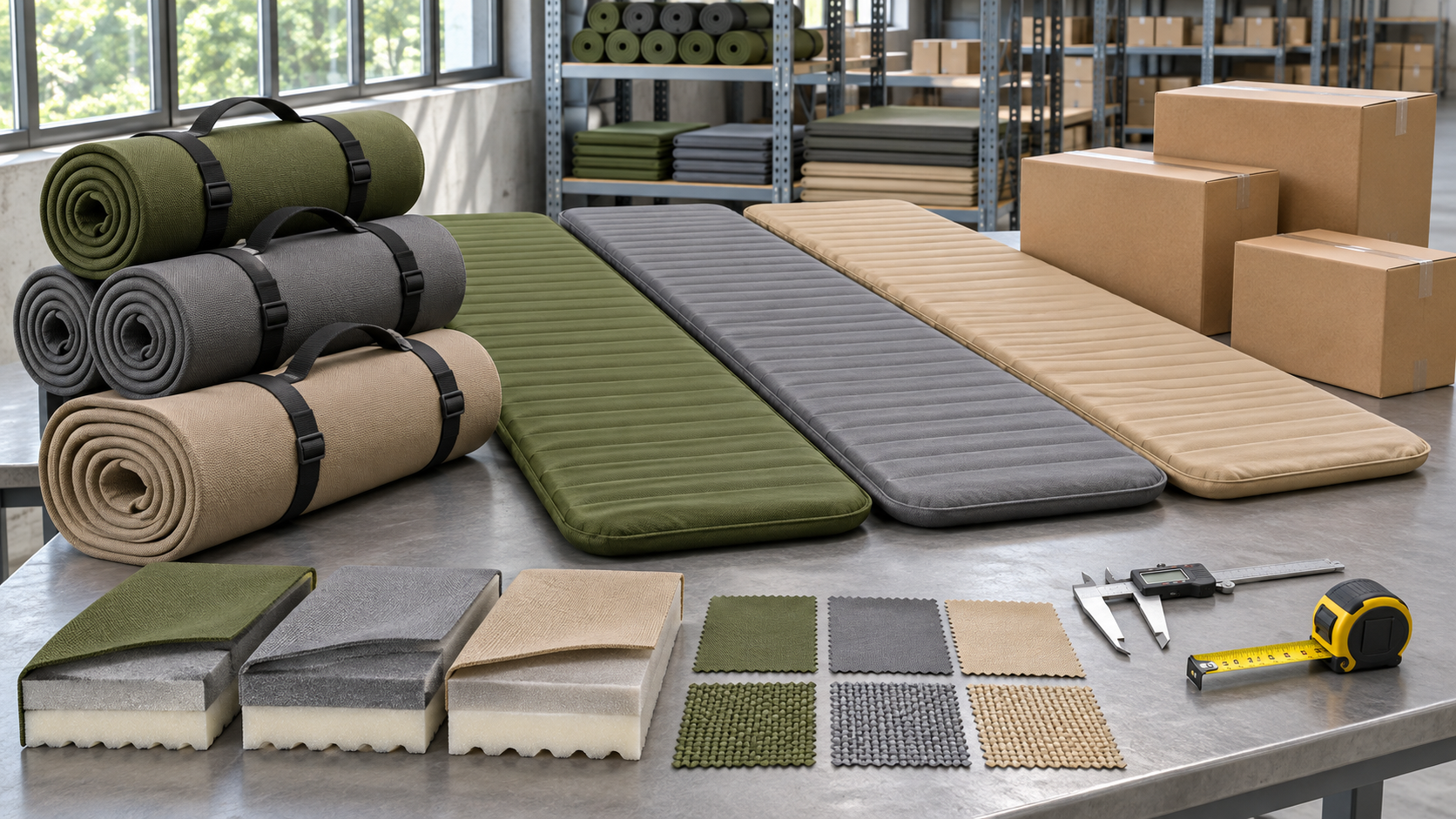
For Europe buyers, camping mat wholesale supplier product development capability is not a general claim to accept at face value. It is a set of decisions to test before a wholesale order: how a brief is interpreted, how materials and construction are proposed, how samples are revised, and how the final specification is locked so that production matches the approved sample. This page focuses only on that development task for camping mat wholesale supply in Europe. It does not replace supplier documentation, destination-country checks, or a signed specification. Use it to structure questions, compare proposals on the same basis, and record what the buyer and supplier must agree before ordering.
A useful evaluation separates ideas from agreed facts. A supplier may suggest a material, closure, surface finish, or packing format, but none of those should be treated as approved until the buyer has reviewed a sample, confirmed the specification in writing, and agreed how changes will be handled. Buyers sourcing for different European destinations should also confirm requirements country by country, and for the specific sales channel and end use, rather than assuming one set of documents or labelling applies everywhere in Europe. Request the relevant documentation from the supplier and verify it against the destination and product configuration being ordered.
Evaluating product development capability for Europe wholesale programs
Start with the brief. A clear buyer brief reduces sampling rounds and prevents a supplier from developing a mat for a different use case. State the intended use, such as camping, outdoor retail, rental, event, or promotional distribution, the user group, the environment where the mat will be used, and whether the priority is packed size, weight carried by the user, cushioning feel, surface grip, insulation from the ground as experienced by the user, ease of cleaning, or durability in repeated handling. These are buyer-defined priorities, not performance claims, and each priority should be translated into a check the buyer can carry out on a sample.
Then ask how the supplier handles development decisions. Ask the supplier to explain, in writing, who reviews the brief, how material options are selected, what information is needed before sampling, and how revisions are recorded. Ask the supplier to identify which elements are standard options and which would be custom development, because the approval route, sampling scope, and risk differ between the two. Ask the supplier to state any limitation in the proposal, such as a construction that cannot be combined with a requested finish, rather than leaving the buyer to discover it after sampling.
Compare suppliers using the same brief, the same sample checks, and the same questions. A lower-priced or faster proposal is not comparable if it is based on a different material, thickness description, edge finish, valve or closure type, or packing method. Keep a comparison record that lists the proposed specification beside the approved specification, so gaps are visible before a purchase order is placed.
From brief to sample: development process checks
Use a staged process so that approval at each stage protects the next stage.
- Ask the supplier to confirm receipt of the brief and to restate the target product, intended use, and open questions before sampling begins.
- Require a written proposal that lists material type, construction, dimensions as requested by the buyer, thickness description, surface and underside finish, edge treatment, closure or valve type where relevant, colour options, and packing format, with each item marked as standard, modified, or custom.
- Ask the supplier to provide a pre-sample checklist of points that cannot be confirmed until a physical sample is reviewed, so expectations are not set by drawings or photos alone.
- Require the sample to be identified by a reference code that links it to the proposal version, date, and revision notes, so later samples are not confused with earlier ones.
- Ask the buyer review team to record sample findings against the brief, including appearance, feel, handling, folding or rolling, packing, and any visible defects, using the same form for every supplier.
- Require every requested change to be listed as a revision with a reason, an owner, and a decision on whether a new sample is needed before approval.
- Ask the supplier to confirm the final approved specification in a single controlled document before production is discussed, and to flag any later change as a new revision requiring buyer approval.
This process does not prove performance. It creates traceability between the brief, the sample the buyer actually handled, and the specification that will govern the wholesale order.
Materials, construction and specification decisions
Material choice should be driven by the use case and by what the buyer can verify on a sample. Ask the supplier to describe the material family proposed for the top surface, core, and underside, and to explain why that combination suits the brief. Ask the supplier to state how seams, bonding, lamination, stitching, or welded edges are formed for the proposed design, and what visible or handling checks the buyer should use at sample and delivery inspection. Avoid accepting descriptive terms alone. Convert terms such as soft, firm, lightweight, or waterproof in ordinary language into agreed specification fields and buyer checks, and ask the supplier to provide supporting documentation where a specific property is required for the destination market.
Construction decisions also affect packing and retail presentation. Specify whether the mat is supplied rolled, folded, or flat, how it is secured, whether a carry strap, bag, sleeve, or band is included, and how many units are packed per carton as agreed for the order. Specify colour by an agreed reference sample or code supplied by the buyer, not by a screen image alone. Specify logo or artwork placement only if branding is part of the brief, including size, position, application method, and the artwork file version to be used, and require a pre-production visual or sample for approval where branding is applied.
Dimensions and tolerances must be agreed as fields, not assumed. Ask the supplier to state the measurement method, the points between which dimensions are taken, and the tolerance the buyer will accept, and record those values in the final specification for the specific order. Do not copy values from another product or another supplier without re-approval.
Buyer decision table for development approval
Use the table below to decide whether development is ready to move to a wholesale order. Each row is a buyer-defined process check, not a claim about a supplier or product.
| Decision Area | Buyer Question to Resolve | Evidence to Request Before Approval | Go / No-Go Check |
|---|---|---|---|
| Intended use case | Ask whether the brief states the user, environment, and priority features clearly enough for sampling | Require the signed brief and the supplier restatement of the brief | Proceed only when both documents describe the same use case |
| Material selection | Ask which material family is proposed for each layer and why it fits the brief | Require a written material proposal and supplier documentation for any required property | Proceed only when every layer is named in the specification |
| Construction method | Ask how seams, edges, and surface finishes are formed and inspected | Require construction notes linked to the sample reference code | Proceed only when the sample matches the construction notes |
| Dimensions and tolerance | Specify the measurement method, measurement points, and accepted tolerance for this order | Require the agreed values recorded in the controlled specification | Proceed only when buyer and supplier sign the same values |
| Sample revision control | Ask how changes between samples are tracked and who approves them | Require a revision log with version, date, and decision for each change | Proceed only when no open revision remains unapproved |
| Packing and presentation | Specify rolled, folded, or flat format, included accessories, and carton packing as agreed | Require a packing description and a packed sample for buyer review | Proceed only when the packed sample matches the description |
| Branding application | Ask whether artwork, position, size, and application method are fully defined | Require the artwork file version and an approval sample or visual where branding applies | Proceed only when branding is approved or confirmed as not required |
| Destination documentation | Ask which documents the supplier can provide for the specific European destination and configuration | Require the documents for review before ordering, checked country by country | Proceed only when the buyer has reviewed the documents for that destination |
If any row remains open, keep development open. Do not convert an unresolved row into an assumption in the purchase order.
Sampling, revision and approval discipline
Sampling works only when feedback is specific. Ask reviewers to separate must-change points from preferences, and to link each comment to a brief requirement or a sample observation. Vague feedback leads to samples that change in unexpected ways. Require the supplier to respond to each feedback point individually, confirming whether it has been actioned, cannot be actioned, or needs a buyer decision, rather than returning a new sample without explanation.
Set an approval rule in advance. Specify who in the buying organisation can approve the final sample, what form that approval takes, and how long the approved sample and specification will be retained for comparison with production and deliveries. Ask the supplier to retain a matching reference sample where that is part of the agreement, and to state how production units will be compared against it at inspection. Agree what happens if a production unit differs from the approved sample, including how differences are reported, sorted, reworked, replaced, or rejected under the order terms.
Also agree change control after approval. Require any change to material, construction, dimensions, colour, branding, or packing after sample approval to be raised as a formal revision, with the reason, effect on the specification, and buyer approval recorded before it is applied. This protects both sides from silent substitution and from disputes about which version was ordered.
RFQ Checklist
Include the following fields in every request for quotation for camping mat wholesale supply so proposals can be compared on the same development basis.
- Ask the supplier to restate the buyer brief, intended use case, and any open questions in the quotation response.
- Specify the material family required for the top surface, core, and underside, or ask the supplier to propose options for buyer selection.
- Specify the dimensions, measurement method, measurement points, and tolerance to be quoted and sampled against.
- Require the supplier to describe the construction method, edge treatment, and closure or valve type included in the proposal.
- Ask the supplier to state which proposal elements are standard options and which are custom development.
- Specify the sample reference system, revision log format, and approval steps required before production.
- Require the supplier to list all documents that can be provided for the specific European destination and product configuration.
- Specify the packing format, included accessories, units per carton as agreed for quoting, and carton marking fields to be completed.
- Ask the supplier to confirm how post-approval changes to material, construction, colour, branding, or packing will be notified and approved.
- Require the supplier to state inspection, acceptance, and non-conformance handling terms for agreement in the order.
Final approval before a wholesale order
Before placing a wholesale order, run a final check against the approved sample and the controlled specification. Confirm that the quotation, the sample reference, the revision log, and the order documents describe the same product. Confirm that destination-specific documentation has been requested and reviewed for the countries where the mats will be sold, without assuming that review for one European country covers another. Confirm that packing, branding, and inspection arrangements are written into the order terms, not left in email exchanges or sample comments.
If the buyer cannot confirm those points, the development stage is not finished, regardless of how promising an early sample looked. Completing this discipline is the practical meaning of product development capability in this context: a shared, traceable route from brief to approved specification that a buyer in Europe can audit before committing to volume.
Discuss Your Requirements
Review our manufacturing capabilities, then share your specifications for a supplier-fit review.