Camping Mat Sourcing: Production Scalability Planning for Europe
By Vincent Xi, Editorial Author, Fieldloom.
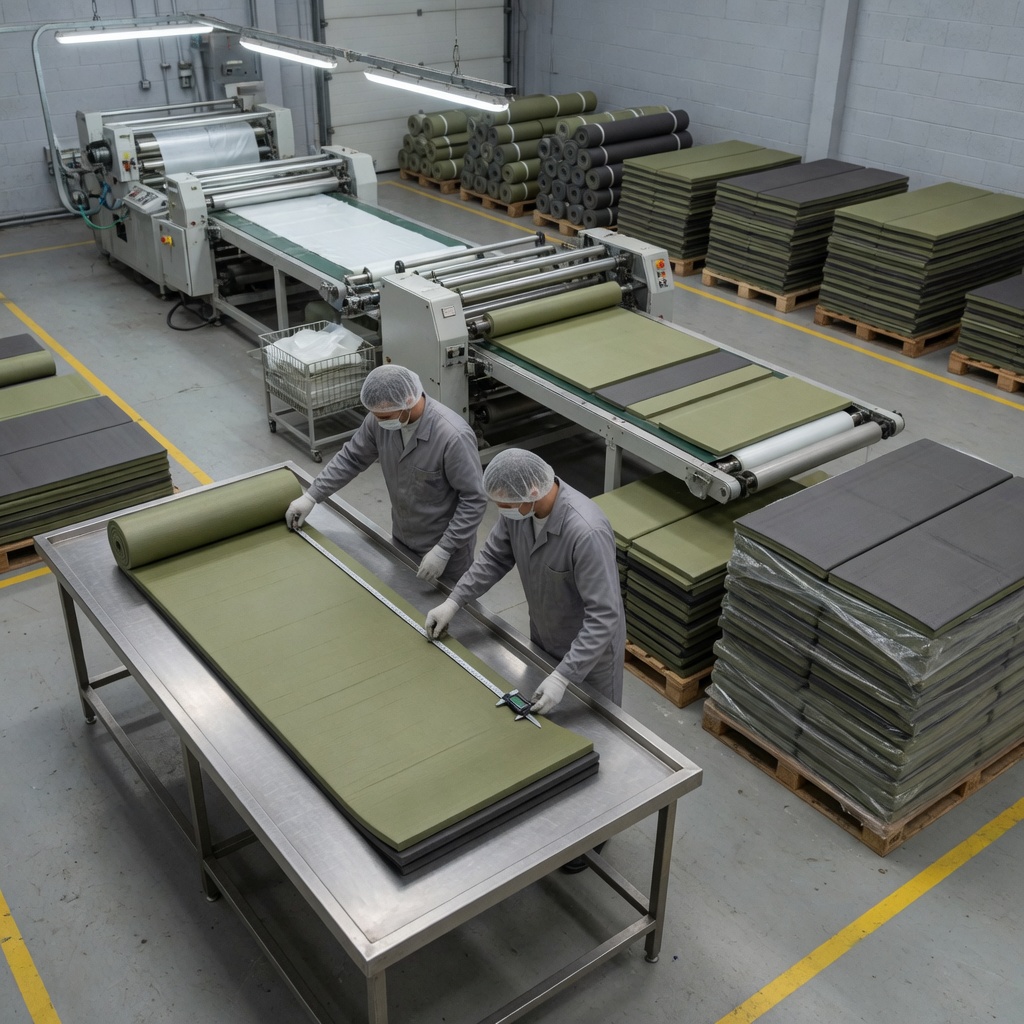
Award a camping mat programme for Europe only when production scalability planning is a written match between your labelled-SKU calendar and residual factory hours. Plant area, a campus equipment count, or a brochure batch size is a screen, not that match. For camping mat procurement, lock usable production area (unit: m²), machines that touch your bill of materials, demonstrated finished-unit batch size (unit: pieces), polyethylene (PE) resin timing, and destination-market file packs against the purchase-order calendar before you approve a peak ship window in the 50,000-plus unit class used as a directory batch screen below.
Directory heuristics associate 10,000-plus m² plants with 50,000-plus unit camping-mat batches, and they cite typical custom MOQs of 500–5,000 units with 15–25 day production runs (units: m², pieces, calendar days; scope: camping-mat manufacturer heuristics in that guide; as-of: publication date not confirmed in the excerpt used for this brief). Treat those figures as audit questions, not as a contract specification (Accio camping mats manufacturer guide). One manufacturer page discloses a 38,000 m² factory, 230-plus equipment sets, more than 16 million m² of camping mats per year, and 200-plus international buyers (units: m², equipment sets, m²/year, buyer count; scope: one mill's self-reported plant-level figures, not a SKU-level audit; as-of: publication date not confirmed in the excerpt used for this brief). Use that as a self-reported scale anchor only, not as a sales-market list (Aiyisi camping mats factory page). This brief's sales market is Europe. Require placing-on-the-market files for the EU, the EEA, and the UK as distinct paths; one technical file, label set, or chemical declaration does not cover all three.
Buyer RFQ award rule for Europe. Approve the seasonal PO only if all four are true in the quote pack: (1) residual hours and usable production m² cover your cargo-ready date after existing bookings; (2) MOQ and price breaks are per labelled EU, EEA, and UK SKU, not only per foam core; (3) capacity is converted into finished units of your size and into packed pallets for a named European warehouse slot; (4) artwork and inspection lots are gated on destination-specific files. If any item is missing, keep the mill in comparison and do not award the peak run.
What production scalability planning should lock before award
In this camping mat procurement use, production scalability planning is the written match between your unit mix and delivery calendar and the supplier's proven output—not its stated maximum. Specify SKU dimensions, foam type, density (unit: kg/m³), thickness tolerance (unit: mm), cover fabric, and packed cubic metres first. Then ask the factory to map those SKUs onto lines, shifts, and raw-material lead times.
Foam-area throughput is the usual false friend. Square metres of foam are not finished camping-mat pieces. The Aiyisi page's plant-level 16 million m² per year from a 38,000 m² site (units: m²/year and m²; scope: self-reported plant-level figures, not a SKU-level audit; as-of: date not confirmed in the excerpt; Aiyisi camping mats factory page) must be converted. Example calculation to verify in the supplier quote, not a measured factory result: a 180 cm × 50 cm mat is 0.9 m² of face area before scrap, folding, and lamination yield; 16,000,000 m² ÷ 0.9 m² ≈ 17.8 million pieces before yield loss, rejects, and non-camping products sharing the same foam. Convert every capacity claim into finished units of your BOM and packed pallets for a European warehouse slot. Award on demonstrated line hours for your construction, not on total mill size.
Europe: EU, EEA and UK files that change the RFQ
Europe is not one customs, labelling, or product-safety territory. Write the RFQ so the supplier names the destination for each PO: an EU member state, an EEA state, or Great Britain (UK), and any Northern Ireland routing your logistics team actually uses. Do not copy an EU declaration onto a UK shipment, or a UK file onto an EEA shipment, without legal review of the current rule for that destination. Do not assume Great Britain files cover Northern Ireland routing, or the reverse, without checking the current delivery-point rule.
Documentation treated as a post-production clerical task is how scale fails for Europe. The Accio 15–25 day production run for custom camping mats (unit: days; scope: custom camping mats in that directory guide; as-of: date not confirmed; converting window, not necessarily PO-to-cargo-ready) does not include extra calendar time for chemical test reports, revised hangtags, or a second carton print plate (Accio camping mats manufacturer guide). If your EU SKU and UK SKU differ in language, importer address, or conformity marking, they are two SKUs for production scalability planning even if the foam core is identical. Dual plates, dual cartons, and dual inspection lots reduce line efficiency. Price that loss in the comparison, or accept unmarked bulk plus local European finishing—only if the importer model supports it.
Separate supplier origin from sales market. A mill may ship from outside Europe; that origin reference is not a sales-market target and does not change this page's audience. For European delivery, specify Incoterm, port or airport, inner-EU trucking where used, and whether goods are already placed on the destination market or still under the importer's responsibility. Those choices change who can sign the safety file and who holds unsold seasonal stock.
Market-research commentary on tent mats flags volatile raw-material costs plus 2025–2026 tariffs as planning uncertainty (scope: tent-mat market commentary, not a camping-mat factory audit and not a duty-rate table; as-of: years named in that note; page date not confirmed) (Pmarketresearch tent mats market note). Tariffs are instrument- and origin-specific. Do not apply that remark as a single Europe-wide rate, and do not treat an EU customs assumption as valid for the UK or an EEA entry point. Ask the supplier to quote duty treatment for the named origin and named entry point (EU customs territory versus the UK, for example) with an as-of date.
Factory area, equipment and batch-size evidence
Area and headcount are screens for a peak camping-mat batch, not confirmation. Confirmation is a time-stamped production record for a comparable construction. Use published heuristics as questions:
- Area versus batch. Accio's 10,000-plus m² / 50,000-plus units pairing is a screening rule of thumb, undated in the excerpt used for this brief, and silent on shifts per day (units: m², pieces; scope: directory heuristic; as-of: date not confirmed; Accio camping mats manufacturer guide). Ask for usable production area (unit: m²) in the producing building, not the whole campus, and for camping-mat line count inside that area.
- Equipment versus product. Aiyisi's 230-plus equipment sets on a 38,000 m² site is a self-reported plant-level figure, not a camping-mat line count, and the page does not date the count (units: sets, m²; scope: one mill's self-disclosure; as-of: date not confirmed; Aiyisi camping mats factory page). Ask which machines touch your SKU: foam extrusion or bun cutting, lamination, die cutting, edge binding, inflatable welding if relevant, compression packing, and carton print.
- Output unit. Convert the self-reported 16 million m² per year claim with your finished size and scrap factor (unit: m²/year; scope: plant-level self-report; as-of: date not confirmed; Aiyisi camping mats factory page). Use the labelled example calculation above. If camping mats are only a fraction of mill output, usable surge capacity is that fraction.
- People. Split headcount into extrusion, converting, QC, and packing for your shift pattern. Packing often bottlenecks European carton and label variants.
Request a 12-month capacity calendar (RFQ specification, unit: months and booked hours; scope: lines that can run your construction) with already-booked hours. Scalability is residual hours in your ship window, not nameplate annual output. If the supplier will not show booked versus free hours under NDA, treat peak-volume promises as unproven.
MOQ, lead time and sample policy trade-offs
Accio states typical MOQs of 500–5,000 units and 15–25 day production runs for custom camping mats, without a publication date, without foam type, and without saying whether those days start at fabric-in-hand or at PO (units: pieces, days; scope: custom camping mats in that guide; as-of: date not confirmed; Accio camping mats manufacturer guide). Use the ranges to structure the RFQ, not to fill the PO.
A low-end MOQ can fit a colour or thickness trial for one EU retailer cluster. A high-end MOQ may run efficiently on a PE line and still be the wrong number if sell-through is split across EU, EEA, and UK label versions. Specify MOQ per labelled SKU, not per foam core. If the mill insists on mixed-label pieces at the high end of that band, require a written split plan and a residual-stock owner.
The cited run is only the converting window in that source. Add resin and fabric lead time, sample approval, inspection, and ocean or rail transit to the European entry point. If PE prices are volatile, as tent-mat market commentary warns (Pmarketresearch tent mats market note), a short converting window does not protect you from a resin queue. Ask for a Gantt that names each wait in days, with an as-of date.
A hand sample from a sample shop does not prove a peak-volume process. Require a pre-production sample off the intended line, then a first-article inspection at the surge quantity you will actually order. A shorter convert usually means fewer QC loops; a longer convert plus a held PE buffer costs capital but reduces miss risk. Price a missed European camping peak in the comparison.
PE supply, seasonal spikes and quality at rate
Closed-cell PE foam is the scalable core called out in tent-mat market commentary: a mature PE chain can support bulk delivery, while resin cost swings and 2025–2026 tariffs disturb manufacturer planning (scope: tent-mat market commentary, not a camping-mat factory audit; as-of: years named in that note; page date not confirmed; Pmarketresearch tent mats market note). That PE-chain remark is not evidence that EVA, TPU-bladder, or fabric-covered self-inflating constructions scale on the same line. Plan the slowest component, not the foam bun.
Seasonal spikes are the European test. Ask the mill to show a prior year in which comparable-mat output rose by your required percentage without widening thickness tolerance or missing cargo-ready. Directory guidance tells buyers to assess ISO certifications, in-house QC, reorder rates, and response times (Accio camping mats manufacturer guide). Those are verification requests, not proof that any named mill holds a current ISO certificate, and not a substitute for a current certificate PDF. Do not treat ISO as a camping-mat product standard. Specify the properties you will measure: thickness (mm), density (kg/m³), peel strength of laminates, compression set, and packed-size recovery after the stated compression hours.
Quality at rate needs a sampling plan that scales. Example assumption to replace with your AQL table in the RFQ: a lot sized for 1,000 pieces will under-sample a peak European drop. Specify lot definition (per shift, per foam batch, per label variant), retain samples, and whether failed lots delay only the EU ship or also the UK ship. Freeze a resin lot code for your PO so a surge does not silently change density.
Dual-sourcing reduces Europe-season risk but doubles qualification and files. Single-sourcing a plant in the Aiyisi self-reported area class (not a Fieldloom measurement) can look efficient until one extrusion outage sits on your peak. Price a documented backup line or held safety stock in Europe, and name who pays storage.
Buyer decision table for European camping mat scale-up
| Decision object | Specify in the RFQ | Compare across suppliers | Verify before approval | Order / award rule |
|---|---|---|---|---|
| Factory area for peak batches | Usable production m² for camping-mat lines; shifts/day | Screen against Accio's area/batch heuristic as cited above; not a standard | Floor plan and photos of actual lines; exclude offices | Award only if residual m² and hours cover cargo-ready after bookings |
| Equipment that touches your BOM | Named machines for foam, laminate, cut, pack | Plant-level equipment-set counts such as Aiyisi's figure cited above are not SKU-specific | Machine list with units/hour for your thickness | Exclude mills that cannot name the bottleneck machine |
| Output unit conversion | Annual finished units of your size, not only m² | Convert area-output claims such as Aiyisi's m²/year figure cited above | 12-month shipping records for a comparable SKU | Reject quotes that only offer foam-area capacity |
| MOQ per labelled SKU | Units per EU / EEA / UK label, not per foam core | Accio typical custom MOQ band as cited above | Written split of mixed cartons and leftover ownership | Do not sign a core-only MOQ if you need three label versions |
| Production window | Days from material-in-hand to packed cargo-ready | Accio converting-day band as cited above | Gantt with resin, sample, QC, and transit as separate days | Hold award if the short-end convert starts before fabric exists |
| PE and tariff planning | Resin grade, kg per finished unit, price-validity date | Volatile PE plus the tariff-year uncertainty cited from Pmarketresearch above | Named origin, HS assumption, and entry point (EU vs UK vs EEA) | Validity date required; no open-ended PE surcharge; no blended Europe duty |
| Surge quality | AQL by lot size at peak volume; retain samples | In-house QC and reorder-rate claims as questions only (Accio) | First-article off the production line, not a sample-shop pad | Gate mass production on signed first-article data |
| Destination files | Separate EU, EEA, and UK document packs | One Europe file is a fail | Importer identity, language set, and chemical declarations per destination | Do not release production artwork until the pack matches the PO |
Camping mat sourcing production scalability planning: RFQ checklist
- Specify the finished unit. State length × width × thickness (mm), density (kg/m³), foam chemistry (for example PE), cover, packed size, and units per export carton so capacity converts from m² to pieces.
- Specify the European destination split. List units for EU member-state, EEA, and UK delivery as separate labelled SKUs; forbid a single Europe line on the quote.
- Specify Incoterm and entry point. Name the Incoterm, origin port or airport, European entry point (EU customs territory versus the UK, plus any Northern Ireland routing actually used), and importer of record.
- Specify the ship calendar. Give cargo-ready dates by week for the camping peak and the latest acceptable cargo-ready date at origin.
- Compare factory area against batch intent. Require usable production m² and treat Accio's area/batch screening pair cited above as a question only (Accio).
- Compare equipment hours, not campus size. Require units/hour on the bottleneck for your thickness; do not accept a plant-wide equipment count such as Aiyisi's self-reported set figure cited above (Aiyisi).
- Compare MOQ per label. Quote MOQ and price breaks inside and beyond Accio's typical custom band cited above, per labelled SKU (Accio).
- Compare converting days versus total lead time. Split Accio's converting-run range cited above from resin lead time, inspections, and transit to the named European entry point (Accio).
- Verify PE planning. Require kg of resin per finished mat, a price-validity date, and tariff exposure for the named origin and entry point for the years cited from Pmarketresearch above—not a blended Europe duty (Pmarketresearch).
- Verify surge quality and certificates. Require lot size, AQL, thickness and density records, destination chemical declarations, and retain samples; if ISO or another management-system certificate is offered, collect the current PDF, scope, site, and expiry. A directory note to assess ISO is not proof of certification (Accio).
- Verify OTIF. Ask for 12-month on-time delivery for comparable outdoor mats and reorder share as directory assessment points, not as a substitute for a trial PO (Accio).
- Approve first article and residual hours. Gate bulk on a production-line sample matching the surge BOM and first-destination carton marks, and require a booked-versus-free hour calendar covering cargo-ready; decline if peak volume is nameplate only.
- Order a trial pallet into Europe. Book one packed pallet to the EU or UK DC for cube, label scan, and damage before releasing the seasonal balance.
- Order with a written surge rider. State the extra-unit cap, notice in days, quality freeze (resin lot, thickness tolerance), and owner of unsold labelled stock after the European season.
How this brief was derived and what to verify
Author note. This page is desk editorial work by Vincent Xi, Editorial Author (author profile). It does not report factory visits, laboratory tests, awards, certifications held by Fieldloom, named clients, or customer outcomes.
Source contexts. This page uses three public texts only: a tent-mat market note on PE-chain capacity planning and 2025–2026 tariff uncertainty (Pmarketresearch tent mats market note); a supplier-directory style guide with factory-area, MOQ, and lead-time heuristics (Accio camping mats manufacturer guide); and a manufacturer product page with self-disclosed plant area, equipment count, annual m² output, and international-buyer count (Aiyisi camping mats factory page). None of those pages is a Fieldloom mill audit or a legal register of EU, EEA, or UK rules. Fieldloom is the publisher of this camping mat procurement brief; figures quoted from those URLs are not Fieldloom measurements.
Concrete data points used (unit / scope / as-of / source). (1) 10,000-plus m² associated with 50,000-plus unit camping-mat batches — unit: m² and pieces; scope: directory screening heuristic; as-of: date not confirmed in the excerpt; source: Accio. (2) 500–5,000 unit typical custom MOQ and 15–25 day production runs — unit: pieces and days; scope: custom camping mats in that guide, converting window not defined as PO-to-ship; as-of: date not confirmed; source: Accio. (3) 38,000 m² factory, 230-plus equipment sets, 16 million m²/year camping-mat output, 200-plus international buyers — units: m², sets, m²/year, buyers; scope: one manufacturer's self-reported plant-level claims; as-of: date not confirmed; source: Aiyisi. (4) Volatile PE costs and 2025–2026 tariffs as planning uncertainty — unit: calendar years named in the note, not a duty percentage; scope: tent-mat market commentary; as-of: years stated in that note, page date not confirmed; source: Pmarketresearch.
Method. Numbers were copied in the units published and labelled with scope and the lack of a clear as-of date in the excerpts. Where a buyer must convert area output into pieces, the conversion is marked as an example calculation to verify in the supplier quote. Heuristics are framed as RFQ questions. Standards and certificates are treated as documents to collect, not as attributes of any company named here.
Limitations — verify before you award. Treat every figure as as published on the source URL, date not confirmed. Accio's area/batch rule is not a recognised capacity standard. Aiyisi's 38,000 m², 230-plus machines, 16 million m²/year, and 200-plus buyers are self-reported and may include other products. Pmarketresearch discusses tent mats and PE; EVA, TPU-bladder, or fabric-covered self-inflating constructions will not inherit PE-line scalability. 2025–2026 tariff language is not a rate table and is not uniform across the EU, the EEA, and the UK. Chemical, safety, and labelling duties differ by destination; this page does not replace counsel or a notified/approved body where a rule requires one. Yield, scrap, and 0.9 m²-per-mat maths are illustrations only. Confirm every number, certificate, residual hour, and duty assumption in the live quote and a process audit before the seasonal PO.
Discuss Your Requirements
Review our manufacturing capabilities, then share your specifications for a supplier-fit review.