Blanket Sourcing Production Scalability Planning for Malaysian Procurement
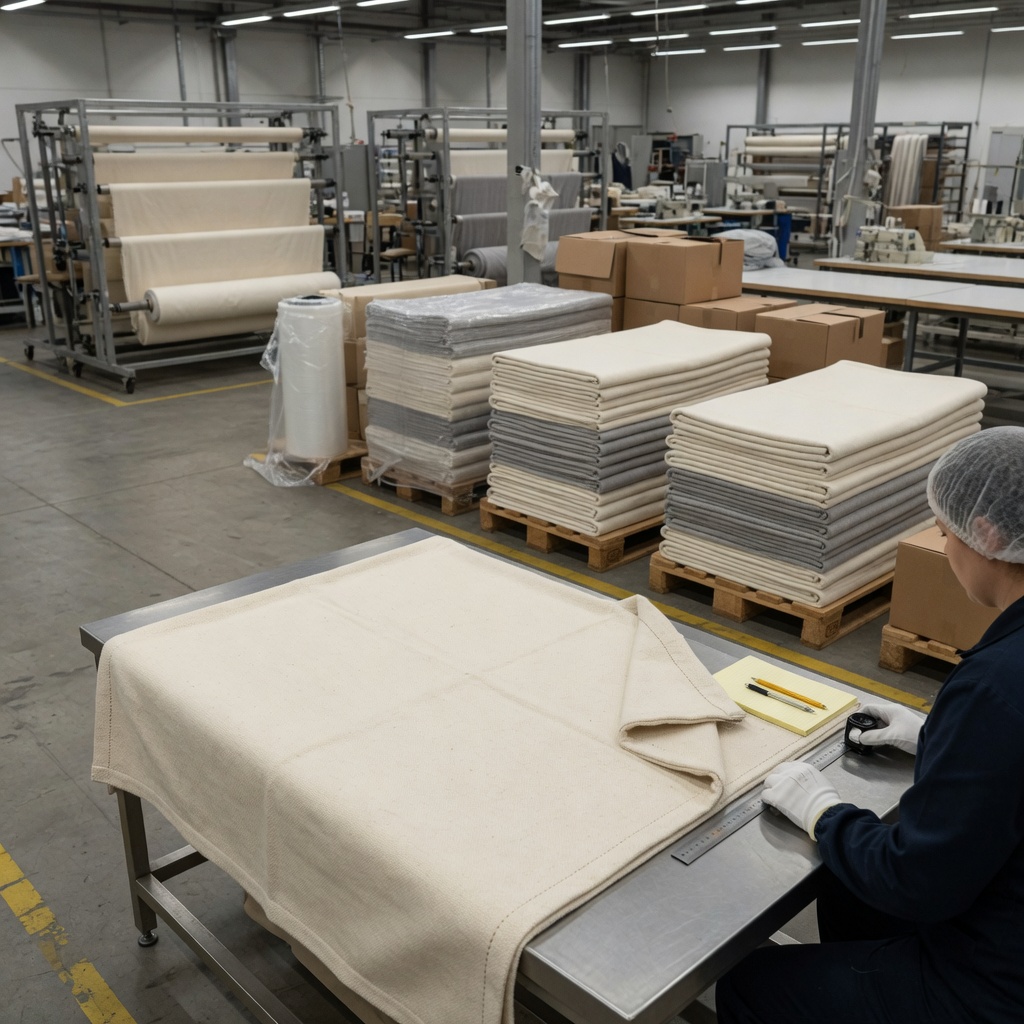
Malaysian B2B buyers who need a reliable flow of finished blankets should treat blanket sourcing production scalability planning as the first procurement decision in the RFQ, not a discussion after unit price. Specify the blanket SKUs, a contract horizon, a total quantity band, a release rhythm with a freeze window, and the capacity-reservation evidence the mill must supply before the first bulk lot is cut. The mill can then allocate weaving or knitting, finishing, sewing, and packing against that plan, and the buyer can issue releases that follow the master production schedule on a just-in-time (JIT) basis instead of storing the full contract volume in a Malaysian warehouse on day one.
Do not skip a gate: specify the product and call-off plan; verify mill capacity and manufacturing lead time for that construction; approve reservation, price bands, buffer ownership, and leftover rules in writing; then order the first firm release only inside the agreed band. The contract remains a purchase of specified blankets. Scalability is the overlay that tells the mill how those blankets will be called off.
Vincent Xi, Editorial Author, Fieldloom Mill author profile. This page uses published manufacturing and sourcing overviews only. It does not claim unpublished factory visits, tests, certifications, client names, or customer results.
Source-backed meaning of a blanket order versus RFQ planning figures
A blanket order in manufacturing is a long-term purchasing agreement for multiple deliveries over a set period at pre-negotiated prices. Published manufacturing guidance states that this structure supports fluctuating production schedules through volume discounts, reduced administrative cost, supplier capacity allocation, and JIT alignment (Blanket Order in Manufacturing). In volume-production practice it is described as a pre-negotiated agreement for a specific quantity over a defined period, with warehoused goods ready for immediate shipment against the production schedule (Volume Production & Blanket Orders). For textile blankets, a China sourcing overview describes China as a leading hub for scalable manufacturing, with clusters in Zhejiang and Jiangsu and published manufacturing lead times of 25–60 days; that overview also states that buyers evaluate quality, volume, sustainability, and capacity verification before multi-year contracts (Sourcing Blanket Supplier In China). Manufacturing-origin cluster context is not a sales-market target and is not a substitute for a named mill quote.
Claim-to-source map (only these facts are treated as sourced).
- Long-term agreement, multiple deliveries, pre-negotiated prices, volume discounts, lower administrative cost, supplier capacity allocation, and JIT alignment: mechanical-power blanket-order overview (2026-dated page as cited).
- Pre-negotiated quantity over a defined period, with warehoused goods ready for immediate shipment against the production schedule: UTRS volume-production blanket-order overview (page as cited).
- Zhejiang and Jiangsu cluster context; published manufacturing lead times of 25–60 days; quality, volume, sustainability, and capacity checks before multi-year contracts: China blanket-supplier overview (2026-dated sourcing page as cited).
All other figures on this page are RFQ controls or labelled examples. They are not mill offers, not Fieldloom capacity claims, and not Malaysian customs, climate, or standards data.
How the data was derived. Blanket-order structure and stated benefits are taken from the two cited manufacturing blanket-order overviews. The 25–60 day manufacturing lead-time range and cluster names are taken from the cited China blanket-supplier overview. No original mill survey, capacity audit, sample test, freight quote, or Malaysian import-document dataset was collected for this page.
Limitations and what to verify. Cluster-level lead times are not a firm mill offer; they vary with construction, quantity, season, and vessel space. Capacity, quality, and sustainability statements require current mill documents and samples. Malaysian ship-to details, Incoterm, packing confirmation, and import documents must be named in the RFQ even though they are not quantified in the source excerpts. Do not treat a named standard’s requirement as this mill’s practice, and do not imply a certification unless a current document is attached. Every planning figure marked below is an example calculation/assumption to verify in the supplier quote and against the buyer’s master production schedule.
Production Scalability Planning for Malaysian Blanket Procurement
The operational failure mode is a mismatch between mill output cadence and site usage cadence. Production scalability planning means the buyer states a horizon, a total quantity band by SKU, a release rhythm, and a capacity-reservation method before cutting starts, so each release is a call-off against a reserved plan rather than a new job.
Keep the product and RFQ decision primary. Name size, construction, fibre content, mass, colour, packing, the Malaysian ship-to or port of discharge, the Incoterm, and the commercial documents required with each shipment in the same RFQ that defines the scalability overlay.
Concrete data points for the first-round RFQ. Item 1 is sourced. Items 2–4 are example calculations/assumptions to verify in the supplier quote; they are not demand guarantees and not mill commitments until materials and line time are confirmed.
- Published manufacturing lead time: 25–60 days (unit: days; scope: published manufacturing lead times for blankets in the Zhejiang and Jiangsu cluster description; as-of context: 2026-dated sourcing page as cited; source: Sourcing Blanket Supplier In China).
- Horizon and total quantity example: 12 months and 18,000 finished blankets (unit: months and pieces; scope: single-contract planning example for Malaysian blanket procurement; as-of context: not a quoted mill offer; example calculation/assumption to verify in the supplier quote).
- Nominal monthly rate example: 1,500 pieces per calendar month, derived as 18,000 pieces ÷ 12 months = 1,500 pieces/month (unit: pieces per calendar month; scope: arithmetic from the example total in item 2; example calculation/assumption to verify in the supplier quote).
- Release-band and freeze-window example: a ±15% collar on 1,500 pieces/month equals 1,275–1,725 pieces per calendar month (1,500 × 0.85 = 1,275; 1,500 × 1.15 = 1,725), with a 30-day freeze window before the agreed ex-works or FOB date (units: pieces per calendar month, percent, and days; scope: flexibility and freeze controls for the same example contract; example calculation/assumption to verify in the supplier quote).
Those numbers start a capacity conversation. They do not authorise cutting until the quote confirms reservation, price bands, buffer ownership, and leftover rules in writing.
How Blanket Orders Support Capacity Allocation and JIT Deliveries
A blanket order converts a stream of spot purchase orders into a capacity reservation. The mill can schedule materials, dyeing or printing, cutting, sewing, and packing against a known (if banded) volume. The buyer calls off finished blankets against actual usage rather than locking one large shipment date.
Capacity allocation is the mill’s decision to keep a share of weekly output available for the named contract instead of filling the calendar with other customers’ spot work. Verification is a request for evidence: relevant looms or sewing lines, typical weekly output of comparable constructions, shift pattern, and on-time history for similar programs. Without that evidence, a scalability claim is only a sales statement.
JIT alignment, as described in the cited blanket-order overviews, means volume can be aligned to the production schedule, including warehoused goods ready for immediate shipment. Someone still pays for storage, insurance, and leftover risk. The RFQ must state who owns the buffer, where it sits, the minimum and maximum weeks of cover, and the leftover rule at contract end. Published descriptions of warehoused goods ready for immediate shipment are the reference model; the buyer still names location and Incoterm. Buffer location, weeks of cover, and Malaysian receiving constraints are not quantified in the source excerpts and must come from the quote plus the buyer’s site plan.
Volume pricing and lower administration appear because one price list and one quality pack cover many releases. The buyer still needs a release procedure that the mill’s order desk and the buyer’s planning system can execute without re-quoting each shipment.
Verifying a Supplier’s Operational Capacity for Multi-Year Blanket Sourcing
Multi-year blanket contracts (for example, 12–24 month horizons, example horizons to verify in the quote) fail when the mill’s peak calendar, labour, or finishing bottleneck cannot absorb the reserved volume. Treat capacity verification as a gate before price is final.
Request, as a minimum:
- A capacity statement scoped to the actual construction, not “blankets in general”: machine types, finishing width, sewing-line count, and a weekly output figure in pieces or kilograms for a comparable SKU.
- Historical output for a similar program across at least two peak months and two off-peak months (customer names may be redacted).
- How the reserved volume sits relative to total plant loading (percentage of relevant lines).
- A backup route (second finishing house, second sewing contractor, or second mill) and the extra days if that route is used.
- Quality and sustainability evidence only at the level the mill currently holds. Distinguish any named standard’s requirement from the mill’s own practice. Do not imply a certification that is not on a current document.
The Zhejiang and Jiangsu cluster context in the sourced overview helps explain where scalable blanket production is described as concentrated and why published manufacturing lead times sit in the range given in data point 1. Cluster membership is not a substitute for a named mill’s numbers. A process walk-through plus recent production records is a weaker check than a documented audit, but it is stronger than a brochure.
A single trial lot (for example, a few hundred pieces, assumption to verify in the quote) proves the mill can make the SKU once. Sustained output for a blanket contract is proven by machine list, loading, materials pipeline, and a written allocation.
Setting Quantity Estimates, Tolerance Bands, and Release Procedures
Start from the usage plan, then add a tolerance band that reflects forecast error. A band that is too tight forces shortages or emergency freight. A band that is too wide stops the mill reserving materials and can erase the volume-price benefit.
A practical sequence:
- Convert demand into pieces per month for each SKU (size in cm, colour, construction, fibre content, mass in g/m² or g/piece).
- State a total contract quantity and horizon (12 or 18 months are example horizons to confirm in the quote).
- Set a monthly or weekly release window with a plus/minus percentage both parties can support. Keep the numbers labelled as planning figures until the mill confirms materials and line time.
- Define the freeze window after which quantity and ship date for that release are firm.
- Define change control: notice in days, extra cost or delay, and who approves a pull-in or push-out.
- Align the release document with the mill’s order-entry fields: SKU, quantity, requested date, Malaysian ship-to, packing-list requirements.
Map lead time from a confirmed release to goods available against data point 1 (25–60 days; unit: days; scope: published manufacturing lead times for blankets in the Zhejiang and Jiangsu cluster description; as-of context: 2026-dated sourcing page as cited) plus the chosen freight. If the mill quotes inside that range, still add time for inspection, documents, and inward clearance into Malaysia. Ask for a split: production days after a firm release versus days when the lot is drawn from an agreed buffer. Confirm transit with the forwarder; do not treat manufacturing lead time as door-to-door time. Inspection days, document days, and Malaysian clearance days are not quantified in the source excerpts and must be verified with the mill, the inspector, and the buyer’s broker or forwarder.
If the mill holds inventory under a JIT clause, a release can be shorter than full manufacturing lead time only for quantity already inside the agreed buffer. Volume above the buffer reverts to full lead time. Write that rule so Malaysian planners do not assume unlimited flexibility.
Measurable Trade-offs in Horizon, Inventory, Cost, and Shortage Risk
Each scalability choice moves cost. Quantify the following using the mill’s quote and the buyer’s internal carrying-cost rate (the internal rate is an assumption to verify with finance):
- Longer horizon versus forecast risk. A 24-month commitment (example horizon to verify) may improve unit price and allocation; it also raises leftover risk if a colour or construction is wrong. Mitigation: SKU-level bands, a mid-term review, and a written leftover rule.
- Tighter JIT versus mill buffer cost. Mill-held finished blankets usually raise unit price or add a storage fee. Larger, less frequent inbound lots into Malaysia raise local warehouse cost instead. Ask for both options priced.
- Firm quantity versus flexibility collar. A firm 18,000-piece take-or-pay figure (example assumption to verify; unit: pieces; scope: the same example contract total as data point 2) gives the mill certainty; a ±15% collar on the nominal monthly rate (example assumption to verify; unit: percent; scope: the same example as data point 4) gives the buyer room. The mill may price the collar as a premium.
- Dedicated capacity versus shared lines. Dedicated sewing or packing reduces peak-season contention and is rarely free. Shared capacity is cheaper until other customers surge.
- Inspection timing. Origin inspection protects the Malaysian receiver and can add days. Destination inspection is simpler administratively and makes claims harder. Specify defect definitions and who pays for replacement lots.
None of these is resolved by a generic flexibility claim. They are resolved by numbers on the RFQ response: price at each volume band, storage fee if any, freeze window, and leftover policy.
Buyer Decision Table: Scalability Levers for Blanket Procurement
| Scalability lever | What the RFQ must specify | How the buyer verifies | Trade-off to quantify before approval | Action to order |
|---|---|---|---|---|
| Contract horizon | Start and end dates; forecast versus take-or-pay | Match to the Malaysian usage plan; mill written acceptance | Price benefit versus leftover risk | Approve only after leftover and cancellation clauses are signed |
| Total quantity and SKU mix | Pieces by size (cm), colour, construction, fibre, mass (g/m² or g/piece); allowed substitutions | Sample against the same construction; mill capacity for that mix | Mix flexibility versus dyeing/setup cost | Freeze mix for the first firm release |
| Release band | Min–max pieces per period and ±% collar (planning figures to verify) | Compare band to evidenced weekly output | Flexibility versus materials reservation | Issue the first release only inside the agreed band |
| Capacity reservation | Dedicated versus shared lines; share of relevant output reserved | Machine list, shift pattern, peak-month history | Reservation cost versus shortage risk | Do not sign if reservation is only verbal |
| JIT / buffer | Who holds stock, where, weeks of cover, ownership and insurance | Warehouse address, inventory-report cadence, Incoterm | Storage cost versus stock-out cost in Malaysia | Name buffer SKUs and max weeks in the contract |
| Production lead time | Days from firm release to ex-works or FOB, make-to-order versus from-buffer | Compare with data point 1 (25–60 days; unit: days; Zhejiang and Jiangsu cluster description; 2026-dated sourcing page as cited); recent similar-lot dates | Faster promise versus reliability | Reject a promise the mill cannot evidence |
| Price mechanism | Fixed versus indexed; volume breaks | Written schedule and index source if used | Price certainty versus mill margin risk | Lock the mechanism before first production |
| Quality and packing | Dimensions, mass, stitch, shade, packing, labelling | Pre-production sample plus inspection plan | Tighter spec versus yield and cost | Approve the sample as the contract standard |
| Sustainability claims | Only claims supported by a current mill document | Current document or mill-practice statement | Claim strength versus audit cost | Attach only in-date documents |
| Malaysia logistics and documents | Incoterm, port or door, commercial documents, inspection location | Forwarder confirmation at quote stage | Origin versus destination risk | Do not release a lot without the named document set |
If a mill response cannot fill a cell, the contract is not ready to approve.
Practical RFQ Checklist for Blanket Sourcing Production Scalability Planning
Every item below is meant to produce a comparable answer the buyer can specify, verify, approve, or order against.
- Identify the product as finished blankets and list each SKU: size (cm), construction, fibre content, mass (g/m² or g/piece), colour, binding, and label language.
- State horizon dates and whether total quantity is a forecast or a committed take-or-pay volume (replace example totals with the buyer’s plan).
- Give a monthly or weekly release band in pieces, including the ±% collar and freeze window in days.
- Require a capacity statement for the exact construction: machines, weekly output, shifts, and the share reserved for this contract.
- Require historical output for a comparable program in two peak months and two off-peak months.
- Ask for production lead time in days from firm release to ex-works or FOB, separately for make-to-order lots and buffer lots, and locate that figure against data point 1 (25–60 days; unit: days; China Zhejiang and Jiangsu cluster description; 2026-dated sourcing page as cited).
- Specify who holds finished-goods buffer, min/max weeks of cover, ownership, insurance, and the leftover rule at contract end.
- Define the release document: required fields, notice period, and the path both parties will use so a release is not a new negotiation.
- Request a price schedule: unit price at each volume band, any storage or reservation fee, and any index formula, valid for the horizon.
- Set quality as the approved sample plus measurable tolerances. Distinguish any named test method from in-house mill practice; do not imply a certification that is not supplied as a current document.
- Specify packing the mill must confirm (carton strength, moisture protection, palletisation) and inspection location, with defect handling.
- Name Incoterm, Malaysian ship-to or port of discharge, and documents required with each shipment (commercial invoice, packing list, and any further document the buyer’s broker requires). Confirm transit with the forwarder; do not treat manufacturing lead time as door-to-door time.
- Ask for a backup production route and the extra days and cost if the primary line is unavailable.
- Require written change control for pull-ins, push-outs, and SKU mix changes.
- Set a sample and first-article gate: no volume production until the pre-production sample is signed and the first bulk lot is inspected against it.
Do not issue the blanket contract until items 4, 6, 7, 9, and 10 have written mill answers and the Malaysian receiving site has confirmed it can handle the chosen shipment size and packing. With those answers, mills can be compared on the same scalability levers, a capacity reservation can be approved against the master production schedule, and the first firm release can be placed without restarting sourcing for every shipment.
Discuss Your Requirements
Review our manufacturing capabilities, then share your specifications for a supplier-fit review.