Beach Mat OEM Product Development Capability: Canada RFQs
By Vincent Xi, Editorial Author (author profile)
For a Canada-bound private-label RFQ, evaluating beach mat OEM product development capability is a manufacturing-release decision. The buyer needs evidence that the supplier can translate a defined use case into a complete construction, produce a representative sample, record measured results, freeze an approval revision, and transfer that revision into production. Catalog availability, OEM or ODM wording, and an unmeasured sample do not establish those controls.
The supplied sources provide candidate directions for an RFQ, not verified performance. The LISO HOME selection article discusses use conditions and material or surface options. The INITI supplier catalog lists construction, customization, carrying, and anchoring options. The Aiyisi product page uses OEM and ODM language for a foldable PP-mat product. Buyers should require evidence for the exact proposed beach mat rather than treat those page descriptions as proof of development or manufacturing capability.
Canada RFQ Evidence for Product Development Capability
Send suppliers one controlled brief and evaluate the returned records against the same release gates. A hold means evidence for the proposed construction remains incomplete; it is not a conclusion about the supplier's wider business.
| Development gate | Evidence to request for the proposed beach mat | Buyer release rule |
|---|---|---|
| Requirement translation | A field-by-field feasibility response covering the use environment, water and sand exposure, cleaning, open and folded format, carrying method, accessories, decoration, packaging, and buyer-defined acceptance criteria | Hold when a mandatory field is unanswered or an assumption is undisclosed |
| Construction definition | Face material and construction, backing or laminate, bonding method, edge finish, seams, fold architecture, closure, handle, carry bag, stakes, decoration process, and immediate packaging | Hold when the return relies on a trade description such as Oxford without defining the offered construction |
| Sample plan | Sample revision, proposed bulk materials and components, decoration process, charges, timing trigger, planned checks, and any temporary substitutions | Hold when the sample differs from intended production without an explicit difference list |
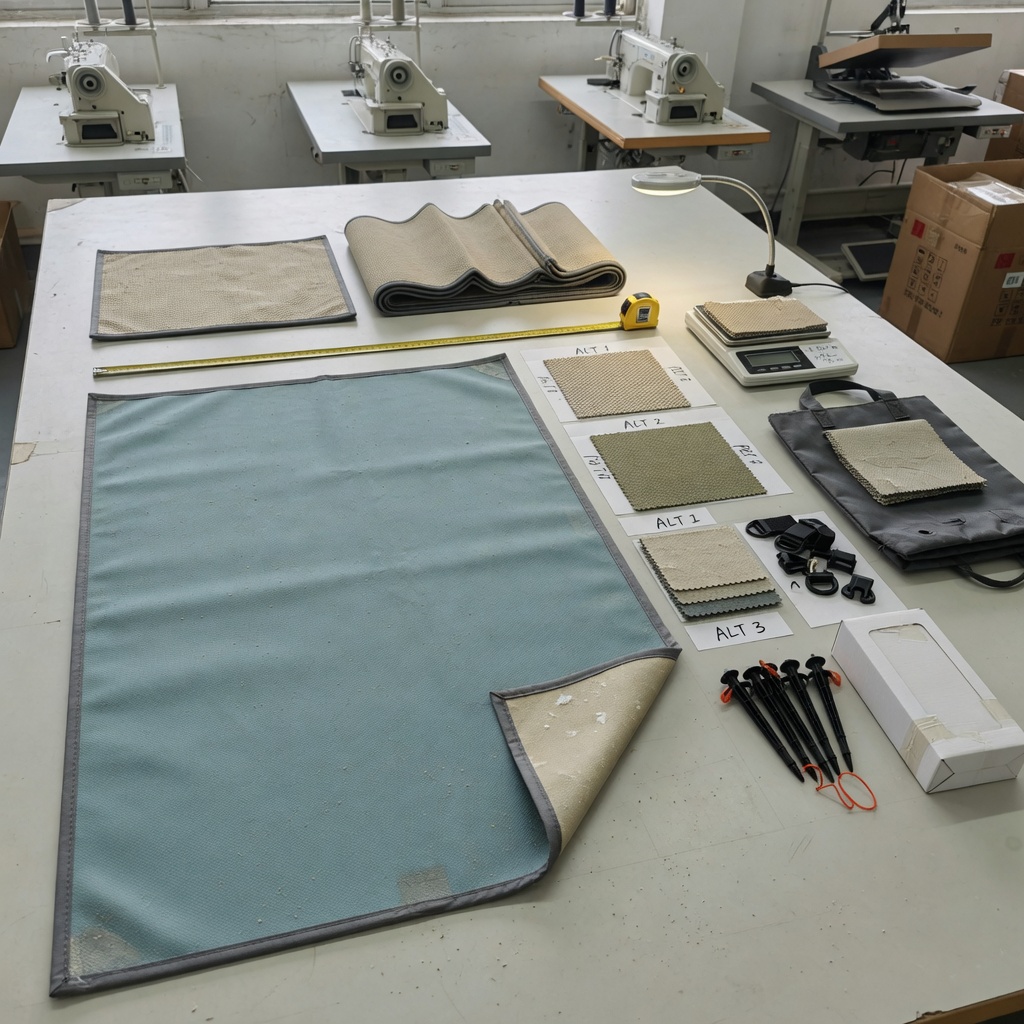
| Production-intent sample | A finished sample representing the proposed materials, components, folds, decoration, accessories, and packout | Hold when only swatches, artwork mockups, or nonrepresentative samples are available |
| Measured validation | Method, conditions, actual result, buyer-approved threshold, sample revision, record date, disposition, and responsible party for each required characteristic | Hold when a record reports only pass or fail without the method and result |
| Approval revision | Signed specification, bill of materials, dimensioned drawing, artwork proof, packaging proof, inspection characteristics, physical reference, and exception log under one revision identity | Hold when approvals exist only in photographs, chat messages, or documents with conflicting revisions |
| Manufacturing transfer | A record showing how the released revision controls purchasing, cutting or weaving, printing, sewing or sealing, finishing, packing, and final inspection | Hold when an unapproved specification or substitution could enter production without buyer review |
| Commercial alignment | A current quote tied to the exact construction, quantity basis, currency, development scope, packaging scope, timing triggers, delivery basis, named place, validity, and exclusions | Compare unit prices only after the product and service scopes match |
| Canada order release | Final configuration, destination, sales channel, transaction inputs, and applicable product, claim, packaging, and commercial requirements confirmed for the actual order | Do not release a generic configuration or rely on unsupported Canada-specific assumptions |
Practical Canada Beach Mat RFQ Checklist
Use this checklist as the working RFQ return sheet. A checked item means the requested evidence is present, current, and reconciled to the quoted beach mat revision. A supplier promise without the corresponding record should remain unchecked.
- [ ] State the intended beach, sand, moisture, cleaning, carrying, storage, and saleable-packout conditions.
- [ ] Identify every mandatory requirement, preferred option, acceptance method, and unresolved buyer assumption.
- [ ] Require a field-by-field feasibility response, including proposed alternatives for any unsupported requirement.
- [ ] Request the exact face material, backing or laminate, bonding method, edge finish, seam, fold, closure, handle, accessory, decoration, and packaging construction.
- [ ] Require a bill of materials and dimensioned proposal tied to a named revision.
- [ ] Ask the supplier to identify temporary sample substitutions and explain each expected production difference.
- [ ] Confirm that the production-intent sample uses the proposed construction, decoration process, accessories, and immediate packaging.
- [ ] Record open dimensions, folded dimensions, packed mass, fold behavior, component count, edge condition, decoration, and packout against buyer-approved methods and thresholds.
- [ ] Require each result to show the method, conditions, actual observation or measurement, sample revision, record date, disposition, and responsible party.
- [ ] Reconcile the signed specification, bill of materials, drawing, artwork proof, packaging proof, inspection characteristics, exception log, and retained sample under the same revision identity.
- [ ] Require written buyer approval before any material, component, construction, decoration, accessory, or packaging substitution.
- [ ] Request a current quote stating the exact configuration, quantity basis, currency, development charges, packaging scope, timing triggers, delivery basis, named place, validity, and exclusions.
- [ ] Collect manufacturing origin and final carton, shipment-mass, and packout inputs for the approved configuration rather than a catalog example.
- [ ] Record the Canada destination, sales channel, intended claims, transaction structure, and documents needed for the buyer's separate compliance and landed-cost review.
- [ ] Keep order release on hold until sample evidence, approval records, manufacturing-transfer controls, commercial scope, and Canada-order inputs describe the same beach mat revision.
Source-Supported Beach Mat Development Directions
The cited pages can help define alternatives for sampling. They do not establish the composition, performance, consistency, or commercial readiness of a supplier's proposed construction.
| Candidate direction described by a source | What the source supports | Evidence still required in the RFQ |
|---|---|---|
| Polyester or Oxford constructions with PEVA or PE backing; recycled polyester; and a woven surface associated with sand release | The LISO HOME selection article presents these as candidate material, backing, or surface directions | Exact composition and construction; backing attachment; edge and fold details; a finished sample; agreed complete-mat methods; actual results; and current documentation for any recycled-content claim |
| Polyester, Oxford, PP-straw, custom-size, logo, carry-bag, and stake options | The INITI supplier catalog presents these as available product or customization directions | Complete bill of materials; dimensioned proposal; accessory and decorated samples; attachment or retention checks; component-count record; and an approved packout sample |
| OEM and ODM service language in a foldable PP-mat context | The Aiyisi product page supports only that the service language appears in that product context | Evidence that the proposed supplier can develop, sample, validate, revise, transfer, and control the exact beach mat requested by the buyer |
Treat each source-described option as an RFQ input. For example, a woven surface associated with sand release still needs an agreed procedure and recorded observations for the proposed finished mat. A recycled-material description still needs current supporting documentation tied to the offered component and claim scope.
Illustrative Beach Mat Baseline for Comparable Quotes
The following values are buyer-side examples for structuring comparable returns. They are not source findings, supplier specifications, or market benchmarks. Each value must be reviewed, replaced where necessary, and verified in the current quote and production-intent sample.
| Comparison field | Example buyer input | Status, as-of context, and verification |
|---|---|---|
| Open format | 200 cm x 150 cm per finished mat in its normal fully opened condition | Source/status: illustrative buyer assumption, not external research. As of: the buyer's calendar-dated RFQ issue date. Verify in the current supplier quote, controlled specification, and production-intent sample. |
| Folded pack envelope | 40 cm x 25 cm x 12 cm maximum per packed saleable unit, including immediate packaging and included accessories | Source/status: illustrative buyer assumption, not external research. As of: the buyer's calendar-dated RFQ issue date. Verify the normal folded configuration in the current supplier quote and approved packout sample. |
| Packed mass | 1.30 kg maximum per packed saleable unit, including the mat, included accessories, and immediate packaging | Source/status: illustrative buyer assumption, not external research. As of: the buyer's calendar-dated RFQ issue date. Verify the measurement method and actual result for the production-intent sample. |
| Quote quantity | 1,200 saleable units per proposed construction and packout | Source/status: illustrative buyer assumption, not external research. As of: the buyer's calendar-dated RFQ issue date. Verify current MOQ, price basis, material or color commitments, quantity tolerance, and packout in the supplier quote. |
Treat these values as comparison inputs until the buyer accepts them and incorporates them into the controlled specification. They do not document a supplier's capability or create a performance claim.
From Sample to Beach Mat Manufacturing Release
Freeze a testable brief. Define the intended surface, exposure to water and sand, cleaning method, carrying scenario, open and folded format, mass target, accessories, decoration, and saleable packout. Replace terms such as waterproof, sand-free, lightweight, and durable with buyer-approved methods and thresholds appropriate to the intended claim.
Approve the sample plan before fabrication. Identify the proposed bulk materials, components, processes, sample revision, checks, charges, and timing trigger. Require the supplier to disclose every temporary substitution and explain how the production version will differ.
Inspect the complete production-intent sample. Review open and folded dimensions, packed mass, face and backing identity, bonds or seams, edge finish, fold behavior, closure, handle, accessory count, decoration, immediate packaging, and the complete saleable configuration. Material swatches can support development but cannot represent finished-product behavior by themselves.
Record actual results. Each record should identify the sample revision, setup or conditioning, method, measurement or observation, acceptance threshold, disposition, record date, and responsible party. Where a visual judgment is necessary, retain an approved reference and define the viewing conditions.
Lock the approval set. Apply the same revision identity to the signed specification, bill of materials, drawing, artwork proof, packaging proof, inspection characteristics, exception log, and retained physical references. Resolve conflicting records before purchase-order release.
Transfer the approved revision. The purchase order should cite the released revision. Require written buyer approval before changing a material, component, construction, decoration process, accessory, or packaging element. A proposed exception should identify the affected characteristic and quantity, supporting evidence, disposition, corrective action, and any required reapproval.
Canada Quote Scope for the Manufacturing Decision
The supplied pages do not establish Canada-specific labeling, compliance, duty, tax, freight, or landed-cost treatment for the proposed beach mat. Do not infer those outcomes from a catalog description. Request the transaction inputs needed for a separate review of the final construction, sales channel, destination, and order.
| Quote control | Supplier return required | Buyer check |
|---|---|---|
| Saleable configuration | Mat construction, closure, handle, carry bag, stakes or other accessories, decoration, insert, immediate packaging, and carton scope | Confirm that the quote, sample, bill of materials, and packout reference describe the same configuration |
| Development scope | Swatches, prototypes, production-intent samples, decoration setup, tooling, testing, packaging development, revision charges, and any stated credit arrangement | Separate development charges from saleable-unit pricing and record what each charge covers |
| Quantity basis | MOQ and pricing by construction, material, color, artwork, accessory set, and packaging configuration, including any material or print commitment | Compare suppliers only on matching quantity and configuration scopes |
| Timing basis | Trigger for each sampling and manufacturing stage, buyer dependencies, approval pauses, material-procurement stage, production stage, and dispatch readiness | Tie timing to documented inputs and approvals rather than an undefined start date |
| Commercial basis | Currency, tax treatment stated by the quoting party, payment terms, quote validity, delivery basis, named place, exclusions, and repricing conditions | Retain the quoted revision and document every subsequent commercial change |
| Origin and shipment inputs | Manufacturing origin stated by the supplier, units per carton, carton construction, external dimensions with units, net and gross shipment mass with units, and any loading assumptions | Obtain data for the final approved packout; do not derive it from catalog descriptions or the illustrative baseline |
| Canada review inputs | Final product description, intended claims, packaging content, destination, sales channel, transaction structure, and supporting documents requested by the buyer or its qualified Canadian adviser | Confirm applicable requirements for the actual product and transaction before order release |
Use the final quote, stated origin, approved packout data, and qualified Canadian advice for any compliance or landed-cost review. The source-described options and illustrative RFQ values are not a basis for calculating or approving those items.
Capability Decision for the Exact Beach Mat
Demonstrated for the quoted revision: The supplier has returned a complete feasibility response, representative sample, traceable measurement records, aligned approval documents, manufacturing-transfer controls, substitution controls, and a current quote for the same saleable configuration.
Conditional: A viable sample exists, but temporary substitutions, open test results, conflicting revisions, packaging gaps, commercial exclusions, or Canada-order inputs still require documented resolution. Keep the affected gate on hold.
Not demonstrated: The return relies on catalog wording, OEM or ODM labels, generic certificates, unmeasured samples, unsupported pass statements, or a quote that cannot be reconciled with the proposed construction and packout.
This decision applies only to the evaluated construction, revision, evidence set, and quote. It should not be generalized to other products or future orders without current supporting records.
Evidence Method and Source Contexts
Source contexts: The LISO HOME selection article was used for candidate use, material, backing, recycled-material, and surface directions represented on that page. The INITI supplier catalog was used for the construction, customization, carrying, and anchoring options it lists. The Aiyisi product page was used only for OEM and ODM wording in a foldable PP-mat context. The author profile was used only for the named author's identity and editorial role.
Methodology: Source descriptions were extracted only as candidate product or service directions. Each description was separated from supplier qualification, finished-product performance, manufacturing consistency, certification, price, and Canada-specific treatment. Open claims were converted into RFQ fields, sample checks, evidence requests, and release decisions. The numeric baseline is explicitly an illustrative buyer assumption and must be verified against the current quote and production-intent sample.
Author basis: The supplied author profile identifies Vincent Xi as Editorial Author. It does not provide a first-hand manufacturing, factory-visit, or product-testing account, so no first-person experience claim is made.
Limitations and What to Verify
The supplied evidence consists of a selection article and supplier product pages. It does not provide an independent factory audit, current capacity record, controlled production record, approved sample, laboratory report, or current quotation for the proposed beach mat. It also does not establish typical MOQ, development timing, production lead time, price, finished-product performance, material consistency, certification, or Canada-specific product and transaction treatment.
Before order release, verify the proposed materials with current documents and physical samples. Confirm construction, dimensions, packed mass, fold behavior, accessories, decoration, and packaging against the signed approval set. Obtain actual results using the agreed methods and thresholds, and confirm commercial and Canada-bound requirements for the final configuration and transaction.
For any material, recycled-content, performance, quality-system, or certification claim, tie the supporting document to the offered component or product, manufacturing scope, sample identity, issuing party, and current validity. If the RFQ names a standard, record its relevant edition, method, scope, sample identity, and result. A standard's requirement is distinct from a supplier's own practice, and neither a catalog statement nor an expired or mismatched document establishes certification.
Discuss Your Requirements
Review our manufacturing capabilities, then share your specifications for a supplier-fit review.