Beach Mat OEM Minimum Order Quantity for United States RFQs
By Vincent Xi, Editorial Author
Decision rule: For a United States beach mat OEM order, treat the minimum order quantity as unresolved until the supplier separates the total finished-unit floor, each variant floor, material and custom-component purchase floors, setup charges, and shipping-pack multiples.
The approvable PO quantity is the lowest shippable quantity that satisfies every documented constraint for the selected specification and assortment. It is not necessarily the supplier's material-purchase quantity. Paid surplus inputs must be identified separately, with their ownership, storage, reuse, and disposal terms stated in the quotation.
None of the supplied sources establishes a current factory-specific beach mat minimum order quantity. Obtain that figure in a dated supplier quotation tied to the final specification, artwork, packaging, price basis, shipment tolerance, and delivery schedule. The supplied manufacturing sources provide general context for production floors, input purchasing, setup economics, and negotiation structures; they do not prove a particular supplier's MOQ. General MOQ context MOQ types and negotiation context
How United States buyers should approve a beach mat minimum order quantity
Use the supplier's written response to assign an approval status:
| Status | Evidence required | Buyer action |
|---|---|---|
| Approve | Finished-unit floor for the PO and every variant; binding constraint; input purchase floors; surplus treatment; carton multiple; price basis; trade term; and dated milestones | Issue the PO against the same quote and specification revisions |
| Clarify | A finished quantity is stated, but material, artwork, label, packaging, or variant constraints are combined or omitted | Return an MOQ matrix with every unresolved field marked mandatory |
| Hold | Quantity may change after PO placement, shipment variance remains open, packaging is undecided, or delivery lacks a defined handoff point | Do not authorize bulk inputs or production |
Compare prices only after quotations cover the same construction, assortment, labels, packaging, quantity treatment, and delivery point. Record paid surplus materials and components separately from finished sellable units so that unit price does not obscure the total cash commitment.
What sets the minimum order quantity
Require a separate response for each possible MOQ driver:
| Quantity type | Supplier response required | Decision effect |
|---|---|---|
| Finished-unit floor | Minimum shippable mats per PO | Establishes the proposed production floor |
| Variant floor | Minimum by SKU, color, size, print, or other controlled variant | Determines whether the total can be divided across the requested assortment |
| Material purchase floor | Purchasing unit, required purchase quantity, planned consumption, and expected surplus | Identifies paid exposure outside the finished order |
| Custom-component floor | Purchase quantity for each included label, pouch, strap, insert, or other custom item | Identifies components that may remain after production |
| Setup alternative | Setup charge and the finished-unit floor available when it is paid | Allows a smaller run to be compared with added fixed cost |
| Pack multiple | Units per inner pack and export carton, including mixed-SKU rules | Converts the production floor into a shippable quantity |
| Sample quantity | Quantity and construction status for prototypes, approval samples, and retained references | Prevents a sample quantity from being represented as the bulk MOQ |
The quotation should identify the binding constraint for each scenario. If constraints interact, require the calculation that converts them into the proposed finished-unit and shippable quantities.
Freeze the beach mat specification before comparing MOQ offers
The cited supplier-authored beach mat page discusses intended use, material, dimensions, and portability as selection considerations. It does not establish an independent MOQ, verified performance result, or capability for another supplier. Beach mat specification context
Control these fields before comparing quotations:
- Intended United States sales channel and use case.
- Open and folded dimensions, measurement method, measurement units, and buyer-selected tolerances.
- Face material, backing when included, basis weight where applicable, thickness where applicable, edge construction, seams, and corner components.
- Artwork method, controlled color reference, placement, coverage, and approved file revision.
- Carry component, unit package, labels, inserts, inner packs, export carton, and mixed-SKU rules.
- Verification method and required evidence for water resistance, sand release, recycled content, durability, or any other voluntary claim.
Include only components present in the approved bill of materials. Optional backing, pouches, straps, or accessories need separate quantity and price treatment rather than being assumed for every mat.
Worked beach mat minimum order quantity example
Every numeral, dimension, quantity, and amount in this section is an illustrative assumption or arithmetic output for one hypothetical United States RFQ. None is a typical specification, market price, freight rate, supplier claim, or observed result. Verify every input in a current, dated supplier, freight, customs, or inspection document before issuing the PO.
| Modeled field | Illustrative assumption to verify |
|---|---|
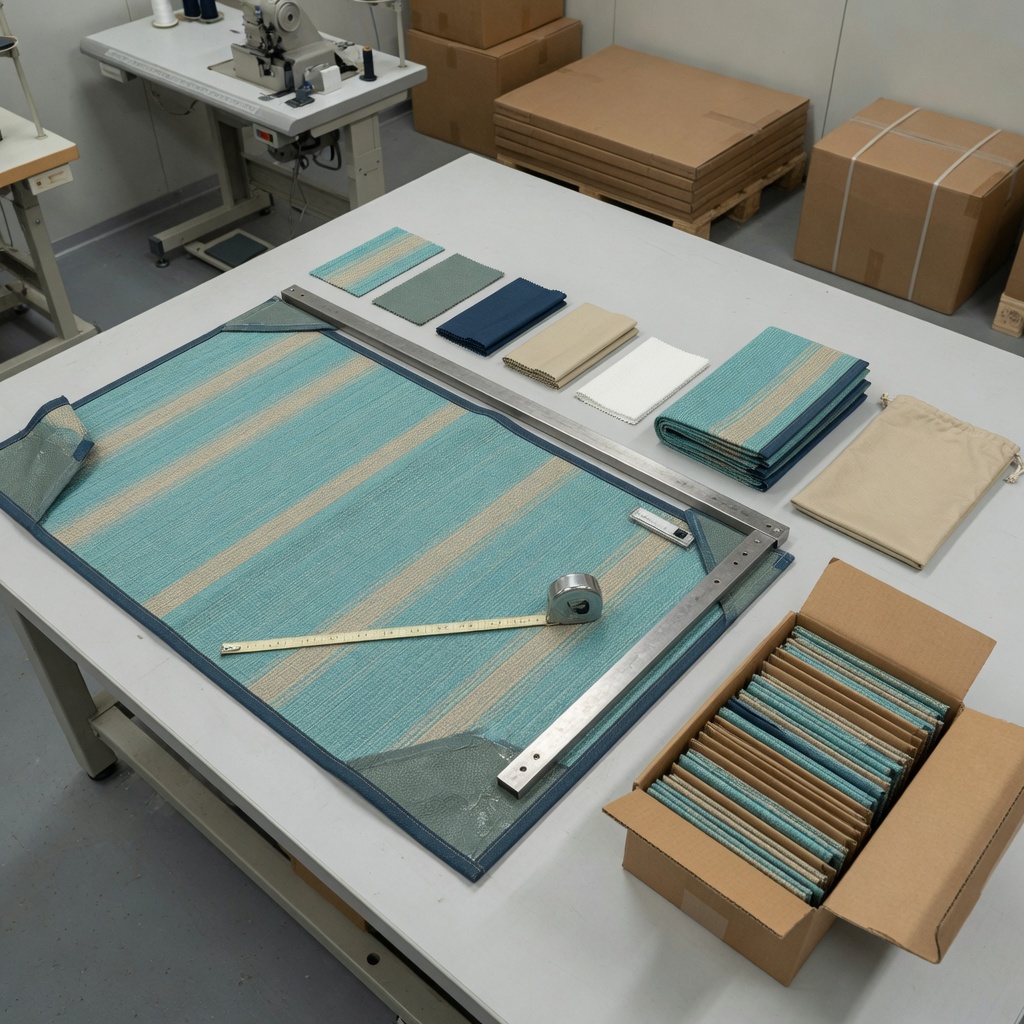
| Buyer sample specification | 180 cm long by 80 cm wide when open, with a buyer-selected tolerance of plus or minus 1 cm in each direction; woven textile face, flexible coated backing, and bound perimeter |
| Finished order floor | 600 finished mats per hypothetical PO |
| Variant floor | 2 hypothetical colorways, each requiring 300 finished mats per colorway |
| Backing purchase floor | Backing equivalent to 720 finished mats per hypothetical PO, comprising 600 finished-mat equivalents for planned consumption and 120 finished-mat equivalents of expected surplus |
| Export packing | 20 finished mats per hypothetical export carton |
| Finished-goods price | USD 7.40 per finished mat for the hypothetical PO, including the stated backing purchase |
| Setup | USD 300 per hypothetical PO |
| Specified logistics | USD 1,800 per hypothetical shipment, before duty and other expressly excluded amounts |
| Cost denominator | 600 ordered, shipped, inspected, and accepted sellable mats per hypothetical shipment |
Arithmetic derived only from those assumptions:
- The variant requirement is
2 colorways x 300 finished mats per colorway = 600 finished mats per hypothetical PO. - The material floor does not increase finished production above
600 mats per hypothetical POonly if the supplier confirms that the120 finished-mat equivalents of hypothetical surplus backingmay remain unused and records its ownership, condition, storage period, reuse restrictions, and disposal authority. 600 finished mats per hypothetical shipment / 20 finished mats per hypothetical carton = 30 export cartons per hypothetical shipment.600 finished mats per hypothetical shipment x USD 7.40 per finished mat = USD 4,440 of hypothetical finished-goods value per shipment.USD 4,440 of hypothetical finished-goods value + USD 300 of hypothetical setup + USD 1,800 of hypothetical specified logistics = USD 6,540 of hypothetical pre-duty cost per shipment.USD 6,540 per hypothetical shipment / 600 accepted sellable mats per hypothetical shipment = USD 10.90 per accepted sellable mat before duty and excluded contingencies.
This model keeps finished units, paid input surplus, carton multiples, and accepted sellable units distinct. A supplier quotation should reproduce those categories with quote-specific values rather than relying on the example.
United States labeling controls tied to minimum order quantity
Determine regulatory coverage from the mat's actual textile construction and intended presentation before approving artwork or a label purchase floor. FTC guidance states that covered textile products generally require disclosure of fiber content, country of origin, and the identity of the manufacturer or another responsible business. It also discusses use of an eligible FTC Registered Identification Number instead of a company name. Confirm coverage, exemptions, wording, and the responsible party for the actual product. FTC textile-labeling guidance
Review country-of-origin marking separately against the current eCFR text in Title 19, Part 134, as applicable on the legal-review and entry dates for the imported article. This is a United States regulatory source, not evidence of supplier certification or company practice. United States country-of-origin marking source
The RFQ should state:
- Which legal requirements apply, who made that determination, and when the determination must be rechecked.
- Final fiber disclosure when applicable, country-of-origin wording, responsible-business identity, placement, attachment method, permanence, and artwork revision.
- Whether an eligible company name or a valid RN will identify the responsible business.
- Buyer or retailer fields such as SKU, barcode, care copy, price, or hangtag content, separated from federal requirements.
- Label purchase floor, application quantity, permitted overage, expected surplus, ownership, storage, reuse, and disposal terms.
- Required evidence for each voluntary material, environmental, or performance claim.
A quotation, website statement, or document from a previous order is not proof of current certification. When certification is required, obtain a current document and verify its holder, product scope, facility scope, validity period, and connection to the quoted order. Label purchasing and application may create commercial quantity constraints, but the cited rules do not establish a beach mat production MOQ.
Landed cost at the approved minimum order quantity
Use accepted sellable units as the denominator:
Landed cost per accepted sellable mat = (finished goods + separately charged surplus inputs + setup + packaging + international logistics + import charges + United States inland delivery + receiving cost) / accepted sellable mats
Avoid double-counting surplus inputs when the finished-goods price already includes them. For every scenario, identify:
- Finished-goods cost and any separately invoiced surplus materials or components.
- Samples, setup, artwork, labels, packaging, and inspection.
- Origin handling, export charges, main carriage, insurance, destination handling, and the party responsible for each item.
- Proposed HTS classification, manufacturing origin, entered-value basis, applicable duty or additional tariff, customs fees, brokerage, and examination contingencies.
- United States inland transport to the named destination, warehouse receiving, and buyer-selected inventory carrying costs.
- Ordered, permitted overage or shortage, shipped, inspected, rejected, and accepted sellable quantities.
Review the proposed classification against the current United States International Trade Commission tariff schedule for the actual construction, manufacturing origin, and entry date. Do not apply a generic duty percentage to every beach mat. United States Harmonized Tariff Schedule
CBP provides general importing-process context. Classification, valuation, marking, entry documentation, and shipment-specific obligations should be checked against current requirements for the actual transaction. CBP importing guidance
For each dated quotation, require the selected Incoterms rule, the named place, and the Incoterms 2020 edition described by ICC. Incoterms rules allocate specified delivery obligations, costs, and risks; they do not establish MOQ, tariff classification, or a supplier's production practice. A rule becomes part of the transaction only when the quotation and PO adopt it with a named place. ICC Incoterms rules
Keep unquoted duty, tariff, examination, storage, demurrage, and destination amounts visibly open. Do not bury unknown amounts in an unsupported landed-cost estimate.
Delivery controls for the approved minimum order quantity
Tie the schedule to the approved quantity, variants, bill of materials, artwork, labels, and packaging. Require calendar dates for quote expiry, specification freeze, sample dispatch and approval, bulk-input authorization, production start, inspection readiness, corrective work, handoff at the named Incoterms place, estimated departure, estimated United States arrival, and requested destination delivery.
For each milestone, identify the responsible party, prerequisite, completion evidence, and schedule consequence of buyer or supplier delay. Require a revised calendar whenever quantity, variant count, artwork, label, package, or material changes. Production completion is not the same as delivery at the United States destination.
When split shipment is proposed, the quotation must state the quantity and variants in each shipment, carton compliance, added charges, responsibility for additional freight and handling, and control of the unshipped balance and remaining inputs. Meeting the total PO floor does not by itself establish that split shipment is available.
Practical beach mat minimum order quantity RFQ checklist
Attach this checklist to the RFQ and require the supplier to answer each item in the dated quotation. Check an item only when the response is tied to the same specification, artwork, packaging, price, and delivery revisions intended for the PO.
Product and assortment
- [ ] State the intended United States use case, sales channel, destination ZIP code, and requested destination-delivery date.
- [ ] Attach the controlled beach mat specification with its title, revision, open and folded dimensions, measurement method, units, and tolerances.
- [ ] List the face material, backing when included, basis weight or thickness where applicable, edge construction, seams, corner components, and every accessory.
- [ ] Identify each SKU, color, size, print, and artwork revision, with the requested finished quantity for every variant.
- [ ] Define the unit package, labels, inserts, carry components, inner pack, export carton, carton dimensions, gross weight, and mixed-SKU rules.
- [ ] Separate required construction from optional pouches, straps, backings, inserts, or other accessories.
Minimum order quantity and surplus inputs
- [ ] Quote the total finished-unit minimum order quantity per PO.
- [ ] Quote the finished-unit floor for each SKU, color, size, print, artwork, or other controlled variant.
- [ ] Name the binding MOQ constraint for the quoted scenario and show how it produces the proposed finished and shippable quantities.
- [ ] List each material and custom-component purchase floor in its purchasing unit, with planned consumption and expected surplus.
- [ ] State who owns paid surplus material, labels, packaging, and components; where they will be stored; how long they will be retained; whether they may be reused; and who may authorize disposal.
- [ ] State whether surplus inputs are included in the finished-unit price or invoiced separately.
- [ ] Quote any setup-charge alternative that permits a smaller finished run and identify all added fixed costs.
- [ ] State the inner-pack and carton multiples, permitted shipment overage or shortage, and the resulting minimum shippable quantity.
- [ ] Separate prototype, approval-sample, and retained-reference quantities from the bulk production MOQ.
Labeling, claims, and import controls
- [ ] Identify who is responsible for determining current United States labeling, country-of-origin marking, customs, state, retailer, and sales-channel requirements for the actual construction and transaction.
- [ ] Attach the proposed label copy and artwork revision, including applicable fiber disclosure, country-of-origin wording, responsible-business identity, placement, attachment method, and permanence.
- [ ] State the label purchase floor, application quantity, expected surplus, invoice treatment, storage terms, reuse limits, and disposal authority.
- [ ] Identify the manufacturing origin and proposed HTS classification for buyer review against the current tariff schedule on the relevant entry date.
- [ ] List the evidence required for every voluntary material, environmental, durability, water-resistance, or sand-release claim.
- [ ] When certification is required, provide a current document identifying its holder, product and facility scope, validity period, and connection to the quoted order.
Price and landed-cost inputs
- [ ] State the currency, finished-unit price, price-validity date, payment schedule, setup charges, sample charges, artwork charges, labels, packaging, inspection, and separately charged surplus inputs.
- [ ] Quote the selected
Incoterms 2020rule with the named place and identify responsibilities through that handoff point, consistent with the cited ICC source. - [ ] Itemize origin handling, export charges, main carriage, insurance, destination handling, brokerage, United States inland delivery, and every exclusion.
- [ ] State the ordered, permitted, shipped, inspected, rejected, reworked, and accepted sellable quantity treatment.
- [ ] Confirm whether split shipment is available and identify the quantities, variants, added charges, and responsibility for remaining goods and inputs.
Quality and delivery
- [ ] Attach measurement methods, workmanship criteria, controlled samples, substitution restrictions, inspection-lot definitions, acceptance rules, corrective-action terms, and reinspection responsibility.
- [ ] Provide dated milestones for specification freeze, sample dispatch, sample approval, bulk-input authorization, production start, inspection readiness, corrective work, shipment handoff, estimated departure, estimated United States arrival, and destination delivery.
- [ ] Identify the responsible party, prerequisite, and completion evidence for each milestone.
- [ ] Confirm that quantity, specification, artwork, label, packaging, or material changes require a revised quotation and delivery calendar before implementation.
PO release decision
- [ ] Record the approved finished-unit MOQ, per-variant MOQ, paid exposure outside finished goods, permitted shipment variance, shippable quantity, carton count, and binding constraint.
- [ ] Record the quote revision, specification revision, artwork revision, label revision, price basis, trade term, named place, and delivery handoff.
- [ ] Mark every conditional, blank, post-PO, or conflicting response as unresolved and hold bulk-input authorization until it is closed in writing.
- [ ] Confirm that the PO references the same approved quotation, specification, artwork, label, packaging, quality, and schedule documents.
The checklist is complete only when its records allow the buyer to distinguish finished sellable units from paid input surplus, reproduce the quoted shippable quantity, identify the delivery handoff, and calculate landed cost using accepted sellable units.
Methodology, source scope, and limitations
The article uses the supplied sources within these boundaries:
- The general MOQ explainers support descriptions of production floors, input-purchase constraints, setup economics, inventory exposure, and possible negotiation structures. They do not establish a current beach mat MOQ, price, capacity, or lead time. General manufacturing MOQ source Secondary MOQ negotiation source
- The supplier-authored beach mat page supports candidate specification questions concerning intended use, material, dimensions, and portability. It is not treated as independent testing or proof of another supplier's capability. Product-specification source
- The FTC, eCFR, USITC, and CBP pages provide United States labeling, marking, tariff, and import-control context. Applicability depends on the actual construction, manufacturing origin, transaction, entry date, and current source text.
- The ICC page provides trade-term context. No Incoterms rule is represented as company practice unless a dated supplier quotation and PO adopt it with a named place.
- The supplied fleece-blanket article concerns a different product family. Its MOQ, specifications, prices, market statements, and capability claims were not transferred to this beach mat article. The citation is retained only to document that exclusion. Excluded cross-product source
The worked example was derived solely through arithmetic applied to assumptions explicitly labeled for verification. It does not report observed manufacturing, testing, freight, market, customer, or supplier-performance data.
The source package does not include source-access dates or a current supplier-specific beach mat quotation. Before PO release, verify current regulatory text, material availability, component floors, conversion assumptions, packaging, prices, tariff treatment, carrier charges, storage terms, and calendar dates against documents tied to the final specification and artwork revisions. The federal sources do not constitute an exhaustive legal review; transaction, state, retailer, or sales-channel requirements may add controls.
Vincent Xi's author profile supports the visible identity and role of Vincent Xi, Editorial Author. It is not evidence of factory visits, manufacturing work, product testing, certifications, client outcomes, or first-person beach mat experience, and no such experience is claimed here.
Discuss Your Requirements
Review our manufacturing capabilities, then share your specifications for a supplier-fit review.