Beach Blanket Sourcing Compliance Requirements: Canada RFQ Controls
By Vincent Xi | Editorial Author
Direct procurement answer: Beach blanket sourcing compliance requirements for Canada should be managed as revision-specific RFQ controls covering product identity and materials, measurable specifications, claims, labels and packaging, manufacturing scope, evidence validity, quotation basis, change control, lot traceability, and production and shipment release. For every applicable control, the Canadian buyer should record the current source, applicability owner, affected product revision, required evidence, supplier response, approval status, and release consequence. Do not award the order until the construction, claims, labels, packaging, quotation, evidence, and approved sample all describe the same offered revision.
The supplied sources do not establish a definitive Canadian legal checklist. In this article, Required, Approved, Exception, and Hold are buyer-defined procurement statuses, not statements of Canadian law. Label content, language, product claims, customs treatment, and other market-specific decisions remain open until the Canadian buyer's assigned owner records current authoritative evidence and confirms its applicability to the offered beach blanket.
Author evidence note: The supplied author profile establishes Vincent Xi's identity and Editorial Author role only. No first-hand factory, product-testing, certification, sourcing-result, or customer-outcome experience is claimed.
Source Basis for the Beach Blanket RFQ
The sources support the contexts listed below. The RFQ controls derived from them are editorial procurement recommendations, not proof of legal applicability or supplier performance.
| Supplied source | Supported context | Appropriate RFQ use | Unsupported inference to avoid |
|---|---|---|---|
| LISO beach mat sourcing guide | This related vendor article discusses use setting, open and folded dimensions, surface fabric, underside or backing, wind-related construction, packaging, and target price as sourcing variables. It also presents possible material routes such as polyester, Oxford fabric, PEVA or PE, and recycled polyester. | Use these variables as prompts when defining the offered beach blanket and requesting component-level answers. | The article does not establish Canadian compliance, substantiate a finished-product claim, or verify a supplier's capability. |
| World Collective fabric sourcing guide | The article discusses cost, minimum order quantity, compliance, traceability, and lead time as fabric-sourcing considerations. | Use these considerations to structure comparable quotations, traceability questions, evidence requests, and schedule dependencies. | It does not provide transaction-specific prices, validated lead times, or Canadian legal requirements for this product. |
| Ivalua Supplier Compliance Guide | The article provides general supplier-compliance and governance context. | Use that context to organize responsibility, evidence status, exceptions, and release decisions. | It is not beach blanket evidence, Canadian legal authority, or proof that a particular supplier conforms. |
| P&G Responsible Sourcing Expectations | The portal publishes P&G's own responsible-sourcing expectations. | Use it to distinguish a named buyer's policy from law, a published standard, or another buyer's requirements. | The policy is not universal and does not establish another company's practice. |
Publication, revision, and retrieval dates were not supplied for these pages. Before relying on a source statement, record the review date, confirm that the page remains current, and preserve the version used for the RFQ decision.
Canada Beach Blanket Compliance Requirements Register
Issue the register with the RFQ. The Canadian buyer owns legal applicability and acceptance decisions; the supplier supplies product, manufacturing, and evidence facts.
| Decision area | Buyer-controlled RFQ input | Required supplier return | Release consequence |
|---|---|---|---|
| Product identity | Intended use, Canada market scope, sales channel, product code, revision, proposed claims, and included accessories | Revision-matched product description, drawing, component list, and exceptions | Hold comparison when the quote, sample, artwork, or evidence covers a different configuration |
| Applicable requirements | Current source, authority type, applicability rationale, owner, affected product or component, and required evidence | Requirement-by-requirement response with evidence references and declared deviations | Hold award when applicability is unresolved or a generic supplier checklist replaces the buyer's register |
| Material construction | Face textile, backing, coating, lamination, adhesive, interlayer, binding, thread, fasteners, carry item, pouch, labels, and packaging where present | Bill of materials, layer order, supplier material descriptions, process disclosure, and source sites | Hold when a component is omitted, described generically, or inconsistent with the sample |
| Measurable specification | Nominal value, unit, upper and lower limits, sample stage, conditioning, measurement method, and acceptance rule | Offered values, tolerances, sample results, methods, and deviations | Hold when qualitative wording replaces measurable acceptance fields |
| Product claims | Exact proposed wording, claimed product or component, conditions of use, method, evidence type, and pass rule | Evidence identifying the assessed item, material, colour, process, site, method, result, and production relevance | Remove or hold the claim when its scope or substantiation is unresolved |
| Labels and packaging | Source-backed content, language instruction, placement, permanence, package hierarchy, and controlled artwork revision | Artwork proof, physical sample, materials, attachment method, and deviation record | Hold artwork until the buyer approves content and the production revision matches |
| Manufacturing scope | Legal entity, production site, relevant subcontractors, and outsourced processes subject to review | Entity and site details, process allocation, and proposed change controls | Hold when the offered goods cannot be linked to the disclosed manufacturing scope |
| Evidence scope | Acceptable declaration, report, certificate, traceability record, artwork approval, or other evidence for each requirement | Holder, issuer, site, item, component, method, result, issue date, validity conditions, and verification route | Reject evidence that cannot be linked to the offered revision and proposed production source |
| Commercial basis | Currency, quote date, validity, product revision, minimum order quantity, schedule dependencies, and included or excluded charges | Signed, revision-linked quotation with deviations and cost effects separated | Hold bid comparison until quotations use the same construction and cost basis |
| Production release | Approved sample, specification, artwork, inspection plan, traceability fields, packing data, and deviation authority | Lot-linked production, inspection, packing, change, and shipment records | Hold production or shipment when records conflict with the approved goods |
A blank response remains Open; it is not confirmation. Descriptions such as lightweight, oversized, waterproof, recycled, sand resistant, or durable are not acceptance criteria unless the RFQ defines the claimed scope, evaluation method, required evidence, and pass rule.
Define the Beach Blanket Before Reviewing Evidence
The related LISO source supports using construction, dimensions, and packaging as sourcing questions. It does not support treating a material name as compliance evidence. The RFQ must identify every offered component and classify it as part of the finished blanket, an accessory, a label, or packaging.
| Specification field | RFQ instruction | Acceptance record |
|---|---|---|
| Open dimensions | State finished length and width in cm, spread condition, measurement locations, conditioning, and permitted variation | Supplier drawing and measurements from the identified approval sample |
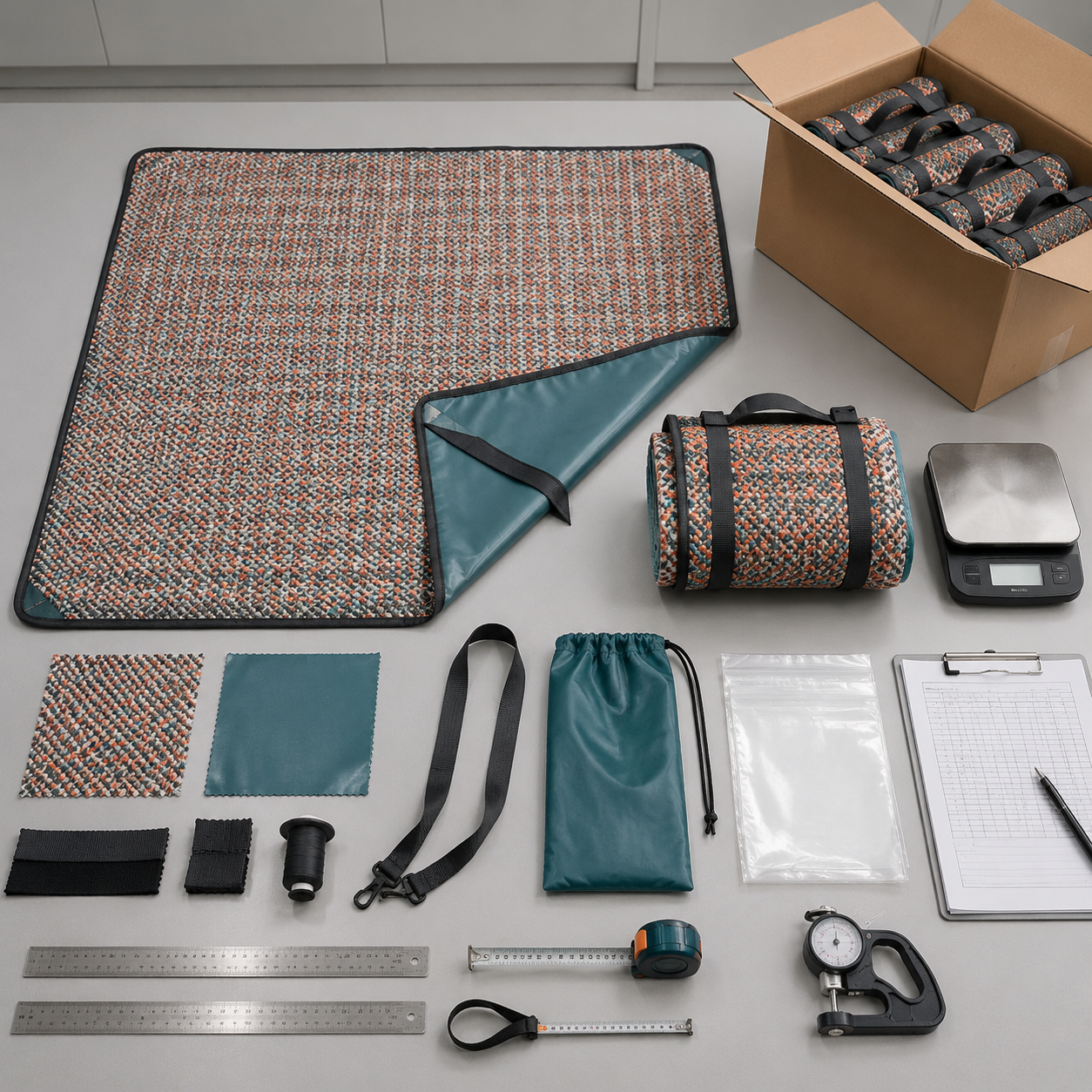
| Folded dimensions | State folded length, width, and height in cm, folding sequence, and whether a pouch or strap is included | Packed-sample measurements and controlled packaging specification |
| Mass | Separate finished-product net mass, packed-unit mass, and master-carton net and gross mass in kg; state the weighing method | Quoted values followed by controlled sample and production records |
| Layer stack | Identify face, backing, coating, lamination, adhesive, padding, or other layer by supplier description and sequence | Bill of materials, swatches, construction section, and approval sample |
| Edges and seams | Define binding width, seam allowance, stitch type, stitch density in stitches per cm, reinforcement locations, and permitted defects | Drawing, manufacturing instruction, close-up sample review, and inspection record |
| Print and colour | Identify colourway, print process, artwork revision, appearance reference, and buyer-defined variation method | Physical approval reference, artwork proof, and production inspection record |
| Carry components | Where included, define strap, closure, fastener, pouch, attachment dimensions, materials, and functional acceptance method | Component specification, assembled sample, and inspection result |
| Unit packaging | Define unit pack, inserts, sealing, materials, controlled copy, and packing orientation | Packaging bill of materials, dieline, artwork, and packed sample |
| Master carton | Define case pack, external dimensions in cm, net and gross mass in kg, packing sequence, and permitted variation | Carton plan, packed-carton measurement, packing list, and final shipment data |
Evidence Rules for Compliance Requirements
Each requirement row should contain the authority type, source URL or document identifier, source revision or review date, applicability owner, affected product or component, required evidence, supplier evidence reference, status, exception, and release gate.
Accept evidence only when its scope can be reconciled to the RFQ. Depending on the evidence type, the record may need to identify:
- the holder or declaring entity;
- the manufacturing site and relevant subcontracted process;
- the beach blanket product code and revision;
- the finished product or named component covered;
- the material, colour, print, coating, adhesive, or treatment covered;
- the requirement or method assessed;
- the result and acceptance basis;
- the issuer, issue date, validity conditions, and verification route;
- the connection to the approval sample and proposed production;
- the review trigger after a source, site, material, process, trim, label, or packaging change.
When the buyer names a standard, the register must distinguish the standard's published requirement from the buyer's acceptance rule and the supplier's routine practice. Naming a standard does not establish conformity. Do not describe a product, site, or supplier as certified without a current document whose holder, site, product scope, issuer, issue date, validity, and exclusions have been checked.
Company policies require the same separation. The cited P&G page supports only the existence of P&G's published expectations; it does not make those expectations applicable to this RFQ.
Example Measurements to Verify in the Supplier Quote
The following figures are buyer-created examples for checking RFQ arithmetic and document alignment. They are not market data, Canadian thresholds, supplier offers, or production specifications.
| Example check | Assumption or calculation | Verification record |
|---|---|---|
| Open size and area | Buyer-created example assumption as of the hypothetical RFQ issue date, to verify in the supplier quote and approval sample: each hypothetical beach blanket has a finished open length of 200 cm and width of 200 cm. Buyer-created calculation at that same as-of point: 200 cm multiplied by 200 cm gives a nominal open area of 4.00 square metres per hypothetical unit. | Revision-matched drawing, signed quotation, stated measurement method, and approval-sample results |
| Folded size | Buyer-created example assumption as of the hypothetical RFQ issue date, to verify in the supplier quote and packed sample: each hypothetical packed unit measures 40 cm long, 30 cm wide, and 12 cm high. | Defined folding sequence, pouch specification, packed sample, method, and permitted variation |
| Product net mass | Buyer-created example assumption as of the hypothetical RFQ issue date, to verify in the supplier quote and approval sample: each hypothetical finished beach blanket has a product-only net mass of 1.40 kg, excluding pouch and packaging. | Signed quotation, identified sample weight record, weighing method, and production inspection result |
| Carton arithmetic | Buyer-created example assumption and calculation as of the hypothetical RFQ issue date, to verify in the supplier quote and carton plan: 10 hypothetical units per master carton multiplied by 1.40 kg product-only net mass per hypothetical unit gives 14.0 kg product-only net mass per hypothetical master carton. | Confirmed case pack, unit net mass, packaging mass, carton net and gross mass, and packed-carton record |
A change to dimensions, mass, layer construction, pouch, or case pack invalidates the affected calculation and triggers review of the quotation, packaging specification, and related evidence.
Canada RFQ Cost and Release Controls
The World Collective source supports treating cost, minimum order quantity, traceability, and lead time as sourcing considerations. It does not provide Canadian landed-cost inputs. Keep the commercial comparison tied to the same beach blanket revision, materials, dimensions, mass basis, claims, evidence obligations, packaging, case pack, and schedule assumptions.
Require each quotation to identify its currency, issue date, validity, included work, excluded work, schedule dependencies, and cost effects of supplier deviations. Product price, sampling, buyer-requested evidence work, tooling, labels, packaging, inspection, transport, and rework should be visible rather than absorbed into an undefined unit-price basis.
No freight, brokerage, duty, tax, or other Canadian import amount is established by the supplied sources. Do not publish or approve a landed-cost figure until the responsible importing party validates the transaction inputs against current authoritative information and the actual goods.
Canada Beach Blanket Compliance Requirements by Release Gate
The gates below apply the general supplier-governance context from the Ivalua source to this RFQ. They are buyer-defined procurement controls, not quoted legal requirements.
| Gate | Required record | Hold condition |
|---|---|---|
| RFQ issue | Approved product definition, applicability register, claims list, evidence schedule, response template, and revision | Intended use, construction, claim scope, or Canadian applicability ownership is unresolved |
| Bid comparison | Completed RFQ, revision-linked quotation, manufacturing disclosure, evidence map, and exceptions | Bids use different constructions, evidence scopes, packaging, or cost assumptions |
| Development sample | Identified sample, bill of materials, measurements, mass record, component records, packaging review, and deviations | Materials are unidentified or sample differences are missing from the quote and specification |
| Preproduction approval | Matching sample, specification, bill of materials, artwork, packaging, evidence status, and manufacturing instructions | A requirement, claim, label instruction, evidence item, or deviation remains open |
| Production release | Purchase order, approved revisions, change-control terms, inspection plan, traceability format, and written authorization | A source, site, subcontractor, material, process, or controlled document differs from approval |
| Production verification | Lot identity, measured results, packaging results, inspection record, changes, and approved deviations | Results exceed buyer-defined limits, traceability is incomplete, or a change lacks approval |
| Shipment release | Final quantity, carton data, packing list, required documents, deviation disposition, and release authorization | Records conflict with the goods or an unresolved deviation affects release |
A concession must identify the deviation, affected goods, risk owner, disposition, corrective action, and approving authority. Supplier descriptions such as equivalent, standard, or normally used do not override the approved revision or change-control process.
Methodology and Limitations
Methodology: The supplied pages were separated by evidence type. Product-definition prompts came from the related LISO vendor article; commercial and traceability considerations came from the World Collective article; general governance context came from the Ivalua article; and the P&G portal was used only to illustrate the boundary around a named buyer's policy. These contexts were translated into RFQ fields, evidence-scope checks, sample records, and release holds. All quantitative entries were separately identified as buyer-created examples and calculations requiring verification in the supplier quote and controlled samples.
Limitations: The supplied evidence contains no Canadian statute, regulation, regulator guidance, customs ruling, product-specific test method, supplier quotation, bill of materials, manufacturing record, laboratory report, certificate, sample result, inspection result, or shipment record. It cannot establish a definitive Canadian legal checklist, approve label wording, substantiate a beach blanket claim, confirm certification, verify supplier capability, determine customs treatment, or calculate landed cost.
Before award, the Canadian buyer must verify the current requirements register, applicability rationale, product and component scope, claims, label instructions, manufacturing entities and sites, evidence validity, sample conformity, quotation scope, change controls, and production-lot traceability. Record each approval against the same product revision in the RFQ and purchase order.
Discuss Your Requirements
Review our manufacturing capabilities, then share your specifications for a supplier-fit review.